 Follow us on Twitter: @ggtl
 Join our friendly community!


Latest news

 2.7.12

When it released last March, the controversy surrounding Mass Effect 3's endings were a focus of intense discussion.
Some vehemently opposed the way BioWare choose to end the trilogy, accusing the developer of cutting corners allowing for a lethargic, albeit confusing ending. Other players believed there was much deeper meaning to the mystery of the conclusion. We've been waiting for the Extended Cut DLC to clear everything up and now that the wait is over, we're both ecstatic and disappointed at what BioWare has wrought.
Editor's Note: This article contains spoilers regarding Mass Effect 3 and the Gears of War franchise. If you intend to play the games and/or don't want the endings ruined, then progress no further.
If you haven't seen the endings yet, check out all of them on GamesRadar.
Andrew's argument for botching an opportunity
A while back, I wrote an article stating my horror as to how fast people jumped on the 'hate BioWare' bandwagon. To me the conclusion of ME3 was more ambiguous than anything. As soon as Harbinger's beam smoked you, that was when I noticed everything around Shepard seemed... different. From the control the Illusive Man had over Anderson to the way Shepard cringed when the Reaper noises echoed across the screen, there was too much that materialized at the end for me to consider it a simple mistake; a failure at elaboration.
Obviously a great deal of people felt the same way which is what gave rise to the Indoctrination Theory. Simply put, people thought the entire final sequence was really Shepard going through the Indoctrination process; attempting to stave it off. Certain videos gave immense evidence to this claim and it honestly seemed like such an intelligent way to leave the series in suspension. However, after the Extended Cut DLC dropped, this theory was immediately dis-proven.

Didn't you know? These guys could be helping you out soon!
Saying all of that, I personally would like to apologize for my stance on the matter. Maybe it was just the sequence of events and the missing pieces that made this whole Indoctrination Theory plausible, but I'll be damned if I couldn't say it was convincing. The new endings are extremely well done, and provide ample information that satisfies my lingering questions. The Catalyst now elaborates on its history, new cut-scenes show Hackett finding out someone got to the Citadel and even how your team gets off world. Most importantly though, the new endings show a very different, yet similar conclusion that feels much better than the original ones ever could. Though, now that we know this was the way BioWare wanted to tread all along and not the way of Indoctrination, I feel a bit dismayed.
BioWare should be commended for going the extra mile for not only acknowledging the fans disproval, but for following it up with a free piece of DLC that clears up any previous issues. There are few companies that would go this far and for that, BioWare, I applaud thee. However, now that we know the truth about the ending, it pains me to realise that either ME3 was rushed out the door at the last minute, or somebody gave the green light to ship the game despite the unfinished ending. We can speculate that it's 'all EA's fault' but that's an unfair accusation as we know nothing of the game's final days of development.

Anderson dying was still a strong sequence.
Regardless of the answer to why the game shipped the way it did, the fact of the matter is that it did ship that way. Akin to Mortal Kombat's horrific online multiplayer and Dark Souls' downright broken multiplayer component, this is something that just cannot be looked over when judging the entirety of the game. What were they thinking? ME3 was incredibly detailed thoroughly and then the end just throws a bunch of janky situations together and we were supposed to be pleased with the outcome? Again, that's why I thought something greater was at hand and this brings up a whole different issue I have with story-writers.
The Indoctrination Theory was an very intelligent take on how ME3 ended and I think if BioWare made it work then we'd be talking about how revolutionary this kind of narrative was instead of, you know, how bastardized it became. Could you imagine if after playing through the game you found out the final choices you were given were a ploy? What if Shepard was tricked into allowing the Reapers to live, forever sealing the fate of the galaxy? The thought of this kind of decision making lifts my gaming soul to untold heights, but alas, this was not the case at all with ME3. It might sound odd, but this reminds me of Epic Games' missed opportunity for the Gears of War franchise.

Even Shepard wanted to see what happened next.
Stay with me here; Gears is something people look at and only think of thick dudes, chainsaws, cover and guns. Well, it didn't use to be like that and if you were there with me during the first Gears, you know exactly what I mean. The Locust were an unknown enemy, one that just emerged and slaughtered humanity by the billions and nobody knew why. Hostages were not taken, communication was impossible, making the situation as dire as possible. As you progressed through the game, the precious resource known as Imulsion was introduced to the player and some of the history of Sera was told.
The rush for the revolutionary resource orchestrated the Pendulum Wars, a 79-year civil war. It all seemed so clear to me and a few other websites that, perhaps, the Locust were the good guys in this matter. I mean, maybe the humans were killing the planet or hurting the Locust by siphoning so much Imulsion, forcing the hand of the Locust. Be honest; how amazing would that have been? Over what we got, I feel this was a completely wasted opportunity to blow away gamers of all kinds. Instead, Gears will still be known for its hardcore action and its lackluster narrative. BioWare has followed in the exact same footsteps and disappointed fans with their decision making process.
I'm a massive fan of both franchises, but I can't sit back and accept the fact that there just wasn't opportunities to make better decisions. Both trilogies are now over, but with Judgment coming and more DLC for ME3 to come, you can bet we haven't seen the last of any of these franchises. I just hope this time around, we don't run into the same circumstances.
Labels: Andrew Whipple III, Bioware, Epic Games, Gears of War, Gears of war 2, Gears of War 3, Mass Effect 3
- Andrew Whipple III

Every year we, the insatiable gamers, are blessed with an assortment of high-quality titles, which we gobble down with the utmost haste. Whether it be one of the greatest games ever conceived or something a bit more modest, we tend to forget the predicaments the main characters go through whilst we're being entertained. Shooting enemies is fun - undoubtedly so - but what about the guy who shoots a loved one? What about the guy who was just going about his everyday life when his town explodes? How about the guy who can't remember his own name? These are the videogame characters we feel most sorry for.
The list of game characters has grown exponentially over the years, and with them the issues that develop in such a memorable way. Some of these problems are a bit more serious than others, but hey, they're still problems right?
9: Solid Snake

The issue: Snake is a clone; he ages rapidly, has to fight multiple metal monstrosities and extraterrestrial soldiers, and has to prevent multiple nuclear strikes across all the games. Also, pretty much everyone close to him dies. Savvy.
Snake is an old bastard, or at least he was, by the time Metal Gear Solid 4 rolled around. Even so, his decrepit arse still had to take down a gaggle of enemies with crazy powers, and a series of metal beasts that could cause the apocalypse; not a small feat by any means. The worst of his conditions, though, is definitely his rapid aging process, being a clone and all. How would you like to live less than half your life and be thrust into a rather impossible scenario multiple times? Not so cool. Also, he fought - well, technically, his father fought - a guy who could control bees. ...bees.
8: Link

The issue: How would you enjoy waking up after defeating the toughest nemesis you ever faced, with all your power and items taken from you? Now, how would you enjoy it if it happened every single time? Also, and arguably worse, Link's vocabulary consists of only "HIIYAAA" and "WAAA" and "UGHH". He's a think-tank, clearly.
Link is a legend in the videogame character kingdom, and so are the design philosophies behind The Legend of Zelda, but those scenarios are going to take a backseat here. You see, at the outset of every game, Link is pretty much a different person who in no way resembles the skillful, item-ridden hero from his last adventure. He can also only communicate via several emotional screams, which explains why Zelda always gets lost some way or another (would you want to be around someone like that?). While there might be some kind of odd lore, and occassional connections to games past here and there, it's never truly apparent in any game. Which - naturally - leads me to believe that he's (a) insane, (b) a robot, or (c) maybe both. With this information we can only conclude that Link is tethered to the Matrix as some evil genius's puppet. I don't think he knows Kung Fu, though.
7: Tidus

The issue: Besides his strange taste in random clothing, Tidus has a problem with being tangible, and another with killing his father to metal music. He also likes Blitzball.
The protagonist from Final Fantasy X with the feathered hair gets a lot of flak for his somewhat... eccentric attitude - laughing scene, anyone? - and his random elbow pad. Tidus goes through quite a bit emotionally as the game continues on, but much to his surprise - and ours - he finds out that he doesn't even exist. That's right; by the time the game ends, Tidus basically just up-and-vanishes from Yuna's arms. Before that, though, Tidus participates in the killing of his father to save the land. I truly have no idea how this works, but when you break it down it sounds pretty bleak; Tidus killed his father to save a land that he can't be a part of because he just discovered he doesn't exist.
...blame Blitzball.
6: Boy from Shadow of the Colossus

The issue: In an effort to bring a girl that means something to him back from the dead, this boy must fight sixteen colossi. And slay every one.
It might not sound too depressing at first, but once you finish killing all sixteen colossi, something very bad happens to that boy. Instead of being rewarded with the chance to restore life to the girl, the boy ends up being turned into a giant demon. After the short stint of demonry subsides, the boy then turns into a baby, and the girl then awakens. So, after all that trouble, the kid has absolutely zero idea of what happened.
That, my friends, is what I call 'the shaft'.
5: Master Chief

The issue: Born and bred to fight, the Master Chief had no childhood and no life besides constant intergalactic warring.
Halo's Master Chief really is quite a depressing character. Whilst the games don't exactly dive deep into his background, the man had no life, no friends, no family; nothing. The only thing left to him was the drive to keep fighting for humanity. Every single day is just another step toward killing more aliens and regenerating more shields. I think the only friend the guy has is Cortana, and she's basically just the Internet. It does make you wonder, though; what does he do to kill time, besides sleeping in space?
4: Dominic Santiago

The issue: For a man whose whole world revolved around finding his wife and kids after his planet exploded, putting the gun to his own wife didn't seem to make him the happiest person.
Gears of War is all about the planet Sera, and how it became scorched due to the Locust emerging to annihilate the humans. After the initial attack, Dom lost his kids and his wife, but had never given up on trying to locate them. Upon entering the Locust Hollow in the second game, Dom finds his wife tortured and destroyed; a husk of her former self. Dom couldn't let her suffer any longer and was forced to shoot her, right in the ole' cranium. Could you imagine yourself dedicating your life to finding someone, actually finally managing to find them, and then having to kill them? To augment that feeling, you can then wake up every morning after that, to a world that's fully destroyed and trying to kill you. Awesome.
3: Castlevania's Dracula

The issue: Every single game, he comes back with greater power, badass traps, horrific monsters, and a thirst for vengeance. But he always ends up getting his arse whipped. Literally.
Castlevania is synonymous with Dracula at this point. Like the description points out, he comes back in almost every iteration more powerful than before. Yet, even if he came back with sixty thousand demons and a Godzilla-sized Death at his side, he'd end up losing to some schmuck that gets all up inside his castle. Having your soul literally ripped apart and being forced to sit there for years before you can manifest enough power in a feeble attempt to come back must suck.
2: Gordon Freeman

The issue: A scientist who really enjoys his work, Gordon somehow managed to turn a rather harmless experiment into a full blown alien invasion. ...good job, Gordon.
Half-Life is famous for having one of the best lead-in moments to a game ever, and it still holds up today. Gordon, being the wonderfully nice scientist he is, was going about his business as usual until he decided to push a cart into a part of the experiment he was helping with. Cue bolts of electricity, alien portals and dead people. Now Gordon is solely responsible for finding out how to fix the problem, which he still hasn't been able to do. Bet you wish you could rewind time a bit, don'tcha, Gordon?
1: Vic Viper

The issue: When an alien invasion comes, there's only one option.
You'd think that, after the first time the galaxy routed the enemy in the Gradius universe, they would prepare some kind of defense force in case it ever happened again. I guess that's too logical, though, because those lethargic asses always send out the Vic Viper whenever there's trouble. What happens if the pilots all got sick and no one could use this spacecraft? I guess it's game over forever? Sorry Vic, those guys are jerks.
Labels: 2011, Andrew Whipple III, Castlevania, Final Fantasy XII, Gears of War, Gradius, Half-Life, Halo, Metal Gear Online, shadow of the colossus, The Legend of Zelda
- Andrew Whipple III

The Gears of War 3 beta is now in full motion, and you're probably already murdering dudes with your bare hands. Great as that may be, your bloodlust might have blinded you to the changes Epic has made to the system. Not sure what I'm talking about? It's alright, Gearsheimers has affected a great many and I'm here to make it all perfectly clear.
Some of the changes present are fairly obvious, so forgive me if I delve into a couple of items the Gears-deprived are ignorant to. Now, where to start? Ah, who could forget the wonderful...
Dedicated Servers

A locust depicting the stranglehold that 'host' connection had on the community.
Arguably the most tremendous addition to the game, the Gears franchise has an infamous history of that heinous thing called 'host advantage'; when the person hosting the game also holds a greater connection and thus inflicts more damage, has greater accuracy, and pretty much everything is better for the host. In Gears of War 3, host advantage doesn't exist, and it's incredible. You see, now no-one has to worry about that sole guy who can take on the entire team with only a pistol, craggy game connections are extinct, and silly things like the room being dumped or host migration have vanished. The servers stand tall and proud, basically making Gears a lag-free endeavour, something that the series has needed from the start.
This has also affected joining games. Unlike the twenty-minute wait everyone had to endure during the launch of Gears of War 2, Gears 3 makes this process seamless and fast. Players will also be able to join your game on a whim when someone else unexpectedly quits. If no one is there to take the place of your former comrade, Epic's 'gear bots' jump into the mix. And, no, they aren't as asinine as the last ones were. Don't you remember the behind the back, no look, Boltok headshots?
Menus, Ribbons & Unlockables

See this here? He too could one day be yours to play as. Maybe.
When Gears 2 released a couple of years back, the menus were something of an afterthought. How bad was it? Well, let's just say that there was no option to even quit the game. In order to do so you had to jump back to your dashboard and boot the game again. Thankfully, Gears 3 sees a departure from this shoddy programming, and goes the extra mile by throwing in unlockables, and special awards that Epic are calling 'Ribbons'.
I really don't care about achievements, trophies, medals or ribbons, unless they net you something worthwhile in the game itself. Surprisingly, Epic has implemented a system that does just that. By completing tasks such as killing twenty-five enemies with the Retro Lancer, or performing a certain number of Executions, not only will you grab Ribbons, but you'll also net add-ons like weapon skins, characters, and unique executions for specific weaponry. In Gears 2 all the weapon executions were open, but if you want all the unique ones in Gears 3 you'll have to work for them.
More about Ribbons; they'll have a direct impact on how fast you'll 'level up'. Once again, a Call of Duty-esque experience system strikes into the heart of another shooter, and it works well for Gears of War 3. Depending on how well you do and how many Ribbons you've achieved, your experience will be bolstered tenfold. Since you pretty much get a Ribbon for everything you do in the game (including being the first to die), doing well and Ribbon-mongering share a symbiotic relationship. Progress is tracked in real-time during a game, like in Gears 2, but you can also observe what you've done on the main menu screen.
Combat

Violence really is the spice of life; a spice which costs $59.99, and is available from September 20th.
The thing that's seen the most tweaking in Gears 3 is probably the way combat unfolds. Sure, the new Team Deatchmatch mode has respawns with lives, which is slightly odd, but I'm really talking about the other major mechanic: rolling. Since the start, you've only ever been able to roll forward, backward, left, and right, frozen-rope style. In the new game, if you hold up and a little to the left while rolling, you guessed it, that's where you're rolling to.
This subtle tweak has changed much more than how it appears on the surface. Rolling with accuracy allows you to hit those tight corners you otherwise might have missed in the previous games. It also allows you to move about more erratically when fleeing for your life, or maybe even when you're chasing someone down. No more rolling in place gents, it's a skill roll now.
You also can't forget that stopping power is still in effect. When someone is shooting you, it means evasion is a necessity, as you won't be moving forward at the standard rate. Remember, Gears is a cover-based shooter, and Epic clearly would like it to remain as such. When it comes to cover, you also have to remember that if your enemy is present when you hop over some cover, landing inevitably on top of them, you'll kick them right in the face, causing disorientation and setting you up for an easy kill.
Oh and before I forget, if you're standing next to a teammate, you can now actually swap weapons with them. That's important because that novice with the Torque Bow can now give it to someone who isn't absolute rubbish with it. Thank you.
Weapons

I won't say it. Really, I won't.
Practically all of the standard weapons make a return in Gears 3, but some new ones and old favorites have surfaced with a twist. Take, for instance, the Gorgon Pistol. Now subtract 'Pistol' and add 'SMG'. That deadly dual-stream of bullets from the second game is now a constant stream, and it's all the better for it. The Hammerburst, along with the Lancer and Retro-Lancer, can all be selected any time you die during the match, to switch with whichever one isn't working for you. Whilst the Retro-Lancer is powerful but highly inaccurate, and the Lancer is largely the same, the Hammerburst is the most accurate of the bunch and can even zoom into a first-person view. Despite the apparent incompatibility of a first-person view in a third-person game, it's actually quite awesome and is a great unique feature of the Hammerburst.
Smoke Grenades are now useful, funny as that sounds, and can change the tide of a fight in a split second. Upon throwing down your smog-inducing spherical device, it'll explode, causing a concussive blast that stuns surrounding foes. The stun still allows enemies to move, but for a short period they cannot fire. Also, the Gnasher works again (thank the gaming Gods). Plus, the Lancer can only be interrupted if you're shot in the revving process. Don't believe me, believe Rod Fergusson:
I'm particularly fond of the fact that the Lancer chainsaw can only be interrupted when it's being raised. Like me, once it's up, it's on!
Active reloading is also a bit different. Veterans won't balk at the standard Lancer and Gnasher shotguns' active reloading, since nothing's really changed, but the other weapons you're used to may tell a different story. Take, for instance, the Hammerburst. Instead of increasing in speed, the Hammerburst takes you off guard by going at a steady rate. This might not seem like much, but in the midst of battle, having varying speeds at which your weapon reloads can make or break the fight. The new sawed-off shotgun is the epitome of this practice. Miss that active and you wont be shooting for a while, but land it, and things are gonna get dead quick.
Whether you've noticed them or not, the Gears 3 beta has given us plenty of minor and major changes. All hasn't been revealed yet, but you can definitely expect much more when the full game hits this September. Also, remember to submit some feedback, over on the Gears of War 3 beta forums. Epic wills it.
What do you think? What's your favourite change from Gears 2 to Gears 3? Let us know in the comments section, or you can tweet us @ggtl.
Labels: 2011, Andrew Whipple III, Beta, Beta Impressions, Epic Games, Gears of War, Gears of War 3, Microsoft Game Studios, Xbox 360
- Andrew Whipple III

If you look around the industry, you’ll notice that regenerative health remains a favourite mechanic amongst developers, and why shouldn’t it? Continuing your onslaught of chainsawing, bullet-hosing manliness after absorbing sustained amounts of firepower to your sternum is always a win. But haven’t you wondered how our favorite protagonists come out of these predicaments alive? Perhaps you’ve questioned exactly what is preventing those bullets from perpetually penetrating their adventures? The answers lie within.
Many think that Halo was the pioneer of regenerative health. And, in a way, they're right; Bungie did bring the critically-acclaimed mechanic to the forefront of mainstream gaming. The birthing of it, though, is located in another castle completely. Nonetheless, regaining lost health after avoiding damage for a period of time is a smooth, insanely popular feature in contemporary games. It provides players with a reason to utilise cover while still being able to bounce back from mistakes in the midst of battle. How else were you supposed to recover from the prismatic dragon-ninja’s shuriken of dark lightning? It makes sense gameplay-wise, but as far as the games that utilise it - that’s a whole different ball game.
Now this list isn’t just about games that use regenerating health; no siree. That list would be far too lengthy and lacks the focus we’re going for here. Instead, this list is fixing its unending gaze on the games that contain unexplained reasons why your character regenerates. If a dinosaur clawed my spleen from the confines of my body, I probably wouldn't recover very well. In videogames, however, they can do so with no real issue. How is this justice?
Each game in the following list will receive a score based on how believable its form of regeneration is. A score of ten marks the most believable regeneration, whilst one indicates ghastliness. Here we go.
Killzone

The Killzone franchise has been through quite a lot during its lifetime. First it was a muddy, messy, overhyped PS2 game; then it transformed into a visually appealing, constantly-delayed PS3 title. And who could forget that glowing PSP game? Regardless of where you stand with the series, Killzone has done one thing consistently from the very beginning: regeneration.
I don’t get it though. You’re the standard space marine who - like the rest of the flock, apparently - is capable of absorbing countless numbers of bullets. Okay, okay: you’re wearing weird space military gear and all that, but I’m going to go out on a limb here and suggest that it doesn’t come equipped with quantum-regenerative mind-gear.
Verdict: These guys aren’t Warhammer 40,000 genetically-altered Space Marines of doom. Bullets hurt badly, and I’m not convinced you can bounce back from a Helghast shooting a rocket down your throat. Still, they’ve got some pretty fancy technology, so maybe its possible. Just maybe... [5/10]
Assassin’s Creed

Altaïr, Ezio; whoever your assassin of choice is, it doesn’t matter. Both of these badass dudes regenerate anything, from minor cuts to arrows in their ass. I think my biggest issue with Ubisoft’s star child is that when you’re fighting someone, another comes up and wants a piece. That’s cool, but things escalate rather quickly, and before you know it you’ve got armoured guards wanting to shove their six-foot pike in unwieldy places. The combat makes it a bit touchy to counter blows every single time, so it’s inevitable that you’re going to be hit with some form of weapon.
Let's paint a picture: your screen is flashing red, you’re screaming, you're running, and you suddenly heal back to full. How does this even happen? Do assassins in the Crusades or Renaissance Italy possess the ability to mend wounds with a snap of the fingers? Yes, you’re technically controlling a memory brought forth by the Animus, but the machine doesn’t give you Final Fantasy powers.
Verdict: Sorry: these highly trained, highly skilled assassins may be the cream of the crop when it comes to silent murder, but they’re no mutant. They’re wearing cloth and light armour so as to be weightless enough to run from any pursuer. However, if hit by tangible force, fall like tangible assassin. There’s no Curaga in this time period. I'd say that you should at least have to be hidden to regain health. [3/10]
Mirror’s Edge

You can shoot people in this game, but it sucks. It sucks because you can’t run whilst firing, and running is what this game is all about. And the running isn't short of its own problems, either.
Running! How the hell can you run when you’ve just been roundhouse kicked by a rhinoceros? It’s a fair question: you’re usually being chased by beefy officers or kung-fu masters who, against your delicate feminine frame, could cause some noticeable damage.
Sometimes you actually have to stop and initiate combat manoeuvres, which is fine, but you take the risk of getting injured. I guess the risk isn't too large though, because in the future everyone seems to have regenerative implants.
Verdict: I don’t know about you, but after I get shot I can totally do a double wall jump. [1/10]
Red Dead Redemption

Great as Rockstar’s wild west adventure may have been, did they explain their regeneration system? In short: no. You’d think that, in an environment where greats were born and slain, you’d receive a little more realism when it comes to pain.
Don’t get me wrong, you can kill people in a shot or two (which is just like real life, apparently), but some of the punishment you can take is downright ridiculous. With the amount of shootouts you encounter, you’ll be tucking yourself away to regenerate constantly. After the eightieth bullet, that leg of yours should be the most decrepit thing on the planet.
Verdict: How about that deer you shot? Do you see it running over to the nearest form of cover? That’s right, you didn't. It isn't coming back, because it can’t regenerate. Instead, it died, like in real life. Are you even listening or are you just skinning that deer? [4/10]
Far Cry 2

Far Cry 2 wasn’t the best game. Questionable AI, dodgy respawning points and horrible stealth mechanics made this gamer cry in dirty corners, but at least the health system was unique.
And gross.
As this video indicates, you can heal manually if you’re at critical health. This form of manual regeneration entails some of the most grotesque animations I’ve ever witnessed. Pulling glass from your wrist, prising bullets free from your kneecaps, wriggling wire out from between your fingers; Far Cry 2 tries its best to make you vomit.
While this mechanic is unquestionably awesome, it makes no friggin’ sense whatsoever. How the hell does pushing a bullet through your arm give health? I’m no medical expert but I’m pretty sure that after you pull a large piece of shrapnel from your arm, it's going to bleed and you probably aren’t going to be using it for a while.
Verdict: Points for disposing of the junk in your body, but deductions for the nonsensical health giving. Also, since the animations are random you could be shot at, and then all-of-a-sudden be pulling a shard of glass from your wrist. Unless the enemy is armed with wine-bottle launchers, that shouldn't happen. [6/10]
GoldenEye 007 (2010 Wii version)

This re-imagining of the famed N64 shooter was high on many gamers’ lists of unbridled anticipation. Then it came out. All I can say here is that Daniel Cr... - er, I mean, James Bond - now regenerates health rather than having to use med kits. Thanks go to Activision, for shattering my nostalgia into lots of tiny unsalvageable pieces with the most contrived game mechanic possible. Why not add laser cannons and giant mechs next time?
Verdict: James Bond is not a space marine. At least, not yet. As good a spy as he is, he's still only a man, and a well-placed bullet ought to puncture his anatomy like a nail through a slab of soft butter. [2/10]
Gears of War

Only the manliest of men can say that this game doesn’t feature enough gore. Gears of War is responsible for doing a lot right, and a whole lot wrong - see Gears of War 2's multiplayer mode, for instance. Regardless, Marcus Fenix and his COG brethren are fighting a war that they must win. And what equipment do they have in order to ensure this victory against a heavily-armed, ruthless enemy? Chainsaws and standard-issue armour.
Just to remind you, these people are fighting against a horde of mutant angries called the Locust, who have a whole arsenal of hurt just waiting to be unleashed. How does a unit that are struggling for any type of technology fight against beasts the size of small buildings with rockets strapped to their back?
They regenerate, of course.
Verdict: There are no shields, no special infusions to make you a God, nothing. That obviously means that when a colossal space laser descends onto the surface of the world, hitting you square in the forehead, so long as you get out of the blast radius within a few seconds everything's good. Where is the sense? [2/10]
Uncharted

This blows my mind. Nathan Drake and company are wearing what appear to be clearance items from JC Penney, and they have no fear of taking on waves of enemies. What happens when Drake gets shot? The obvious of course: he regenerates. But how?! How can you heal gaping shrapnel and bullet wounds, with your half-tucked shirt as your only form of protection?
Verdict: I guess half-tucked shirts are the new Kevlar. [1/10]
Call of Duty

There is nobody in the entire galaxy that would be able to survive a .50 cal straight to the chest at point-blank range. No manner of Void Armor, magical forces or hostage children used as shields could save you from your dire fate. In Call of Duty, however, apparently they can.
I still remember the day I stopped playing Modern Warfare. I was patiently waiting for some camping hobo to return to the window he’d shot me from several times before. When he appeared, I focused and fired a very accurate shot, dead centre in the middle of the poorly-hidden gentleman's chest. And he didn't die. Even despite the fact that my reticle registered the hit, the bastard lived and shot me again.
Verdict: No. [1/10]
Red Faction Guerrilla

Red Faction is known for its ridiculously enticing destruction. The GeoMod is something that hasn’t been embraced throughout the industry, and it’s ridiculous that it hasn’t been utilised more. However, the very mod I was just praising shows why Guerrilla’s regeneration system makes no sense.
First off, Alex Mason is wearing some kind of industrial rain coat that frightens me. Second, you can be decimating a building and have a two-by-four block of solid concrete fall straight on your face, and yet can still get up after the ragdoll physics have stopped, and be good for another round. Is Mason made of rubber or something? Last time I checked, he was still human, and concrete still really, really hurts when thrown on top of you.
Verdict: Even on Mars, a building collapsing on you is still a building collapsing on you. You’re not coming back out. Ever. [1/10]
Labels: 2011, Andrew Whipple III, Assassin's Creed, Call of Duty, Gears of War, Goldeneye, Killzone, Mirrors Edge, Red Dead Redemption, Red Faction Guerrilla, Uncharted
- Andrew Whipple III

Collectibles have been a mainstay in the video gaming world for some time now. With such high-profile titles like Grand Theft Auto IV and Assassin's Creed utilising them, it has practically become a necessity to include some type of collectible if you want a game to achieve greatness. However, contemporary collectibles and bonuses are all mostly failures, and quite frankly that’s because to this day there still hasn't been a title that's done collectibles better than the Donkey Kong Country series.
It may be a bold claim, but Rare’s masterpiece is definitely the pinnacle of collectible mastery. I’m getting ahead of myself here; let’s set this scenario up. Collectibles. Games. They’re practically synonymous. They can be anything from tags of fallen comrades that you find on your romp through a post-apocalyptic wasteland, random shards of power hidden throughout a city, or balls of light that are set in hard to reach environments. Whatever it is that you’re collecting, it all adds up to something greater, something that could unlock a better ending, an achievement, or maybe just something as simple as bragging rights.
The name of the game is to keep the interest of the player piqued. These little devilish programs tether your attention to a solitary game, keeping a gamer engrossed in a title for extended periods of time. Their addictive nature can provide until, perhaps, the sequel hits stores or the developer managed to squeeze some DLC out. Grand Theft Auto IV is a perfect example of this type of play. Releasing two critically acclaimed and rather large episodes via DLC, the lure of more achievements and just being involved in Liberty City was enough for millions to take the dive. Unfortunately, the collectible side of things wasn’t nearly as polished or fun. Want an achievement? Well, get ready to wander about Liberty City to locate and kill over 250 flying rats. There’s no easy way to find them, unless you look online, and the only thing you get out of the deal is a shoddy number that adds up to a meaningless score. Where’s the fun in that?

Furthering my examples of heinous collection design, Assassin’s Creed comes to mind. It follows the same ridiculous attempt at garnering the attention of gamers by employing an impoverished flag collection system. Being the game’s expansive collectible, these flags are hidden very, very thoroughly throughout multiple cities. So much so, that there’s absolutely no way to tell where they might be stashed. If you were to investigate the whereabouts of all of these digital atrocities, you’d spend embarrassing amounts of time checking every nook and cranny and for what? The explicit sound of an achievement clambouring onto your television screen? No thanks.
The examples of triple-A games butchering collectibles are astoundingly high and continue on with the likes of Call of Duty 4: Modern Warfare, Gears of War and many more. With all this amazing technology and immersive storytelling at our fingertips, you’d think we’d be able to one up a series that debuted on the SNES.
The main reason why Donkey Kong Country succeeds is accessibility. Anyone can jump in and immediately be familiar with how the game functions. Believe it or not, this accessibility actually accentuates the way the bonuses and collectibles work. You see, if you’ve played a Donkey Kong Country game in the past, you’ll know that bananas are the most common form of collectible. Grab 100 and you’ll be awarded with an extra life, but they also double as a tool in another important way. Say that you notice a lone banana looming curiously over a gaping chasm. You might ask yourself what it’s doing there and how you might grab it. In actuality that banana is marking a bonus barrel, the other form of collectible in every DKC game.

The banana marker is important because it helps people locate clandestine bonuses they need to achieve 100% completion. Without having to resort to annoying internet guides, it’s an extremely efficient and effective way to keep players involved. Unfortunately, the first DKC didn’t really award people for grabbing that elusive 100% mark, but where it failed, DKC 2: Diddy’s Kong Quest undoubtedly surpassed. It did such a superb job that, in actuality, DKC2 is the catalyst for this article.
It was fun to locate the bonus barrels in the first game, but DKC2 put more of an emphasis on making you want to find all the bonuses. This time around, if you were able to complete a bonus room you were awarded with a Krem Koin. These 'koins' could then be turned in at Klubba’s Kiosk to unlock special stages in a secret level called The Lost World. Not only that, each and every level in DKC2 contained one, hard to find DK coin. If you were able to obtain all Krem Koins and successfully find every DK coin, you’d be treated to a special boss fight and an alternate ending to the game.
Maybe it doesn’t seem like much, but let me assure you that it’s a big deal. What other game makes finding collectibles a rewarding and equally fun experience? DKC2 took the addictive nature of the collectible item and wove it into the balance of the overall game. You didn’t have to collect everything to feel like you’d accomplished something, but for the people who went the extra mile, there was something extra special waiting for them. We need more of that type of programming in our games today. We need a seamless, wholly integrated system that makes seeking out collectibles fun and actually doable again; no more of this game guide garbage.
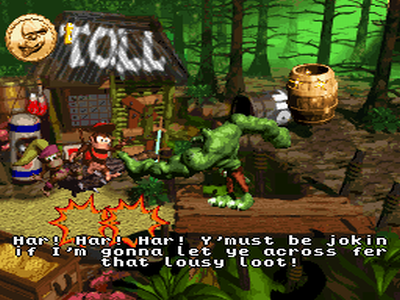
I think what Rare did with the DKC series is unparalleled. It definitely can be mimicked, but with how trophies and achievements work nowadays, it’s unlikely. There have been games that reward people for their collecting efforts, such as Halo 3 with its unlockable armor pieces and Mass Effect with its stat boosts for unlocking certain achievements. Though mostly cosmetic, both these games at least hand you something worthwhile for completing a milestone, and that’s commendable. I just wish more developers would look to the system set in place by the Rare of yore.
Once again, collectibles are responsible for running a substantial amount of the gaming addiction. Practically every game sports some type of collectible, but none can come close to the unrelenting perfection set in place by the DKC series. There’s no reason why games can’t augment what DKC has done, but if one thing’s for sure it’s that the gaming industry would be a much better place if they did.
Labels: Andrew Whipple III, Assassin's Creed, collectibles, Donkey Kong Country, Donkey Kong Country 2: Diddy's Kong Quest, Feature, Gears of War, Grand Theft Auto IV, Rare
- Andrew Whipple III
 The sequel to arguably 360’s most treasured game to date, Gears of War 2, was probably the most eagerly anticipated game of the year and last week Marcus and co. returned to kick Locus arse once again.
Gears 2 is a constant battle for survival for the humans of Sera. The Locust have been sinking cities through a new, unknown means and now Jacinto is their last beacon of hope. In a final, desperate attempt to destroy the Locust, an attack at the Locust’s home turf is made. Marcus and the rest of Delta squad return to the Locust tunnels to take the fight to them. As humanities final stand, Gears of War 2 involves larger battles with more gears being sent into the action.
 On first impressions of Gears 2, there isn’t much evidence of change from the sequel. Take cover-kill-move is still the most effective tactic, the graphics are still beautiful and the many ways of massacring the locust still never get old. Epic boasted of the many improvements and modifications it has made on Gears 1; apart from changing the roadie-run so you don’t jump to cover when simply trying to get from A to B and a stronger cover system, there isn’t much evidence of this. Not that it’s a problem, there wasn’t much in Gears of War 1 that needed improvement and if Epic had messed with the sequel too much it would have lost the magic of the first game.
The two main aims of Epic when they began Gears 2 were better plot and longer game play. By bringing comic book writer, Joshua Ortega on board they hoped to make the game more emotional with a deeper plot. Don’t expect Gears 2 to have you blubbing like a baby, it won’t. But who would buy this game for its emotional content anyway? The length of the campaign has been improved though. I managed to play through it on the normal difficulty in 3 days but that was pretty much constant play when I wasn’t sleeping or at college. Average campaign length is about 10-12 hours but I’m sure plenty of people will be able to tear through it at a quicker rate.
 As well as the main plot of ‘kick the crap outta the locust’, sub-plots have also been added, the search for Dom’s wife, Maria being one of them. Many of these plots aren’t finished by the end of the game. The finale of the game is also rather disappointing. The sudden ending is anti-climatic, rushed and as annoying as the ending to Halo 2 but clearly gives the opportunity for a Gears of War 3.
Despite its few flaws, Gears of War 2 is an exceptional game, far surpassing the prequel and can be expected to be under many gamers Christmas trees this December - that is if you can wait that long to play it.
9.5/10
Lewis
Labels: 360, Gears of War, Gears of war 2, Review, Xbox
- Anonymous
Epic Games, the creators of the Gears of War games have recruited the British author Karen Traviss to write 3 Gears of War books. The first which has been named The Battle of Aspho Field is said to be set before the events of the first game.
These books are being written because the storyline was left slightly empty and players will now have a chance to find out more about Marcus Fenix and Delta Squad.
The author Karen Traviss has also written a few of the Star Wars spin off books.
Gears of War 2 will be released on the 7th of November.
Grimmy
These books are being written because the storyline was left slightly empty and players will now have a chance to find out more about Marcus Fenix and Delta Squad.
The author Karen Traviss has also written a few of the Star Wars spin off books.
Gears of War 2 will be released on the 7th of November.
Grimmy
Labels: 360, Book, Gears of War, Xbox
- Gr1mmy
Subscribe to our content
and never miss a single thing

 subscribe to our monthly newsletter:
Our most recent writing

Our most recent reviews
Recent comments
All comments are subject to our commenting policy
Latest videos

Subscribe on YouTube

GGTL Classics
Some of the very best articles dug out from deep in the GGTL archives, written by some of our past and present wordsmiths alike.
Your continued use of this website and/or any others owned by Gamer's Guide to Life.com represents your acceptance and indicates your full understanding of all of our legal policies and terms. Our legal policies and terms are legally binding. If you in any way disagree with or refuse to be bound by any part of said legal policies and terms, you are advised to leave this website immediately.