 Follow us on Twitter: @ggtl
 Join our friendly community!


Latest news

 19.3.12


Downloadable content, along with digital distribution, is commonplace among contemporary gaming.
Not only does it allow developers to fix issues with their game post-release, but it also gives gamers the ability to augment their experience with extra features and content, if they so choose. Great as it may be, what about flagrant issues that prevent a game from being completely playable? How much content do developers hold back, so as to put it on the marketplace at a later date? When do we say that enough is enough?
Ever since the launch of Microsoft's original Xbox, DLC has blossomed into essential material that every game must embrace. As a matter of fact, it's such a decisive feature that, upon release, some games that have yet to release any DLC already have a section of the marketplace dedicated to it. At the extreme opposite end of the spectrum, some games have DLC available on their release day, a sin that many gamers regard as unacceptable. And for good reason.

Hey, I'll totally help you up here for like, you know, five bucks.
Gaming isn't a cheap hobby. Whilst you can certainly wait for games to come down in price in sales or on the used market, it's still something that you dedicate ample time to and pay for with your hard earned money. That's why when a game releases and, on day one, it already has DLC available for purchase, gamers froth with anger. Shouldn't that DLC be contained within the game itself? Take Resident Evil 5 as an example; not long after launch, a multiplayer mode became available that was found to already be on the disk. Needless to say, no one was happy about that.
One can blame BioWare and their flagship Mass Effect 3 for the current resurgence in DLC hate. Following in Resi 5's shameful footsteps, ME3 will contain day-one DLC, entitled From Ashes, at a cost of $10 or 800 Microsoft Astral Credits. However, for those who are willing to fork over the extra cash for the N7 Collector's Edition (or Digital Deluxe Edition) the DLC will come at no additional cost. BioWare has already stated their reasoning for the day-one content, but that hasn't stopped people from outright boycotting the game entirely. Overzealous as it may seem, I still see where they're coming from.
Allow me a few humble words. We are gamers; we are not developers. As much as we may see and read about it on the internet, we don't know what it's like to build a game from scratch. We don't know the ins-and-outs of working with certain engines and other design protocol, and we don't work at an office where we answer to the producer at every waking moment. However, as the consumer, we cherish a quality product and when something is wrong, our voice is usually heard. There still isn't a amiable way of accepting an additional fee for content on top of what we just paid for, and I expect there never will be. On day one, I expect to have everything out of the box that's core to the game world in question. Sure, I might miss out on a multitude of space rifles, colourful armor and other transforming oddities of doom (since you can't pre-order everywhere), but special missions that actually contain an interactive, core character is not something I'd want to lose out on.

That's right, baby! This punch will finish you and... the game dropped. Cool.
Saying that, BioWare's decision to implement this day one DLC does trouble me somewhat. I'm incredibly excited about ME3, but I definitely won't be purchasing a different version of the game just so I can get that extra content. Acquiescing in this way lets the developer and distributor know that what they're doing is somewhat acceptable. It's something that I just can't do.
This whole debacle poses several other questions brought on by this console generation, including one that still pertains to Mass Effect; are developers purposely holding back core game content so as to sell it to us later? If we're using ME3 as an example, that answer would surely be a resounding yes. However, I don't feel that every developer takes advantage of the DLC system in this way. Take, for instance, Rockstar and their exquisite, high-quality DLC for Grand Theft Auto IV. It was a bit pricey, yes, but the content and effort put into The Lost and Damned and The Ballad of Gay Tony cannot be denied.
Other developers, like Mortal Kombat's NetherRealm Studios, use DLC in ways that were both accepted and not. NetherRealm provided excellent support for their game well past its launch day, with a slew of DLC and hot fixes to make the game as balanced as it possibly could be. Whilst that's a struggle in itself, NetherRealm did a commendable job and I wish other studios showed as much passion as they have. Unfortunately, NetherRealm also used DLC to cover up the brittle multiplayer infrastructure. If you had a chance to play MK online, you know exactly what I'm talking about. Constant input lag, match slowdown, dropped games, broken lobbies - everything a fighting game considers critical to a great experience was entirely screwed.

Think I can summon you to fight this crazy boar thing? The network is still down? You can't let me die to this thing!
Fun as it was, I hold errors like MK's high on my sin list, and that leads us directly into another argument; what's acceptable when flagrant errors prevent a game from being completely playable? DLC can help this matter as unforeseen circumstances arise; issues naturally happen. For this reason, DLC can be a boon to certain games. Even still, there's no denying the embarrassing amount of games that rely on DLC to correct post-release issues. LittleBigPlanet and SOCOM: Confrontation threw up several patches just to allow you to play correctly. Gears of War 2 has its own special place in hell for what it did to its players on launch day and several months after. The point is, DLC allows games like MK to release with the intention of fixing the problem later. Dark Souls, one of my favourite games of last year, released with completely broken multiplayer functionality. It took From Software months to come out with the necessary fixes and even then, there were some mechanics that just didn't work in the way that it was intended they should.
DLC isn't the end of all things; it's just the opposite. Developers may not be using the system in ways that we would like to see, but its flashes of brilliance make gaming today a thing of beauty. It'll take time to weed out the issues but we can do our part by voting with our wallets and voicing our opinions on official message boards about what we think is acceptable. I'll never come out and say that day one DLC is ever 'alright', but I will always take a working game over something that requires several thousand title updates.
What do you think about day-one DLC? Do you have issues with patches coming in late or requiring several for you to even play your game? Voice your opinions below!
Labels: Andrew Whipple III, Dark Souls, DLC, Feature, Grand Theft Auto IV, Mass Effect 3, Mortal Kombat, Opinion, Resident Evil 5
- Andrew Whipple III

Jack Thompson's argument has one vital flaw; it's hard to prove that violent video games 'damage' children, because you have to let them grow up. Finding out whether a childhood obsession with Grand Theft Auto leads to the cultivation of a hooker-beating, car-jacking, tracksuit-wearing 20-year-old maniac means that you have to both actively let a child play GTA, and then wait until he's a grown adult. It's time consuming, messy, morally objectionable and a bit weird.
However, there is still a way that we can find out what kids think of this super-violent alternate reality, and what their tiny innocent minds process while brutal imagery flashes through their tiny eyes. Unfortunately, I couldn't steal a child (not after last time, and I'd let a mate borrow the cage), so it was up to one brave writer: Matthew Orona of Bitmob. This is what happens when a kid plays GTA.
You can read Matthew's article on Bitmob.
"I egged him on to take the car in front of him which was waiting at the red light. He quickly looked up at me with disgust and refused, stating that the car was already owned by the person driving it."
First, a general observation: 4-year-olds are right little buggers. They dribble, shout, scream, punch, grab, bite, scratch, and spill everything everywhere. However, their favourite thing by far is to claim that every single object is theirs. See that vase your Mum gave you? Theirs. Your brand new Honda? Theirs. That chocolate bar you're eating? Definitely theirs. So, why is this child so terrified of taking someone's car? Either he's one of the kindest and most empathetic toddlers this side of young Gandhi, or it triggers the divide between action and principle. When in the home, it's easy for a child to say that 'everything belongs to them' in front of a parent, but actually physically taking something off a complete stranger is too much for most. As far as the child is concerned, the game is synonymous to real life, and the morals that they uphold in the real world translate directly to the virtual one. At least, for now...
"At one intersection he attempted to brake, but he was travelling too fast. Instead of ploughing into the rear of the car ahead of him, he swerved to the right and popped up onto to sidewalk. In doing so, he accidently ran over a woman walking towards his oncoming car. He was incredibly ashamed of himself and profusely apologised."
Again, just as a real life tragedy such as this would render a child horrified and ashamed, so does the video game. Children blur the lines between reality and the imaginary far more than most adult gamers, magnifying the whole experience and making it more involving, and either more joyful or terrifying, depending on the circumstances in the game.
"Only seconds later, he witnessed a policeman jump out of his patrol car to pursue a criminal of San Andreas. His eyes lit up as he asked if he could drive the police car. I reminded him that it was only a game, and it was fine to take the car. As he drove the squad car, I pressed L3 to turn on the lights and siren. He asked very excitedly if he could get the bad guys too. With a huge smile I pressed R3 to initiate the Vigilante Missions. It was as if his imagination had come to life. He was taking down delinquents left and right."
Remember that lesson in school where you were told how the police are your friends, and PC Nicey would give a little speech on how they catch the bad people? That was cool. What was even cooler were the cars. "Ha! Look at them lights! Looks at them hats they wear! They get GUNS! Kewl!". Being a policeman or policewoman is the height of awesome for all kids. Grand Theft Auto now becomes their way of living out this fantasy, drifting round corners and stopping the evil-doers in the name of the law. The interesting thing here is that while killing criminals in GTA is very violent, it's violence in a good cause; you're ridding the streets of evil. The child here displays no regrets or apologies, because he knows that the police are the 'good guys'. This is, presumably, before the inevitable time when the kid grows up and gets pulled over for doing 41 on a 40mph road, has to fork out a £300 fine and realises that the police are nothing but corrupt and sadistic creatures of pure evil who thrive off the salty tears of mere mortals by extracting every last penny from their battered wallets.
Because I'm not bitter at all.
"In all his time with Grand Theft Auto he never once encountered any of the controversy surrounding this notorious title. He didn’t beat any hookers with a baseball bat. He didn’t deal drugs. He didn’t go on a murderous rampage. He certainly never once had a cup of hot coffee. He didn't avoid these things because I told him he couldn't try them. It just never occurred to him to commit these acts."
After more ambulance and fire-fighting work, we get to the crux of the matter. The kid has killed a number of people, either by accident or through vigilante missions, but all his actions have been justified morally. He never stole a car from someone, because that's not the right thing to do. Sure, he took the police car and the ambulance, but only because no one was in them and he hasn't quite got the hang of property laws yet. He killed, but only for a good and righteous cause. And he never once did the sort of evil things that plague an adult's playthrough, simply because he never thought of it. Why, in this world, should he beat up a hooker? Yes, all the necessary tools are there - weapons, hookers, dark alleyways - but there's no reason to commit such a grievous act. If anything, Grand Theft Auto has enhanced the child's morality; unlike most players who kill and steal for the hell of it, the kid only does what he thinks it is right to do, even if it provides him with some escapist fun in the form of a police chase. Do you really see this player growing up to kill and drug deal in later life?
Dr. Hawke has reached his conclusion. The 18+ rating is there for a reason; games are much more involving for children than they are for adults and, obviously, that means they're more dangerous: I have no doubt the same experiment with Dead Space 2 would produce endless nightmares. But as for children immediately turning into bloodthirsty murderers: it's doubtful. As a general rule, children shouldn't be allowed to play videogames so violent or repugnant as GTA, but if this toddler is anything to go by, they don't look at games with the same cynical eyes we do. As soon as you booted up GTA IV, you wanted to run someone down, didn't you? But for this child at least, it's just a fun way to become a policeman, and not much else.
Please don't take this as proper medical advice, as my BSc in Medical Sciences is actually written in crayon on the back of some tissue paper, but feel free to have a discussion of the findings below, and follow our Twitter.
Disclaimer
Quotes in this article are taken from Matthew Orona's original article on Bitmob.Use of these quotes is for illustrative purposes only, and the Gamer's Guide to Life Network does not claim to own, in any way, the quotes used here.
Quotes shown here may have been edited or abridged to better fit the context of this article.
Labels: 2011, Bitmob, Children, Chris Hawke, Gaming Addiction, Grand Theft Auto, Grand Theft Auto IV, GTA, GTA4, San Andreas, Study, Videogames and Violence
- Chris Hawke

Grand Theft Auto.
It sends a small shiver down your spine, no? You can forget your Modern Warfare and your FIFA; if you want a game that encapsulates all that's great about gaming, you look straight to arguably the most popular, loved and revered series ever made. From the breathtaking and ground-breaking GTA III, to the hedonistic overkill of San Andreas, and Grand Theft Auto IV, the highest rated game ever made - Grand Theft Auto was all that gaming needed to be.
But was it worth it? Now that the hype has all but disintegrated into ashes, and days spent roaming the vicious streets of Liberty City are all but a distant memory to most, we can clad Niko Bellic in his trademark tracksuits and set out once more, beneath overcast skies, to cause some havoc. It's all so 'noughties'.
Nearly every detail is perfect. That's the first thing to hit you. You survey the typical Mohawk street, from the bin bags left out in the rain to the businessmen sprinting home, and absolutely nothing looks out of place. The cars queue, fumes rising from their dirty exhausts; the outdoor vendor expertly squirts condiments onto hotdogs; people run from the downpour, holding up newspapers to protect their receding hair or charging to the nearest awning with shopping bags in tow. The graphics might be a little blurry, but Rockstar have studied every detail of the city that never sleeps, and somehow crammed all the trappings and activities that happen into a single disc. The whole place just feels alive.
And let's not forget how important that is. Mafia II was criticised for feeling sterile and lifeless, and reviewers pointed to Liberty City, more than two years Mafia's predecessor, as an example of a city that feels teeming with life and energy. When you steal a car, people react. When you pull a gun, people run. Bags get dropped, screams ring out, the world explodes into panic. This gets taken for granted, but it's so vital for an enjoyable experience; remember how depressing it is when you shoot an enemy in a videogame, only for them to just stand there and soak it up like a slightly 'slow' superhero? Aiming a shotgun at a passer-by, only for them to glance up, look back down and keep walking? Doing something extraordinary only for the world around you to look on with indifference? It snatches that atmosphere, that feeling of realism and believability (yeah, it's a word), and crushes it with a sharp stamp of the lacklustre. In GTA IV, every action has a reaction, just like Newton's third law.
Which brings us neatly and smoothly onto GTA IV's best feature: its physics. The Euphoria physics engine, familiar to any gamer, allows for the most realistic movement and horrific ragdolls. Forget scripted animations when a cop gets shot; instead, he stumbles, clinging onto anything he can find, before collapsing in a crumpled heap on the cold pavement. Just as the AI has the intelligence to react to what the player is doing, the physics engine allows characters to react to bullets and objects. The effect is exactly the same: no two shots are ever the same, allowing for infinite replay value and endless fun. Watching a hapless bystander tumble and fall, or seeing - I hate to say - static civilians suddenly thrown into the air, cartwheeling several times before face-planing on the damp road as your stolen Infernus careers into the U.N. is unbelievably boisterous activity, despite the questionable morality.
For a minute, focus solely on the sound design. Forget about the glorious physics or the vibrant graphics, and just keep your ears open. The hustle and bustle is all there; car horns in the distance, constant chatter down cellphones, a police siren storming past as birds sing and water laps against the concrete barrier. It's goddamn perfect. The slightest details, even the most gruesome, are meticulously recreated: the sound of some poor soul's head smashing into the windscreen, or a gut-churning scream from a terrified passenger of the vehicle you've just jacked. The care and attention that Rockstar have put into something as small as sound design oozes out, clear for all to see (or hear). Each facet, each tiny detail; each seemingly unnecessary area of the game has been perfected and mastered.
Of course, you can focus on the tiny details until your face goes blue, but it's medically inadvisable and, frankly, a little creepy. Ask any player what the main - possibly only - fault was, and they'll simply say "it wasn't fun enough". Now, 'fun' is an incredibly odd and subjective word; it can mean a plethora of different things to different people. Prod a bit further, and eventually you'll get something like: "Well, couldn't that have put harrier jets in there too?".
Ah. There it is. After San Andreas spoiled gamers with harriers, jetpacks, tanks and all manner of improbable luxuries, it was a shock to some that Rockstar then created a game which was so... grounded. Literally. Helicopters were your only set of wings, and you didn't even go higher than the tallest building in the game. People will put this down to the game being 'too realistic', but without realism, we wouldn't have that beautiful physics engine or that perfection of detail. No: Grand Theft Auto IV suffered one crippling flaw. After the dark and engrossing plot had tied itself up, there was bugger all to do.
Roman wanted to go bowling. Brucie wanted to hit a strip club. Some random woman wants to do god-knows-what. You can scrape together half an hour's worth of enjoyment from slow-mo driving along vast stretches of sidewalk, clipping poor souls and watching them fly through the air; or even doing a good deed and finding some crimes to swiftly and gruesomely stop with your Police Cruiser (crime doesn't pay, kids), but they're shallow and meaningless. The excellent assassination missions were only 10 in number, and extra-story missions are non-existent. Can't we be a proper vigilante, stopping bank robberies and security van hijacks? Can't we have a near-endless supply of assassination missions from a random generator? Can't we have something to do, rather than aimlessly wandering the streets and jumping off high buildings? The lack of a proper lobby system meant the multiplayer died out quickly, and while there is certainly fun to be found even now, you'll find yourself longing for activities with more depth, more purpose.
But when a game's only misstep is the player simply wanting more, you know you've got a winner on your hands. Ever since that beautiful teaser trailer threatened to break the internet with the sheer volume of rabid gamers trying to view it, the world knew Grand Theft Auto IV would be special. Lo and behold, almost three years on, you can still slide the disc back in to your platform of choice, load up a save and find Liberty City as breathtaking, stunning, wondrous and alive as it was all those years ago.
It's like you never left.
Want to reminisce about times gone by? Put your comments below, and follow our Twitter - tweet us and we'll do our utmost to reply.
Labels: 2011, Chris Hawke, Feature, Grand Theft Auto IV, GTA4, Looking Back On, Retrospective, Rockstar
- Chris Hawke

Collectibles have been a mainstay in the video gaming world for some time now. With such high-profile titles like Grand Theft Auto IV and Assassin's Creed utilising them, it has practically become a necessity to include some type of collectible if you want a game to achieve greatness. However, contemporary collectibles and bonuses are all mostly failures, and quite frankly that’s because to this day there still hasn't been a title that's done collectibles better than the Donkey Kong Country series.
It may be a bold claim, but Rare’s masterpiece is definitely the pinnacle of collectible mastery. I’m getting ahead of myself here; let’s set this scenario up. Collectibles. Games. They’re practically synonymous. They can be anything from tags of fallen comrades that you find on your romp through a post-apocalyptic wasteland, random shards of power hidden throughout a city, or balls of light that are set in hard to reach environments. Whatever it is that you’re collecting, it all adds up to something greater, something that could unlock a better ending, an achievement, or maybe just something as simple as bragging rights.
The name of the game is to keep the interest of the player piqued. These little devilish programs tether your attention to a solitary game, keeping a gamer engrossed in a title for extended periods of time. Their addictive nature can provide until, perhaps, the sequel hits stores or the developer managed to squeeze some DLC out. Grand Theft Auto IV is a perfect example of this type of play. Releasing two critically acclaimed and rather large episodes via DLC, the lure of more achievements and just being involved in Liberty City was enough for millions to take the dive. Unfortunately, the collectible side of things wasn’t nearly as polished or fun. Want an achievement? Well, get ready to wander about Liberty City to locate and kill over 250 flying rats. There’s no easy way to find them, unless you look online, and the only thing you get out of the deal is a shoddy number that adds up to a meaningless score. Where’s the fun in that?

Furthering my examples of heinous collection design, Assassin’s Creed comes to mind. It follows the same ridiculous attempt at garnering the attention of gamers by employing an impoverished flag collection system. Being the game’s expansive collectible, these flags are hidden very, very thoroughly throughout multiple cities. So much so, that there’s absolutely no way to tell where they might be stashed. If you were to investigate the whereabouts of all of these digital atrocities, you’d spend embarrassing amounts of time checking every nook and cranny and for what? The explicit sound of an achievement clambouring onto your television screen? No thanks.
The examples of triple-A games butchering collectibles are astoundingly high and continue on with the likes of Call of Duty 4: Modern Warfare, Gears of War and many more. With all this amazing technology and immersive storytelling at our fingertips, you’d think we’d be able to one up a series that debuted on the SNES.
The main reason why Donkey Kong Country succeeds is accessibility. Anyone can jump in and immediately be familiar with how the game functions. Believe it or not, this accessibility actually accentuates the way the bonuses and collectibles work. You see, if you’ve played a Donkey Kong Country game in the past, you’ll know that bananas are the most common form of collectible. Grab 100 and you’ll be awarded with an extra life, but they also double as a tool in another important way. Say that you notice a lone banana looming curiously over a gaping chasm. You might ask yourself what it’s doing there and how you might grab it. In actuality that banana is marking a bonus barrel, the other form of collectible in every DKC game.

The banana marker is important because it helps people locate clandestine bonuses they need to achieve 100% completion. Without having to resort to annoying internet guides, it’s an extremely efficient and effective way to keep players involved. Unfortunately, the first DKC didn’t really award people for grabbing that elusive 100% mark, but where it failed, DKC 2: Diddy’s Kong Quest undoubtedly surpassed. It did such a superb job that, in actuality, DKC2 is the catalyst for this article.
It was fun to locate the bonus barrels in the first game, but DKC2 put more of an emphasis on making you want to find all the bonuses. This time around, if you were able to complete a bonus room you were awarded with a Krem Koin. These 'koins' could then be turned in at Klubba’s Kiosk to unlock special stages in a secret level called The Lost World. Not only that, each and every level in DKC2 contained one, hard to find DK coin. If you were able to obtain all Krem Koins and successfully find every DK coin, you’d be treated to a special boss fight and an alternate ending to the game.
Maybe it doesn’t seem like much, but let me assure you that it’s a big deal. What other game makes finding collectibles a rewarding and equally fun experience? DKC2 took the addictive nature of the collectible item and wove it into the balance of the overall game. You didn’t have to collect everything to feel like you’d accomplished something, but for the people who went the extra mile, there was something extra special waiting for them. We need more of that type of programming in our games today. We need a seamless, wholly integrated system that makes seeking out collectibles fun and actually doable again; no more of this game guide garbage.
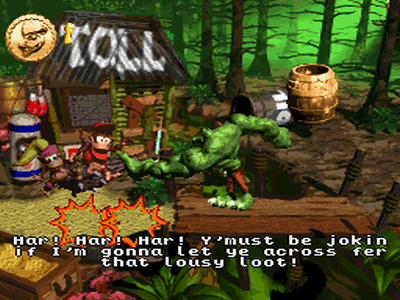
I think what Rare did with the DKC series is unparalleled. It definitely can be mimicked, but with how trophies and achievements work nowadays, it’s unlikely. There have been games that reward people for their collecting efforts, such as Halo 3 with its unlockable armor pieces and Mass Effect with its stat boosts for unlocking certain achievements. Though mostly cosmetic, both these games at least hand you something worthwhile for completing a milestone, and that’s commendable. I just wish more developers would look to the system set in place by the Rare of yore.
Once again, collectibles are responsible for running a substantial amount of the gaming addiction. Practically every game sports some type of collectible, but none can come close to the unrelenting perfection set in place by the DKC series. There’s no reason why games can’t augment what DKC has done, but if one thing’s for sure it’s that the gaming industry would be a much better place if they did.
Labels: Andrew Whipple III, Assassin's Creed, collectibles, Donkey Kong Country, Donkey Kong Country 2: Diddy's Kong Quest, Feature, Gears of War, Grand Theft Auto IV, Rare
- Andrew Whipple III
Subscribe to our content
and never miss a single thing

 subscribe to our monthly newsletter:
Our most recent writing

Our most recent reviews
Recent comments
All comments are subject to our commenting policy
Latest videos

Subscribe on YouTube

GGTL Classics
Some of the very best articles dug out from deep in the GGTL archives, written by some of our past and present wordsmiths alike.
Your continued use of this website and/or any others owned by Gamer's Guide to Life.com represents your acceptance and indicates your full understanding of all of our legal policies and terms. Our legal policies and terms are legally binding. If you in any way disagree with or refuse to be bound by any part of said legal policies and terms, you are advised to leave this website immediately.