 Follow us on Twitter: @ggtl
 Join our friendly community!


Latest news

 24.4.11

When the weather is warm I don’t want to play video games. My desire to sit glued to the TV wanes during the summer months. Life has more whimsy, more spontaneity and more nuance - not only does it seem a shame to lock myself inside during this time, but video games hardly seem like the right outlet for a sense of whimsy: doing something I do every other day of the year.
I once wrote an article about how video games are on a collision course with irrelevancy. I genuinely believe in everything I said in that article but its deficit was that it lacked specifics. I intentionally avoided citing many examples of what I found to be both vapid and worthwhile in video gaming because I have a difficult time touching on a topic and not digging down full steam.
I want to spend some time sharing video games I think are more than what we typically expect; titles that can be deep, expressive, exploratory, and even beautiful. It’s during these upcoming months when I’m most willing to expand my tastes; it’s summer, so let’s be more carefree, more expressive, more lustful, more sexy, more fun and more empathetic. Let’s be more everything.
Small Worlds
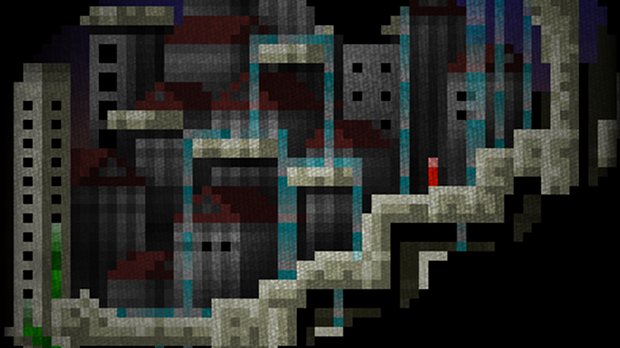
Open world games have lost their novelty for me since Super Mario 64. In their inception, they promised exploration, implying ostensibly limitless discovery. It was less a descriptor of how much freedom the game afforded you and more a promise of a world worth investigating every inch, not blowing everything up.
Nowadays, the term “open-world game” carries with it that very connotation of wanton destruction. Games like Just Cause and Red Faction unleash players into high-octane explosive playgrounds where environment and exploration are secondary to unrestricted fun. Destructive fun. The danger in that approach is that it abandons one of the core pleasures of being loosed into an imagined space - the simple joy of exploration.
Small Worlds exemplifies that core exploratory pleasure of open-world games. It’s a flash-based indie game about a series of 2D pixelated areas with no goal other than to discover what is around you. You play as a small anthropomorphic bunch of pixels that initially finds himself (or herself) encased in a glass bubble. The only visible way out is a tunnel through the floor. You can see nothing else. Your character is mostly surrounded by darkness, and soon finds that his or her only real option is to escape out of that opening. As you leave your hatch, you uncover more from the darkness as it gives away to a network of tunnels. The more you uncover, the more the camera pans away from your avatar, revealing the extent of the environment you’ve discovered. And there’s a lot to discover.
Small Worlds impresses because it’s a small indie game that executes the ideas behind open-worlds as well as, if not better than, any proper big-budget title. This should be a learning experience: whether you’re scaling buildings, driving stolen cars, or just running around, one of the biggest joys of an open-world environment should be the opportunity to simply exist there. There should always be a persistent sense of discovery.
There are blockbuster games that touch on this sentiment today. Red Dead Redemption crafted a western landscape that wasn’t necessarily always interesting to look at, but felt so legitimate that it was a pleasure to inhabit when the game required you traverse it, and was always good to allow appreciation for a sunset or a slow, winding basin trail. Likewise, Fallout 3’s environment was depressing, but its atmosphere was distinct, complete with its own self-deprecating tone and mid 20th century motif. Even Just Cause 2, with its emphasis on explosions and naive destruction, brandished an island with hidden pockets of peace where the ability to destroy suddenly halted in favour of a few fleeting moments of serenity.
Sometimes, it takes a bare-bones approach to distill the essence of what makes something valuable. Small Worlds takes this approach and encapsulates our basic ideas of exploration in a way that presents them equal to any element, quietly pleading game developers to take note.
Everyday Shooter

I generally loathe twin-stick shooters. Geometry Wars and the like just make me sick - I can’t deal with the amount of challenge those games ruthlessly pile on, and I don’t like feeling like the game is trying as hard as it can to make me fail, as though it were making fun of me. I don’t play games to be pummeled with challenge just for challenge’s sake.
The exception to this distaste is Everyday Shooter. Though it plays like most other twin-stick shooters, it’s in the area of presentation that Everyday Shooter becomes more than a trawl through bullet hell.
While it is definitely a video game, Everyday Shooter occasionally errs towards being a creative tool. One of the core concepts in Everyday Shooter is dynamic response: enemies are abstract geometric shapes that weave and swerve, not necessarily to destroy you (though they will), but also in rhythm to the beat and tone of the soundtrack, which is entirely guitar-based. When enemies are destroyed, guitar riffs and twangs plunk to signal victory; when combos are initiated, the riffs compound and complement each other as the combo increases. In a sense, enemies in Everyday Shooter function more as notes than hard obstacles. It’s synesthesia.
The design of Everyday Shooter a fairly simple system to interact with, but it’s built with some meaning behind it, adding a genuine sense of discovery to an otherwise tired game. It’s not a game I zone out while playing - it’s a game I can't help but think about.
Everyday Shooter differs from other abstract music games because it is less predicated on expression and more about the exploration of mechanics. While games like Electroplankton center around creating music, Everyday Shooter focuses on discovering music. Every level is different in its presentation of graphics, sound, and chaining system; level 4, for instance, has enemies that are more erratic, and they hide behind clouds of murk until you’re close. I kept dying on this level until I learned to be more patient in my movement and carefully hit smaller enemies, triggering smaller, quicker notes before advancing to the bigger baddies, which trigger large payoff riffs. This took a long time to figure out.
What does it mean in the context of creating music that I have to rub up against the enemies before I can even see them? What does it mean when the music itself is practically eluding me?
Everyday Shooter is a game that reorients your motivation to play while you’re engaged in it. It gives you a taste of what it’s like to contribute to something beautiful, and then it makes you fight for that right to contribute. There’s a struggle for creation here, a gem of euphony buried in the game’s mechanics.
When you finally unearth it, it’s nothing short of precious.
Mirror’s Edge

I first played Mirror's Edge during a stage when I was utterly bored and unimpressed by video games. I had bought a 360 in an effort to fertilize my interest in gaming, and Mirror’s Edge was just what I just happened to pluck off the bargain bin. It may very well have been one of the best quickfire purchases of my life. Mirror’s Edge is a game of simplicity, serenity, and most of all, beauty.
You probably know, but Mirror's Edge is a first-person parkour/free-running game for PS3/360 that mainly takes place on the rooftops of an urban-paradise. It's essentially a platformer with a focus on speed and fluidity of motion; the goal is to get from point A to point B as fast as possible.
Every time I play Mirror’s Edge I’m impressed. Not necessarily by the tightness of the mechanics or how much fun I have when I play (it’s often very frustrating), but by the way I feel when I play the game.
The caveat is that I’m one to be inspired by aesthetics, how nicely things look and feel, and that may not be the case for everyone. But I find Mirror’s Edge striking. It’s a game highly focused on environment and your interaction with it. You navigate a minimalist world muted in white, accentuated with drips of only the most vibrant colors that come to define particular areas: a soft swatch of green fills a massive cargo boat, hard yellows tense an ascent through a treacherous atrium, and a deep blue coats a skyscraper in the ultimate moments of the game. It’s a world that uses extreme simplicity to focus your attention.
In high school I was reading some venerated classics. The Great Gatsby, Our Town, The Grapes of Wrath, Kafka’s work, etc. And amongst those, I was playing Mirror’s Edge. All these works swirled in my mind and became a well of inspiration for me as I started to write my own fiction. I drew heavily from the feelings and images Mirror’s Edge swelled in me. There was suddenly beauty in walls and ceilings, vibrant color could bring me to tears and make me wistful. I wrote stories about lovers in elevators and swooned over the crunch of death that follows leaping off buildings.
It was like a virus. The serene minimalism and the way you interact with it infected my sense of beauty and mixed with my previous notions of what was aesthetically pleasing. I could hardly focus on tasks because I missed the simplicity of that world. It was the one time in my life when I genuinely yearned to relinquish myself to an imagined universe that seemed so much more profound, so much more a pleasure to inhabit than our own.
To me there is an ineffable quality to Mirror’s Edge. Something about its design is special in a way I can’t clearly express, partly because it’s personal and partly because the game itself is adequate explanation. That's something that makes me want to hang on to a copy long past its release, long into the future.
Labels: 2011, Everyday Shooter, Fallout 3, Indie, Just Cause 2, Mirrors Edge, Open World, Parker Scott Mortensen, Red Dead Redemption, Small Worlds
- Parker Scott Mortensen

If you look around the industry, you’ll notice that regenerative health remains a favourite mechanic amongst developers, and why shouldn’t it? Continuing your onslaught of chainsawing, bullet-hosing manliness after absorbing sustained amounts of firepower to your sternum is always a win. But haven’t you wondered how our favorite protagonists come out of these predicaments alive? Perhaps you’ve questioned exactly what is preventing those bullets from perpetually penetrating their adventures? The answers lie within.
Many think that Halo was the pioneer of regenerative health. And, in a way, they're right; Bungie did bring the critically-acclaimed mechanic to the forefront of mainstream gaming. The birthing of it, though, is located in another castle completely. Nonetheless, regaining lost health after avoiding damage for a period of time is a smooth, insanely popular feature in contemporary games. It provides players with a reason to utilise cover while still being able to bounce back from mistakes in the midst of battle. How else were you supposed to recover from the prismatic dragon-ninja’s shuriken of dark lightning? It makes sense gameplay-wise, but as far as the games that utilise it - that’s a whole different ball game.
Now this list isn’t just about games that use regenerating health; no siree. That list would be far too lengthy and lacks the focus we’re going for here. Instead, this list is fixing its unending gaze on the games that contain unexplained reasons why your character regenerates. If a dinosaur clawed my spleen from the confines of my body, I probably wouldn't recover very well. In videogames, however, they can do so with no real issue. How is this justice?
Each game in the following list will receive a score based on how believable its form of regeneration is. A score of ten marks the most believable regeneration, whilst one indicates ghastliness. Here we go.
Killzone

The Killzone franchise has been through quite a lot during its lifetime. First it was a muddy, messy, overhyped PS2 game; then it transformed into a visually appealing, constantly-delayed PS3 title. And who could forget that glowing PSP game? Regardless of where you stand with the series, Killzone has done one thing consistently from the very beginning: regeneration.
I don’t get it though. You’re the standard space marine who - like the rest of the flock, apparently - is capable of absorbing countless numbers of bullets. Okay, okay: you’re wearing weird space military gear and all that, but I’m going to go out on a limb here and suggest that it doesn’t come equipped with quantum-regenerative mind-gear.
Verdict: These guys aren’t Warhammer 40,000 genetically-altered Space Marines of doom. Bullets hurt badly, and I’m not convinced you can bounce back from a Helghast shooting a rocket down your throat. Still, they’ve got some pretty fancy technology, so maybe its possible. Just maybe... [5/10]
Assassin’s Creed

Altaïr, Ezio; whoever your assassin of choice is, it doesn’t matter. Both of these badass dudes regenerate anything, from minor cuts to arrows in their ass. I think my biggest issue with Ubisoft’s star child is that when you’re fighting someone, another comes up and wants a piece. That’s cool, but things escalate rather quickly, and before you know it you’ve got armoured guards wanting to shove their six-foot pike in unwieldy places. The combat makes it a bit touchy to counter blows every single time, so it’s inevitable that you’re going to be hit with some form of weapon.
Let's paint a picture: your screen is flashing red, you’re screaming, you're running, and you suddenly heal back to full. How does this even happen? Do assassins in the Crusades or Renaissance Italy possess the ability to mend wounds with a snap of the fingers? Yes, you’re technically controlling a memory brought forth by the Animus, but the machine doesn’t give you Final Fantasy powers.
Verdict: Sorry: these highly trained, highly skilled assassins may be the cream of the crop when it comes to silent murder, but they’re no mutant. They’re wearing cloth and light armour so as to be weightless enough to run from any pursuer. However, if hit by tangible force, fall like tangible assassin. There’s no Curaga in this time period. I'd say that you should at least have to be hidden to regain health. [3/10]
Mirror’s Edge

You can shoot people in this game, but it sucks. It sucks because you can’t run whilst firing, and running is what this game is all about. And the running isn't short of its own problems, either.
Running! How the hell can you run when you’ve just been roundhouse kicked by a rhinoceros? It’s a fair question: you’re usually being chased by beefy officers or kung-fu masters who, against your delicate feminine frame, could cause some noticeable damage.
Sometimes you actually have to stop and initiate combat manoeuvres, which is fine, but you take the risk of getting injured. I guess the risk isn't too large though, because in the future everyone seems to have regenerative implants.
Verdict: I don’t know about you, but after I get shot I can totally do a double wall jump. [1/10]
Red Dead Redemption

Great as Rockstar’s wild west adventure may have been, did they explain their regeneration system? In short: no. You’d think that, in an environment where greats were born and slain, you’d receive a little more realism when it comes to pain.
Don’t get me wrong, you can kill people in a shot or two (which is just like real life, apparently), but some of the punishment you can take is downright ridiculous. With the amount of shootouts you encounter, you’ll be tucking yourself away to regenerate constantly. After the eightieth bullet, that leg of yours should be the most decrepit thing on the planet.
Verdict: How about that deer you shot? Do you see it running over to the nearest form of cover? That’s right, you didn't. It isn't coming back, because it can’t regenerate. Instead, it died, like in real life. Are you even listening or are you just skinning that deer? [4/10]
Far Cry 2

Far Cry 2 wasn’t the best game. Questionable AI, dodgy respawning points and horrible stealth mechanics made this gamer cry in dirty corners, but at least the health system was unique.
And gross.
As this video indicates, you can heal manually if you’re at critical health. This form of manual regeneration entails some of the most grotesque animations I’ve ever witnessed. Pulling glass from your wrist, prising bullets free from your kneecaps, wriggling wire out from between your fingers; Far Cry 2 tries its best to make you vomit.
While this mechanic is unquestionably awesome, it makes no friggin’ sense whatsoever. How the hell does pushing a bullet through your arm give health? I’m no medical expert but I’m pretty sure that after you pull a large piece of shrapnel from your arm, it's going to bleed and you probably aren’t going to be using it for a while.
Verdict: Points for disposing of the junk in your body, but deductions for the nonsensical health giving. Also, since the animations are random you could be shot at, and then all-of-a-sudden be pulling a shard of glass from your wrist. Unless the enemy is armed with wine-bottle launchers, that shouldn't happen. [6/10]
GoldenEye 007 (2010 Wii version)

This re-imagining of the famed N64 shooter was high on many gamers’ lists of unbridled anticipation. Then it came out. All I can say here is that Daniel Cr... - er, I mean, James Bond - now regenerates health rather than having to use med kits. Thanks go to Activision, for shattering my nostalgia into lots of tiny unsalvageable pieces with the most contrived game mechanic possible. Why not add laser cannons and giant mechs next time?
Verdict: James Bond is not a space marine. At least, not yet. As good a spy as he is, he's still only a man, and a well-placed bullet ought to puncture his anatomy like a nail through a slab of soft butter. [2/10]
Gears of War

Only the manliest of men can say that this game doesn’t feature enough gore. Gears of War is responsible for doing a lot right, and a whole lot wrong - see Gears of War 2's multiplayer mode, for instance. Regardless, Marcus Fenix and his COG brethren are fighting a war that they must win. And what equipment do they have in order to ensure this victory against a heavily-armed, ruthless enemy? Chainsaws and standard-issue armour.
Just to remind you, these people are fighting against a horde of mutant angries called the Locust, who have a whole arsenal of hurt just waiting to be unleashed. How does a unit that are struggling for any type of technology fight against beasts the size of small buildings with rockets strapped to their back?
They regenerate, of course.
Verdict: There are no shields, no special infusions to make you a God, nothing. That obviously means that when a colossal space laser descends onto the surface of the world, hitting you square in the forehead, so long as you get out of the blast radius within a few seconds everything's good. Where is the sense? [2/10]
Uncharted

This blows my mind. Nathan Drake and company are wearing what appear to be clearance items from JC Penney, and they have no fear of taking on waves of enemies. What happens when Drake gets shot? The obvious of course: he regenerates. But how?! How can you heal gaping shrapnel and bullet wounds, with your half-tucked shirt as your only form of protection?
Verdict: I guess half-tucked shirts are the new Kevlar. [1/10]
Call of Duty

There is nobody in the entire galaxy that would be able to survive a .50 cal straight to the chest at point-blank range. No manner of Void Armor, magical forces or hostage children used as shields could save you from your dire fate. In Call of Duty, however, apparently they can.
I still remember the day I stopped playing Modern Warfare. I was patiently waiting for some camping hobo to return to the window he’d shot me from several times before. When he appeared, I focused and fired a very accurate shot, dead centre in the middle of the poorly-hidden gentleman's chest. And he didn't die. Even despite the fact that my reticle registered the hit, the bastard lived and shot me again.
Verdict: No. [1/10]
Red Faction Guerrilla

Red Faction is known for its ridiculously enticing destruction. The GeoMod is something that hasn’t been embraced throughout the industry, and it’s ridiculous that it hasn’t been utilised more. However, the very mod I was just praising shows why Guerrilla’s regeneration system makes no sense.
First off, Alex Mason is wearing some kind of industrial rain coat that frightens me. Second, you can be decimating a building and have a two-by-four block of solid concrete fall straight on your face, and yet can still get up after the ragdoll physics have stopped, and be good for another round. Is Mason made of rubber or something? Last time I checked, he was still human, and concrete still really, really hurts when thrown on top of you.
Verdict: Even on Mars, a building collapsing on you is still a building collapsing on you. You’re not coming back out. Ever. [1/10]
Labels: 2011, Andrew Whipple III, Assassin's Creed, Call of Duty, Gears of War, Goldeneye, Killzone, Mirrors Edge, Red Dead Redemption, Red Faction Guerrilla, Uncharted
- Andrew Whipple III

You know what I love? A nice coffee in the morning. You know what else I love? Great video game soundtracks. I find that as I get older, soundtracks in video games are becoming more and more important to me. The more observant amongst you may have noticed that I gave Shatter an 8/10. While the gameplay is pretty cool, I don’t think that I would have given it that score without its amazing electro soundtrack that I’m still listening to today.
What relevance does this have to this article? Well, considering news is a little slow in the post-Gamescom video game world I thought I’d do a little run down of my top 5 favourite soundtracks of all time. (This list doesn’t include games with licensed music, for example GTA 4, or music games, such as Lumines)
5) Shatter
This game has an incredible, heart-thumping electro soundtrack which perfectly complements the game’s arcadey action. I loved this soundtrack enough to buy it online for more than the price of the actual game.
4) Breath of Fire 3
I may be biased because of nostalgia here, but this game’s upbeat and jolly soundtrack matches the game’s mood perfectly.
Highlight: The Town Loved By The Wind
3) Mirror’s Edge
This game’s trance-y soundtrack really suits the game’s art-style and gameplay well. Also, I generally tend to stay away from the trance/rave sub-section of electro, but this really swayed me.
(Note: Matt may or may not have a huge crush on Lisa Miskovsky)
2) Final Fantasy 8
Final Fantasy 8’s music was incredibly necessary in the narrative of the game. Back on the PS1, facial expressions couldn’t be used to show emotion, and there was obviously no speech. As a result of this, Square had to use music to show what the characters were thinking and what the general mood was. This game’s soundtrack is so good that it was performed live in front of sell-out crowds all over the world.
Highlight: Fithos Lusec Wecos Vinosec
1) Bully
Bully isn’t well known for its music. In fact, it’s not really known at all, forgotten in the dying days of the last console generation. This is unfortunate because it has an astoundingly good soundtrack that ranges from 70s style rock-pop to electro to good old chip-tune. I can’t stress enough how much you need to play this game, even if only for its soundtrack. Bully truly is a modern classic.
P.S. Sorry about not posting in a while, had some crazy University business to sort out (I'm going to York :)).
Labels: Breath of Fire 3, Bully, FF8, Matthew Meadows, Mirrors Edge, Shatter
- Anonymous

Mirror’s Edge was released in 2008 by DICE. I haven’t reviewed it until now because I hadn’t felt like I’d finished with it. But now, after completing it 4 times, I can tell you that it is fantastic, for me, but might not be for other gamers.
You see, I’m an odd type of gamer. Whereas some complain about frustrating gameplay, I love it. Remember that Burnout demo? I set myself a course stretching the entire length of the sizeable demo level and challenged myself to complete it at full boost without crashing. 15 hours later I did it. Sounds like hell? Well you probably won’t like this game.

The reason I make the connection between the Burnout challenge and Mirror’s Edge is that they both offer incredible frustration. At times Mirror’s Edge can be the hardest, most unforgiving game in the world. At other times it can be a free flowing, rewarding experience which will leave you gawping at the excellence of the first-person camera perspective.
However, even the masochistic gamers like myself, will hate the combat. While hand-to-hand combat is passable, the shooting really blows. If you dare fire at any target more than 1 meter away you will undoubtedly miss, due to the terrible aiming controls of the guns. What annoys me the most is that the developers probably justify this lack of accuracy by saying “oh, well, your not supposed to use guns, it’s a platformer”. Bullshit. Let me tell you now, when you get onto a certain section of the game that takes place on a boat, you will agree with me 100%.

If you appreciate good art style you’re in for an absolute treat. Mirror’s Edge is my favourite looking game of all time. Sure Killzone 2 looks nice, and sure Uncharted wasn’t without it’s charm, but Mirror’s Edge paints the important parts of the game in different colours making the game look like a 6 year old’s painting that has been sharpened by Picasso.
The score I’m about to give is for you guys. You are the ones who may or may not purchase the game because of this and as such it would be irresponsible for me to give it a 10/10 (which is my personal score). Because of the frustration factor, which will turn a lot of gamers off, I just can’t recommend it for everyone.
5/10
Matt
Labels: Matthew, Matthew Meadows, Mirrors Edge, Review
- Anonymous
 I know the original plan was to do this on video, but I decided that it would be little more than me talking to a camera for 5 minutes, holding game boxes if I didn't do it this way. Anyway; 2008 was a great year. Here are my top 5 from it:
#5 Resistance 2

Resistance 2 should be used as an example for all game developers. Easy to pick up and play, hard to master. Great online mode, no lag. Amazing co-op gameplay with classes that actually work together; Resistance 2 does it all. Well maybe not, it has all of the fundamentals of a classic…but at times it feels like that’s all it has, fundamentals.
#4 Mirror’s Edge

Mirror’s Edge is the most unique game I have played all year. Even though combat is a big let down, and at times the missions can be frustrating (see boat level), the times when you run from rooftop to rooftop being chased by the police, are among the best of the year. Just as a note, ME has my favourite art style in a game ever.
#3 Grand Theft Auto 4

GTA 4 represents a more mature GTA series in times to come. I welcome this change. Whilst other games can boast of “amazing” character creation or “ground-breaking” user generated content, GTA 4 is one of the only games in history that have ever captured the feeling of a real city.
#2 Burnout Paradise

This is what racing games should be like. I don’t want to tune a car’s engine; I want to smash it to hell while jumping off a car park roof. I don’t want boring tutorials; I want to smash a car to hell, while jumping off a car park roof. I don’t want to change my car’s tyres, I want to smash it to he- OK, you get the picture. Burnout shows racing at its very best.
#1 Fallout 3
Fallout 3 has a great setting. Sure, at first it looks like a bunch of rocks and debris scattered around a wasteland, but if you dig deeper, what you find is an immersive world full of rich characters with good voice acting (at times), and a fun combat system. However, the thing that made this my game of the year was all of the little finishing touches. Stumbling on an exhibition in a museum that contains a replica vault complete with car salesman-like voiceover? Amazing.
Matt
Labels: Burnout, Fallout, Game of the Year 2008, Grand Theft Auto, Matthew, Matthew Meadows, Mirrors Edge, Resistance 2
- Anonymous
While my Wrath of the Lich King installs i bring you the Mirrors Edge Flash Game, which is made by a collaboration of EA and Borne Games. Its a little tricky controls but easy to get used to. So have a play around in this mini game!
Grimmy
Grimmy
Labels: Flash, Mirrors Edge
- Gr1mmy
Subscribe to our content
and never miss a single thing

 subscribe to our monthly newsletter:
Our most recent writing

Our most recent reviews
Recent comments
All comments are subject to our commenting policy
Latest videos

Subscribe on YouTube

GGTL Classics
Some of the very best articles dug out from deep in the GGTL archives, written by some of our past and present wordsmiths alike.
Your continued use of this website and/or any others owned by Gamer's Guide to Life.com represents your acceptance and indicates your full understanding of all of our legal policies and terms. Our legal policies and terms are legally binding. If you in any way disagree with or refuse to be bound by any part of said legal policies and terms, you are advised to leave this website immediately.