 Follow us on Twitter: @ggtl
 Join our friendly community!


Latest news

 12.8.11

File this under 'Movie-game tie-ins that sucked a lot less than they could have'. Toy Story 2: Buzz Lightyear to the Rescue isn't a great game, but then, it was harder to tell back then, wasn't it? I was seven years old in 1999. It's sometimes tempting to approach things with the same critical eye as a seven year-old and grade things on a scale of fun and voraciousness; if we want to keep playing - even if we don't know why - the game is good. And, by those merits, Toy Story 2 isn't much worse than the 3D platformers it's copying, such as Super Mario 64. Is the hassle of good game design really worthwhile when you can produce the same enjoyment with a clunky movie-game?
I guess a seven year-old doesn't really know what it means to call platforming 'clunky'. It means this: Buzz Lightyear moves with the inertia of a spinning top. He's overly lithe and prone to bounding past or falling short of whatever destination you'd intended for him. You'll never be able to make a jump in good faith that you'll land safely, and whatever sense of depth perception you have should be left at the door.
And then there's the story. Like any good 3D platformer, you're running around performing idiotic tasks for friends Hamm, Slinky, and Rex, in order to collect important objects; namely, Pizza Planet tokens, which are required to progress to new levels, the last of sees you rescuing Woody. Presumably, Hamm, Slinky, and Rex are on your side, and presumably they'd like to rescue Woody, too. They've access to these powerful Pizza Planet tokens, but curiously they won't give them to you unless you've collected fifty coins, saved six army men or beaten them in a race around Andy's backyard.
...some friends.
It doesn't make sense, but this is a game I spent a lot of time with when I was seven. Playing it, I can't help but reconnect dots between my seven-year-old self and my nineteen-year-old self. Twelve years ago, I was in this digital playground, and twelve years later I still enjoy it. It's familiar, too; I'd be lying if I said that I really thought games twelve years ago were that different from today, at least in the ways that matter.
Red Dead Redemption, for instance, is essentially Toy Story 2; a giant world that you explore and gain help from strangers inside, in exchange for help with their myriad problems, from herding sheep to hog-tying outlaws. The biggest improvement we've made since Toy Story 2 is how to create characters who are willing to put up with the fickleness of NPCs. More than anything, NPCs are selfish jerks, but our protagonists are written to be more patient, so it evens out. Our ability to justify gameplay in the context of a plot is increasing.
I can't think of any way to measure 'fun'. I could say that I have just as much fun playing Toy Story 2 as I do playing Red Dead, and there would be virtually no way to back it up or prove otherwise. So, let's explain it like this: Toy Story 2: Buzz Lightyear to the Rescue is as much fun as Red Dead Redemption, but it's not as consumable. I get tired of Toy Story 2 much more quickly than I do Red Dead Redemption. There are huge amounts of effort put into creating a world in Red Dead that obfuscates just how video game-y it is; incentive to come back, incentive to replay, and incentive to never leave.
The biggest improvement over the last dozen years? Games' ability to rope you in and never let you go. You don't just want to play video games anymore; you want to be lost in them. Games' gameplay, mechanics and stories have all taken baby steps compared to the expansion of their knowledge in how to hook you with meta scores, achievements and volume of content. You're getting more for your money than you ever have before.
Isn't that nice?
Labels: 2011, Feature, Parker Scott Mortensen, PlayStation, PS1, Sony, Toy Story 2: Buzz Lightyear to the Rescue
- Parker Scott Mortensen

How do you make a story about shooting people interesting? Whilst video games have long been nearly synonymous with violence, they’ve never been as synonymous with shooting a gun as they are today. Games are often pixelated representations of conflict at its boiling point: they take place at a moment that has already exhausted every method of resolution not including the death of other human beings. Where is the room for a story in a conflict that’s always at its breaking point?
At first look, I’m inclined to be impressed by the new Bioshock Infinite trailer. There’s a lot of glitz and twists on the idea of aligning crosshairs, shooting and killing people. There are new mechanics to bring objects into existence from other dimensions, new guns to shoot at people, rollercoaster expressways to ride and riots to start. Technologically, these things have never existed in a video game before. We’ve been able to shoot people in the face for years now, but we’ve never been able to do it in a floating city, and we’ve never done it so fancifully in such a way.
That construction is what made me ultimately not care about the original Bioshock, a game about shooting people with flourishes that made it feel different. It too was full of things that, technologically, we hadn’t done before either. There were audio logs to listen to, plasmids to toy with, and an underwater city to explore. Bioshock’s uniqueness as a shooter came from its narrative twists, its commentary on utopian society, its Randian roots. So in the end, the most memorable and lasting parts of the original Bioshock were not all the ways you could kill people, but the atmosphere of its underwater city, Rapture, and the story surrounding your trawl through it.
I suspect Bioshock Infinite will work in much the same way, and that’s disappointing. In fact, it’s gotten to the point where I feel disappointed whenever I’m given a gun in video games. It's not as interesting to shoot people as the amount of shooting in video games would suggest. When a video game hands you a gun, it’s likely the developers’ conceit that it’s hard to entertain you and tell a story at the same time. How much easier would it be to instead let you just shoot everything in sight?
Surely, there's a way, but the problems are rife and deeply ingrained. For instance, telling a story about a character with a gun creates a discrepancy between the character depicted in a game’s cutscenes, and the character you paint during gameplay. This problem is infamous in the Uncharted series: Nathan Drake, a supposed everyman, who - in cutscenes - can love a woman, speak Latin and decipher hundred year-old treasure maps, is reduced to a murderous war machine in gameplay. For such an everyman, Drake has a lot of blood on his hands.
Why is it that, in video games, the most emotionally embracing and impactful moments happen only in non-interactive cutscenes? One of the best parts of the original Bioshock was its lack of cutscenes, creating a world that was immersive sheerly because it never took you out of it. What excites me the most about Bioshock Infinite is, like its predecessor, its tinges of ideas more interesting than merely shooting people, and the prospect that I may actually participate in them. Watching this trailer sparks some hope that perhaps Infinite can do something to end that disconnect between the character in cutscenes and the character in gameplay. Maybe I can do more than just kill.
My favourite part of this new trailer for Infinite is the part where Elizabeth comes across a dying horse. As she consoles the horse and discovers that she may be able to heal it, you’re given the choice to euthanise it. “He’s in pain,” says Elizabeth. “Not for long,” says Booker, the player’s character, as he cocks his pistol. I have killed a horse before in a video game - it happened fecklessly countless times in Red Dead Redemption - but I’ve never been put into an environment that encouraged much thought about killing one, nor given the choice to do it in front of someone pretty and naive, someone who cared about the animal in a way I thought foolish.

For that moment, Bioshock Infinite isn’t a game about shooting things with a narrative that surrounds it. In games where it is your primary task to shoot, the story will always play second fiddle to the task of killing. The player's mind will always be overflowing with the mental intricacies of the mechanics leading up to a kill, thinking more about cover, bullet drop, ammo management and enemy position than they ever will about plot crescendos, foreshadowing, characterisation or any other basic tenet of storytelling.
How wonderful, then, to have a moment in a shooter where the mechanic may still involve aiming a gun, but yet feel more than the standard face-off between me and the faceless enemy NPCs, managing my ammo or super powers, or even the basic task of aligning a reticule over a bad guy’s face. Instead, it’s something much more simple: a conflict about my capacity to care irrationally for an animal for the sake of another person, someone I might be beginning to care about. In that instance, Bioshock’s core gameplay of pulling the trigger becomes the narrative, rather than just being the bait that tugs you towards the it. For a moment, shooting actually tells a story.
Unfortunately, that instance takes up perhaps twenty seconds of the trailer. The other fourteen minutes are the more technologically-impressive displays of the ways in which Irrational Games have succeeded in making that basic task of killing other people more entertaining. By letting players move anywhere within a battlefield by way of the Skyline, the rollercoaster track that connects the city, killing people becomes a much more entertaining and dynamic affair.
Battlefields with open spaces aren’t new, but the scale and traversal mechanics of this one seem to be. It’s dazzling to think of the code behind such a presentation, something that can render a whole lively world while a player, an agent of chaos, rushes through it on his or her whims; a gigantic world responding to your every movement. It’s all on a scale larger and more explosive than we’ve seen before.
But time is not kind to that which impresses through scale. We will always be able to create a larger scale for ourselves, one that outdoes our previous efforts in every way. If we set out to create the largest, most technically-impressive world, that can handle thousands of computations at a single moment, it’ll be outdone by our next, bigger, technical feat, which handles millions of computations in moments shorter.
The original Super Mario Bros is one of the greatest games of all time, and perhaps the greatest to this day. It hasn’t endured that honour because it is technically impressive. Super Mario Bros was the dictionary for the ideas we reach for and expect out of games today: scaling difficulty, left-to-right platforming, moving from world to world, boss fights, and - most importantly - the princess in the castle. The idea of a journey towards an eventual end goal was not something we’d had before in video games, and we are now better for having learned that structure.
In the same way that Mario became remembered for its language of video games, I suspect Bioshock Infinite won’t be remembered for its language of killing people. For the most part, we are no better for the additions Irrational have made to our lexicon of murder. We can now kill people on rollercoaster tracks and use inter-dimensional ammo and shoot crows at people, but none of these are as interesting as deciding on a single pull of the trigger to end an animal’s life.
In all likelihood, Bioshock Infinite will not be a great game. It will be a good, mechanically-sound game that will, at the end of the day, be about shooting things, and there will be a story that happens around you and passes you by. You will spend most of your time killing things in Infinite, and there is nothing wrong with that. We have always been killing people in video games, and we will probably continue to kill people for the rest of video games’ existence. But maybe someday we’ll find a way to kill that's imbued with things that actually matter to us. I like to think that day will come - perhaps it can start with killing a horse.
Labels: 2011, 2K Games, Bioshock, Bioshock Infinite, Feature, Irrational Games, Parker Scott Mortensen
- Parker Scott Mortensen

Mirror’s Edge is one of my most favourite games of all time. It’s a game of simplicity; a sublime experience where all excess between you and the the game environment is thrown out the window. It’s defenestration of the superfluous in favour of immersion, and that’s a wholly unique concept for video games.
Mirror’s Edge for iPhone is not this, but it is worthwhile in its own right. While the console iteration of Mirror’s Edge was a first-person experience, the iPhone iteration is a side-scrolling platformer among the lines of Canabalt. As a game about fluid momentum, Mirror’s Edge translates extremely well to this type of gameplay, and the iPhone is a great place to execute it.
On consoles, Mirror’s Edge was somewhat difficult to control, but Mirror’s Edge on iPhone - we'll refer to it from now on as 'ME iOS', for simplicity's sake - is smooth and intuitive. To make Faith run in a given direction you swipe either left or right, to make her jump you swipe up, and swiping down makes her slide. It’s a pretty simple set of commands, but the game achieves that desirable zen-like sensation of fluidity by churning these variables together, and adding a handful of micro-gestures that increase how quickly Faith can traverse. It’s a little more complicated than Canabalt, for instance, where your only control is when and how long to jump, but ME iOS not so complex that it’s frustrating.

ME iOS is a short experience, and no single level is completely satisfying either, as each is short and typically littered with a few enemy encounters. Similarly to the console version, the enemy encounters are the game’s weakest aspect: combat in ME iOS is frustrating, a nasty road-bump on an otherwise calming experience. Faith can slide, jump kick and disarm enemies she meets by swiping either down, up, or left and right, but each option will either follow lethal gunfire, slow Faith down, or eventually kill her and end a run if failed. None of these consequences enhance the game experience; rather, they detract from it. Like the Mirror’s Edge on consoles, ME iOS would benefit from either retooling the role of combat or doing away with it altogether, especially as it interrupts the more satisfying fluidity of the gameplay.
Since this mobile version of Mirror’s Edge succeeds so well in delivering a calming, zen-like experience, I would have appreciated some longer levels, or perhaps a mode of infinite level generation where I could just keep running and navigating. As it is, I probably won’t return to ME iOS, simply because the levels aren’t worth returning to once you’ve mastered them. There are collectible runner bags, akin to Mirror’s Edge on consoles, but they are frustrating to reach and don’t really exemplify the game’s controls and what kind of gameplay they can achieve. Still, if you liked Mirror’s Edge and can find enjoyment in spurts of fluid platforming, Mirror’s Edge on iPhone is definitely worth checking out.
7/10 [?]
Labels: 2011, App, DICE, EA, iOS, iPad, iPhone, Mirror's Edge, Parker Scott Mortensen, Review
- Parker Scott Mortensen

Everything in life is harder when you’re dating someone. Having a girlfriend or a boyfriend tethers you to another human being in some way, but never the same way twice. Every relationship I’ve had has been different. I’ve had relationships where I was scared and in need of attention and validation, and I’ve had relationships where the need to reaffirm my love felt obnoxious. I’ve cared for girls who didn’t care back, and I’ve cared for girls who didn’t need much attention at all. Each relationship changed the fundamentals of my life, restructuring my habits and routines to include a foundation that integrated another person, one I cared about in some way.
Enslaved: Odyssey to the West is a game that could take the genre of linear action adventure, established by games like Uncharted, and reorient the paradigm around the relationship between two people, but it never achieves that experience in any meaningful way. It follows a man and a woman, Monkey and Trip, as they escape a slaver airship in post-apocalyptic New York city and make their way to destroy the slaver headquarters.
I find a large portion of Enslaved to be similar to the Uncharted series. Enslaved maintains its pace by mixing platforming, puzzles, and combat so that one element never overstays its welcome, analogous to Uncharted, linear to the point where every bit of gameplay is a step to the bait of a new cutscene. The best part of Uncharted’s most recent outing, Uncharted 2, was watching the progression of the relationship between Nathan Drake and his lady friends, Chloe and Elena. Disappointingly, the conceit of Uncharted 2 was that action was paramount; that players would play no actual part in the development of the conflict between Drake and Chloe, or in how Elena and Drake would grow more attached, but instead would spend their time shooting militant Russians, climbing crusty walls and discovering buried treasure while the character interaction took place tangentially around them.

The growing relationship between Monkey and Trip is more evident in Enslaved than the relationships in Uncharted, but the surrounding mechanics are less enjoyable. The result is that the relationship stands as the most interesting thing in Enslaved. Monkey and Trip show quiet signs of budding intimacy and love, and while these become the most rewarding parts of the game, they are often obfuscated by video game tropes and repetitive mechanics.
Mechanically, Enslaved is uninteresting. For combat, there are two attack buttons; one for quicker, lighter hits and one for slower, more painful hits. The only difference in varying between either type of attack is time, so the result is that you may kill someone only slightly more quickly if you’re putting in the effort to pay attention. There are also buttons to block and dodge, and sometimes you’ll be asked to hit both buttons together for a wide attack that gives you more space to fight, though none of those options are ever necessary.
The most fun is in mashing the attack buttons and watching as Monkey whirls his staff, clanking against the metallic enemies. In true video game fashion, you’ll have to repeat this process again and again against faceless mechanised robots, remnants of the apocalypse. It’s fun to bang on them for a while, but without any need for higher-level mastery, the flourish of watching Monkey smack things dies quickly.
The platforming and puzzles in Enslaved are also mostly fuelled by the fun of watching Monkey perform them. Unlike Nathan Drake, Monkey (true to his name) can swing and climb more nimbly and spryly, making gigantic, drawn-out jumps, and the animation is all is wonderfully nuanced. With a little timing, you can jump from handhold to handhold more quickly and fluidly. But, like Uncharted, the platforming in Enslaved is so linear that its only real claim is to show you more pretty parts of the environment. Similarly, the puzzles are less of a puzzle and more of a mathematical problem: the answer to every stumbling point is a matter of the order of operations, figuring out which lever to pull first, which to pull last.

Enslaved is admittedly really pretty to look at - it’s the most lush apocalypse I’ve ever seen - but a game about two people shouldn’t be about its graphics, and it certainly shouldn’t be about the nuances of smashing into robots or the fluidity of scaling a wall. They are mechanical operations that require massive repetition. In Uncharted, these mechanics are also repetitious, but they're mostly kept fresh by the changing context of the environment and the story cutscenes that bookend the snippets of action; in Enslaved, this isn’t enough. Uncharted has the money behind it to make the repetition fun - Enslaved doesn’t, but pretends it does.
Where the mechanics of Enslaved prove most entertaining is when they’re put in the context of Monkey and Trip’s relationship. One of the longest combat sequences is in the chapter where Trip finds her mountain home abandoned and rushes off ahead of Monkey, leaving him to fight waves and waves of mechs. It’s arguably one of the most repetitious parts of the game but also one of the most intense and memorable.
Without the context of needing to reunite with Trip, the scene would be like most other parts of the game, where the most interesting bit is watching the fight play out through the pretty graphics (which, in this case, are a backdrop of sunrise high in the mountains). It’s admittedly nice to look at, but if it’s beautiful to beat through hordes of robots set against the cream-coloured twilight of morning, isn’t it more beautiful to do it all in the name of someone you love?
As the game begins, the conceit is that Monkey is physically tethered to Trip by a slave headband; straying too far from her will kill Monkey, and additionally, if Trip dies, Monkey dies - it’s fodder to establish the sort of relationship two people grow out of forced physical contact, but the mechanic is never really developed in any interesting way. The combat and platforming that take place at the beginning of the game are as complex and difficult as the combat and platforming at the end of the game. There is no restructuring of basic concepts to include the safety of another person, no acknowledgement for the presence of a loved one. If there’s a relationship growing in Enslaved, there’s certainly no evidence of it in the gameplay.

And so, the best parts remain the unplayable. At the end of the game Monkey and Trip discover (via cutscene) that, the entire time, the slaves they had been trying to free were trapped in an alternate reality, living lifelessly in the real world but thriving in the memories of a single man, the slaver, who had lived before the apocalyptic war and wasn’t actually responsible for the death of Trip’s family. His world is ours, a place where people still get married and where children go to school, where we drive cars and ride horses and see plays and listen to music and pay taxes. Monkey looks into the old world before deciding to destroy it, and finds it overwhelmingly beautiful. Seeing Monkey become engrossed by the alternate reality, Trip destroys the machine powering it, destroying the world and cutting the power, freeing the slaves. As the lights of the complex flicker off, Trip buries herself in Monkey’s arms, looks up at him and quietly asks whether she has done the right thing.
It’s a beautiful note to end on, one more dissolute and licentious than you’re typically fed in a video game. There is almost always a firm end to a video game story; whatever you’ve spent the last ten hours doing is coloured in triumph, validation that all your time spent was worthwhile. In Modern Warfare 2, this came as a dagger to the forehead; in Uncharted 2 it was the evil Russian’s demise; in Pac-Man it’s the flicker of your high score on the leaderboard.
In contrast, the only steps forward in Enslaved come through the relationship between Monkey and Trip as the rest of the world falls apart. Extrinsically, nothing good happens, from Monkey killing hundreds of mechs, to finding Trip’s family dead, to the disintegration of Trip’s relationship with the amatory character Pigsy. The only thing remaining as the curtain falls on Enslaved is Trip and Monkey, holding onto one another in the dark, wondering if it were all even worthwhile.
The image is a strong one, but not one you’ll participate in. The most frustrating thing in video games is the tendency to take control away from the player the moment things start to get heavy with emotion. When it’s time to get emotional, it’s time to put down the controller and watch a cutscene. I don’t want to watch Monkey and Trip hold each other, I want to be the one to recognize that someone I care about is scared and initiate the moment of embrace. When I’m playing Enslaved, I’m whacking robots with sticks. When I’m watching Enslaved, I’m finding two people develop feelings for each other.
In its emphasis on relationships, Enslaved depicts the blossoming of quiet affection that transcends shared hardship. Otherwise, it’s a mechanical and repetitive action brawler and platformer. The latter experience will inevitably wither in relevance while the former may stick in our minds forever. Only when the line blurs between the two does Enslaved stand a chance of becoming something that you might not be ashamed to show to someone you care about.
6/10 [?]
Labels: 2011, Enslaved: Odyssey to the West, Parker Scott Mortensen, Review, Uncharted, Uncharted 2
- Parker Scott Mortensen

When the weather is warm I don’t want to play video games. My desire to sit glued to the TV wanes during the summer months. Life has more whimsy, more spontaneity and more nuance - not only does it seem a shame to lock myself inside during this time, but video games hardly seem like the right outlet for a sense of whimsy: doing something I do every other day of the year.
I once wrote an article about how video games are on a collision course with irrelevancy. I genuinely believe in everything I said in that article but its deficit was that it lacked specifics. I intentionally avoided citing many examples of what I found to be both vapid and worthwhile in video gaming because I have a difficult time touching on a topic and not digging down full steam.
I want to spend some time sharing video games I think are more than what we typically expect; titles that can be deep, expressive, exploratory, and even beautiful. It’s during these upcoming months when I’m most willing to expand my tastes; it’s summer, so let’s be more carefree, more expressive, more lustful, more sexy, more fun and more empathetic. Let’s be more everything.
Small Worlds
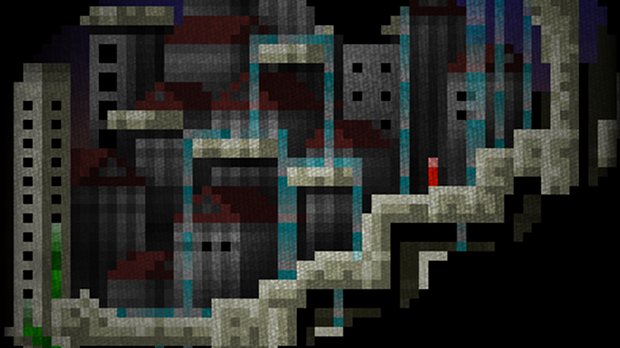
Open world games have lost their novelty for me since Super Mario 64. In their inception, they promised exploration, implying ostensibly limitless discovery. It was less a descriptor of how much freedom the game afforded you and more a promise of a world worth investigating every inch, not blowing everything up.
Nowadays, the term “open-world game” carries with it that very connotation of wanton destruction. Games like Just Cause and Red Faction unleash players into high-octane explosive playgrounds where environment and exploration are secondary to unrestricted fun. Destructive fun. The danger in that approach is that it abandons one of the core pleasures of being loosed into an imagined space - the simple joy of exploration.
Small Worlds exemplifies that core exploratory pleasure of open-world games. It’s a flash-based indie game about a series of 2D pixelated areas with no goal other than to discover what is around you. You play as a small anthropomorphic bunch of pixels that initially finds himself (or herself) encased in a glass bubble. The only visible way out is a tunnel through the floor. You can see nothing else. Your character is mostly surrounded by darkness, and soon finds that his or her only real option is to escape out of that opening. As you leave your hatch, you uncover more from the darkness as it gives away to a network of tunnels. The more you uncover, the more the camera pans away from your avatar, revealing the extent of the environment you’ve discovered. And there’s a lot to discover.
Small Worlds impresses because it’s a small indie game that executes the ideas behind open-worlds as well as, if not better than, any proper big-budget title. This should be a learning experience: whether you’re scaling buildings, driving stolen cars, or just running around, one of the biggest joys of an open-world environment should be the opportunity to simply exist there. There should always be a persistent sense of discovery.
There are blockbuster games that touch on this sentiment today. Red Dead Redemption crafted a western landscape that wasn’t necessarily always interesting to look at, but felt so legitimate that it was a pleasure to inhabit when the game required you traverse it, and was always good to allow appreciation for a sunset or a slow, winding basin trail. Likewise, Fallout 3’s environment was depressing, but its atmosphere was distinct, complete with its own self-deprecating tone and mid 20th century motif. Even Just Cause 2, with its emphasis on explosions and naive destruction, brandished an island with hidden pockets of peace where the ability to destroy suddenly halted in favour of a few fleeting moments of serenity.
Sometimes, it takes a bare-bones approach to distill the essence of what makes something valuable. Small Worlds takes this approach and encapsulates our basic ideas of exploration in a way that presents them equal to any element, quietly pleading game developers to take note.
Everyday Shooter

I generally loathe twin-stick shooters. Geometry Wars and the like just make me sick - I can’t deal with the amount of challenge those games ruthlessly pile on, and I don’t like feeling like the game is trying as hard as it can to make me fail, as though it were making fun of me. I don’t play games to be pummeled with challenge just for challenge’s sake.
The exception to this distaste is Everyday Shooter. Though it plays like most other twin-stick shooters, it’s in the area of presentation that Everyday Shooter becomes more than a trawl through bullet hell.
While it is definitely a video game, Everyday Shooter occasionally errs towards being a creative tool. One of the core concepts in Everyday Shooter is dynamic response: enemies are abstract geometric shapes that weave and swerve, not necessarily to destroy you (though they will), but also in rhythm to the beat and tone of the soundtrack, which is entirely guitar-based. When enemies are destroyed, guitar riffs and twangs plunk to signal victory; when combos are initiated, the riffs compound and complement each other as the combo increases. In a sense, enemies in Everyday Shooter function more as notes than hard obstacles. It’s synesthesia.
The design of Everyday Shooter a fairly simple system to interact with, but it’s built with some meaning behind it, adding a genuine sense of discovery to an otherwise tired game. It’s not a game I zone out while playing - it’s a game I can't help but think about.
Everyday Shooter differs from other abstract music games because it is less predicated on expression and more about the exploration of mechanics. While games like Electroplankton center around creating music, Everyday Shooter focuses on discovering music. Every level is different in its presentation of graphics, sound, and chaining system; level 4, for instance, has enemies that are more erratic, and they hide behind clouds of murk until you’re close. I kept dying on this level until I learned to be more patient in my movement and carefully hit smaller enemies, triggering smaller, quicker notes before advancing to the bigger baddies, which trigger large payoff riffs. This took a long time to figure out.
What does it mean in the context of creating music that I have to rub up against the enemies before I can even see them? What does it mean when the music itself is practically eluding me?
Everyday Shooter is a game that reorients your motivation to play while you’re engaged in it. It gives you a taste of what it’s like to contribute to something beautiful, and then it makes you fight for that right to contribute. There’s a struggle for creation here, a gem of euphony buried in the game’s mechanics.
When you finally unearth it, it’s nothing short of precious.
Mirror’s Edge

I first played Mirror's Edge during a stage when I was utterly bored and unimpressed by video games. I had bought a 360 in an effort to fertilize my interest in gaming, and Mirror’s Edge was just what I just happened to pluck off the bargain bin. It may very well have been one of the best quickfire purchases of my life. Mirror’s Edge is a game of simplicity, serenity, and most of all, beauty.
You probably know, but Mirror's Edge is a first-person parkour/free-running game for PS3/360 that mainly takes place on the rooftops of an urban-paradise. It's essentially a platformer with a focus on speed and fluidity of motion; the goal is to get from point A to point B as fast as possible.
Every time I play Mirror’s Edge I’m impressed. Not necessarily by the tightness of the mechanics or how much fun I have when I play (it’s often very frustrating), but by the way I feel when I play the game.
The caveat is that I’m one to be inspired by aesthetics, how nicely things look and feel, and that may not be the case for everyone. But I find Mirror’s Edge striking. It’s a game highly focused on environment and your interaction with it. You navigate a minimalist world muted in white, accentuated with drips of only the most vibrant colors that come to define particular areas: a soft swatch of green fills a massive cargo boat, hard yellows tense an ascent through a treacherous atrium, and a deep blue coats a skyscraper in the ultimate moments of the game. It’s a world that uses extreme simplicity to focus your attention.
In high school I was reading some venerated classics. The Great Gatsby, Our Town, The Grapes of Wrath, Kafka’s work, etc. And amongst those, I was playing Mirror’s Edge. All these works swirled in my mind and became a well of inspiration for me as I started to write my own fiction. I drew heavily from the feelings and images Mirror’s Edge swelled in me. There was suddenly beauty in walls and ceilings, vibrant color could bring me to tears and make me wistful. I wrote stories about lovers in elevators and swooned over the crunch of death that follows leaping off buildings.
It was like a virus. The serene minimalism and the way you interact with it infected my sense of beauty and mixed with my previous notions of what was aesthetically pleasing. I could hardly focus on tasks because I missed the simplicity of that world. It was the one time in my life when I genuinely yearned to relinquish myself to an imagined universe that seemed so much more profound, so much more a pleasure to inhabit than our own.
To me there is an ineffable quality to Mirror’s Edge. Something about its design is special in a way I can’t clearly express, partly because it’s personal and partly because the game itself is adequate explanation. That's something that makes me want to hang on to a copy long past its release, long into the future.
Labels: 2011, Everyday Shooter, Fallout 3, Indie, Just Cause 2, Mirrors Edge, Open World, Parker Scott Mortensen, Red Dead Redemption, Small Worlds
- Parker Scott Mortensen

This past week, Naughty Dog revealed the multiplayer component of their much-anticipated Uncharted 3, and it appears to be a massive expansion of the multiplayer in Uncharted 2. While the second Uncharted's multiplayer was surprisingly robust and lasting (around 40,000 players still play daily, a year on from release), it mostly conformed to our expectations for what a multiplayer game should be.
Based on Naughty Dog's reveal of Uncharted 3's multiplayer, it looks as if they're aiming to really add some new ideas to the conventional multiplayer experience. This is still a cops-and-robbers shooter, but with some new ideas that may prove to preserve onward in multiplayer experiences to come.
Before perusing the nuances of Uncharted 3's multiplayer, make sure you watch Naughty Dog's reveal video to get a good snapshot of all the additions.
1: Three Team Deathmatch and the 'buddy system'
Along with the tried-and-true Team Deathmatch, Uncharted 3 puts an emphasis on tight-knit team play with Three Team Deathmatch, a game mode which pits three teams of two against each one another. By constraining the size of the teams, players are forced to cooperate with one another, resulting in a 'buddy system' style of play, which is further encouraged by the ability to spawn on your teammate so long as they're not in the middle of combat. Team play has always been the quickest route to winning in multiplayer games, but in most games it's hard to communicate with a large team, even using voice chat. The 'buddy system' could do wonders for keeping players coordinated, partied or not.2: Two-part maps
Dynamic maps are not a new idea, and Uncharted 2 even had its own few map fluctuations, such as aeroplanes swooping down and knocking off large strips of cover from the map, or helicopters coming in to attack both teams. But Uncharted 3 takes this idea and jumps ten steps ahead; in the above video, players are shown fighting on an airstrip between accelerating convoys and an aeroplane, pre-take off, and then later at a more traditional, cover-based airbase-hangar arena. These two maps are actually connected. After the plane sequence (lasting presumably about half the match), all players are transported to the hangar and the match continues.This two-part map system really spices up the traditional multiplayer formula, making it something more cinematic and more exciting, hopefully whilst still retaining the balance between team advantage. If the timing between the shift in gameplay environments is reasonably predictable, perhaps players can use the switch strategically, giving dynamic gameplay environments much more bearing on gameplay than we've previously seen.

3: Emblems
If there's one thing video games have proven in this era of multiplayer, it's that players love validation. They want to know when they're doing well, and they want everyone else to know it, too. Emblem editors can be found in games like Call of Duty and Halo: Reach, where you can design your own insignia to be shown on your character, or to pop up alongside other players when you've killed them. The new take on emblems in Uncharted 3 is to display the top player's emblem in the playable, natural environment, smacking the map with personality.You can see this in action at about 45 seconds into the mutliplayer trailer, where a custom emblem is embellished onto the hangar map. Presumably, these emblems can change as the map goes on, meaning the top player will dominate the map aesthetically, as well as putting bullets into your skull.
4: Medal Kickbacks
At first glance, Medal Kickbacks seem like the equivalent of killstreaks, the ubiquitous multiplayer mechanic pioneered by Call of Duty that rewards a string of successive kills with more killing power. In reality, Uncharted 3's Medal Kickbacks are a more refined version of this killstreak mechanic. Instead of rewarding players for racking up as many kills as they can, Medal Kickbacks reward players for specific types of kills, such as kills on opponents who are currently attacking one of your teammates, perhaps kills with an unconventional firearm, or maybe headshot kills.In the above video, you can see Drake activating a Medal Kickback to use an RPG at the most opportune moment. Fine-tuning the criteria for killstreaks discourages the 'kill as many as possible as quickly as possible' mentality, and instead rewards more finesse with a bigger payoff. Hopefully, the mechanic will discourage techniques that focus on getting the most kills with the least effort, such as camping near spawn points or 'spamming' quick-kill weapons.
5) Power Plays and Overtime
Power Plays kick into gear when one team is grossly dominating the other. What they are exactly isn't yet defined, but we do know that they give the losing team a chance to close the gap and the winning team a chance to close the game. If you've ever played multiplayer of any kind, you'll know the experience isn't all that enjoyable when there's a big disparity between the teams, no matter if you're on the winning or the losing side. It may feel good for the winners to steamroll another team, but after a while, domination gets stale. Power Plays work to prevent this snooze-fest from occurring.Similarly, it's pretty frustrating when both teams are neck and neck but the match suddenly ends due to something that's happening on the other side of the map, irrelevant to you. Kicking things into overtime for ridiculously close matches helps ascertain the true victors.

6: YouTube and Facebook Integration
Facebook is integrated with nearly every service available in 2011, but it's rarely been done successfully in a video game. Both PSN and Xbox Live allow social networking in some form (be that Twitter or Facebook), but neither are particularly quick or presented in an interesting way. In Uncharted 2, Naughty Dog included the ability to tweet whenever players levelled up or completed a campaign chapter, and the result was pretty annoying.This time around, Naughty Dog has really gone the extra mile to make sure Facebook integration with Uncharted 3 is done in a compelling and tasteful way. From the Uncharted 3 multiplayer menu, you can see which of your Facebook friends are online, what they're playing, and what media they've uploaded, all of which is viewable from your console.
Similarly, YouTube integration lets users edit and upload videos seamlessly from their console. It's a small step, but the effect is a much smoother, more encouraged experience.
7: Uncharted TV
Possibly the most interesting addition to multiplayer is Uncharted TV. The best clips and images will be selected by Naughty Dog and broadcasted over Uncharted TV, a small reel of clips playing the corner of the screen between matches in multiplayer. It seems innocuous, but the logic behind it is actually pretty ingenious."If you watch a football game, you talk about it the next day because everyone watched the same game," says Christophe Balestra, co-president of Naughty Dog. "This is (to) get people who play to have a better experience."
Simply by creating a common feed of content, Naughty Dog is looking to tie the community together in a more meaningful way than a common set of mechanics. This way, players can commentate outside the game to their friends about what they've seen online, which pushes the Uncharted multiplayer experience out of the living room and into conversation.

8: Crotch Kicking
The benefit of this addition is self-evident.Are you one of the many eagerly anticipating Uncharted 3: Drake's Deception's release? Have you lost sleep due to sitting up until unholy hours, looking at screenshots and videos? Do you simply love the way Drake can climb a building? Give us all your thoughts in the comments section below.
Labels: 2011, Feature, List, Multiplayer, Naughty Dog, Parker Scott Mortensen, Trailer, Uncharted, Uncharted 2, Uncharted 3, Video
- Parker Scott Mortensen

This week I was walking back to my apartment from the library, when a man walking fifty yards behind me began to belt out the soundtrack to Beauty and the Beast. I found this quietly hilarious. He seemed to have lost all sense of appropriateness and instead relinquished himself to the swelling impulse to yell at the top of his lungs, that comes when listening to music through headphones. When I returned home, I told this story to my friends, expecting a big laugh and cheers of "awesome!", but instead no one laughed or even found the story that interesting.
I don't think it was a bad story - I just didn't tell it in the right way. I don’t have much problem at recreating stories when I write, but in extemporaneous speech it’s excitingly nerve-wracking. There are an infinite number of stories in this world based on the way we choose to tell them: depending on what we emphasise and de-emphasise, a story about a young boy on his way to football practice could have a dramatically different feel. Likewise, the way I tell a story about an overweight man screeching Disney tunes out-of-key could make it seem incredibly humdrum, or the most interesting thing that happened that week. The thrill isn’t in the range of stories to tell, but in the idea that I could have something uniquely important to share with others.
Jason Rohrer’s Sleep is Death builds itself from this desire to share and co-create. It is not a game where you win or lose, but a game of expression between two people who want to tell a story, an arena devoid of winners and losers, only experience. The structure of Sleep is Death asks for two players, either networked or locally connected. One tells a story and the other plays through it. Using rudimentary pixel art, the storyteller can either create or choose his or her own setting, objects, and characters for the other player to interact with.

From there, the boundaries are nearly limitless. Once the scene is set up, each player takes thirty-second turns deciding what to do. The player may move around and perform any action he likes, the effects of which must be rendered and responded to in his thirty-second turn. Thirty seconds may seem like a short time to work with in telling a meaningful story, but it’s thrilling in the same way that recounting an event to a friend extemporaneously is, with some general outline of what it is that you want to convey but with the specifics waiting to be filled in.
I first played Sleep is Death with my friend Corey Williams. Our stories were mostly exploratory, testing the game and each other. In his story, I was a man dreaming about spending time with a woman. I exploited this scene, pleading her to come to bed with me. Once she did, I woke up, and my wife asked me what I’d just been dreaming about. I nervously had no explanation. She caught on to the fact that I'd had a romping sex dream and asked if the dream woman was better in bed. I confessed, lithely, yes.
While the storyteller has the ultimate control in what happens, the player character is an agent of chaos, capable of destroying all gravity of the situation. I found myself doing this at first, knocking things over, trying to undress people, and setting things on fire. This is mostly a remnant of playing open-world games and platformers, where the joy of running around and tinkering is encouraged. Here, that still holds some novelty since the game is completely user-powered, which means every action can be compensated with art and feedback from the storyteller through the game's editing tools. But I found the experience of sabotage quickly unfulfilling. More interesting was seeing where my friends’ stories took me.
I wouldn’t know whether I could call Sleep is Death a 'hard' game, much less whether or not I’m 'good' at it. The game calls for people to react in thirty-second intervals, which isn’t always easy. Sometimes, I’d find something unexpected and take too much time considering my options to do anything really meaningful in my turn. I probably wasn’t the most interesting player to help develop the story, but maybe my storyteller wasn’t interesting either. Sometimes we were having fun, sometimes we were struggling.

I came into Sleep is Death expecting it to be a great tool to use when telling stories to other people, but I found that the ability for one character to interact with the storyteller’s work enabled more than just a frozen narrative. Sleep is Death may be a tool to empower people to share stories in a more realised way, but the addition of an active second person makes the experience ooze more. The result is something less tidy but more personal.
There’s an aspect of co-creation in Sleep is Death that is simultaneously thrilling and scary. Once I was past the point of wanting to test the system, the interaction in the game became bizarrely intimate. The exchange is different with every person, like sitting down to have a conversation with someone new. Letting your creative juices ooze onto a piece of paper is one thing, but letting them ooze directly onto another person is another, and the knowledge that everything you’re interacting with isn’t AI, but a human, only stamps the exchange with an added smack of intimacy.
And now, I wonder what else is out there for me. What stories do I have worth sharing? What stories are people waiting to tell me?
What stories will I make with other people?
Engaging in co-creation isn’t easy, and while it seldom produces the most meaningful of stories, it’s a nice way to talk to someone. I never played with anyone who had any larger vision for the result of our product, but it hardly mattered in the moment. After the game is over you’re given a book of screenshots of your experience, snapshots of each player’s turn. Despite the crude pixel-art, my impetuousness, and our weakly uncreative minds, there will always be something special about stepping away and looking at something that took the equal effort of two people to create, like a good conversation, saved forever.
If you'd like to play Sleep is Death with Parker Mortensen, you can reach him at parkermortensen@gmail.com. To learn more about the game and to purchase it, visit the game's website.
Labels: 2011, Co-op, Feature, Jason Rohrer, Parker Scott Mortensen, Review, Sleep is Death
- Parker Scott Mortensen

Stacking is a simplified and more casual version of the adventure games of yore. To me it was particularly evocative of the Monkey Island series, titles known for their quirky, humourous stories and esoteric puzzles. Despite only being Double Fine’s second foray into the downloadable game arena, Stacking is a delightful game for anyone pining for a classic adventure game.
The player controls Charlie Blackmore, the smallest (and perhaps most adorable) doll in a family of Russian nesting dolls. Charlie can stack into, and 'unstack' from, larger dolls to solve puzzles and save his family, who have been captured by the evil child-labour propagator, known as the Baron. Charlie explores a larger-than-life, early 20th century Britain, as he quests to save his family from the Baron and undo nasty child labour laws once and for all.
In the same way that Monkey Island was about finding and combining items to solve puzzles, Stacking is about applying the correct item to the correct situation. The only difference is that your items are characters, the dolls, spread out across the environment and full of such personality and quirkiness that they colour the game a strikingly unique, enjoyable puzzle-playground. What would be static, menu-based inventory items in most games turn into a circus of charming dolls scurrying around the playable field. Each doll has one ability that it can perform, ranging from generally useless actions (breakdancing and flatulance) to uniquely applicable ones (vomiting cookies and playing pied piper). The flavour provided by these character-items makes puzzle solving much more visual and friendly to those not well-learned in the obscurity of adventure game logic.

Stacking actually does a lot to circumvent much of the frustration which adventure games can inspire, most notably the tendency for visual puzzle-solving to become repetitive and irritating. Take Monkey Island, or even more modern adventure games, like Sam & Max; it’s easy to get stuck or lost in the game’s language, which is often impractical or humourous rather than logical. Who knew that a rubber chicken could be used as a zipline trolley? A pot can double as a helmet? There’s a certain out-of-the-box abstract logic to adventure games that takes a conditioned mind to recognise, and that invites some negative frustration. Being able to see the dolls' abilities in Stacking helped me to understand how a particular doll could aid in a situation. Even though the puzzles are rarely brilliant, elegant, or even all that complex, the impressive visuality of it all is a nice design choice that cuts through a lot of that nebulous misunderstanding and frustration that adventure games have forced players to wallow in for years.
Every puzzle has multiple solutions, but usually it only needs to be solved once to proceed through the game. If you were to just go find one solution to every puzzle, Stacking wouldn’t take you very long to complete, but there’s fun to be had in discovering every solution: they’re usually clever and make use of an unfamiliar doll. The real upside of multiple-solution puzzles is that, chances are, you’ll be able to figure out at least one of the solutions without much trouble, which goes a long way in removing the dissatisfaction of getting stuck on a particularly tricky riddle.
A trend in modern iterations of adventure games that I really appreciate is the hint system, and Stacking has a three-step hint system that begins vaguely and ends by directly outlining how to proceed. This mechanic can help anyone along at any time, during any puzzle, only augmenting how ideal Stacking is for adventure game fans of any calibre.

Stacking bookends puzzles and levels with stylised cutscenes that mimic the silent films of the game's era: bouncy piano music plays whilst the dolls bounce up and down to indicate who's talking to whom, and after a second or two the screen shifts to text and dialogue. It's part of the charm, but the scenes come up often and run slowly, and none are skippable. If anything, their use highlights how antiquated the idea of a cutscene can be in a game, but given Stacking’s late 19th/early 20th century motif, the antiquation feels almost appropriate.
There’s a strong aesthetic in Stacking that’s both charming and cohesive. Dolls scuttle and wobble about with an almost stilted animation that feels very appropriate for they way they look. The garbled grunts and chubby faces of the dolls provide just enough enjoyment to make me fine with being stuck in puzzles momentarily, because at least the experimentation was still visually fun. Environments in the game range from a high-class train, to a cruise boat, to an ominous zeppelin. Each feels decorated and is populated with a cast of new dolls and puzzles that fit the setting. In one level of a train car I found a crowd of humongous dolls wearing monocles and top hats, feasting on piles of golden coins served to them by lowly child labourers, as a fire - fuelled by hundred dollar bills - roared behind them. Much of the reason to play this game is to enjoy the art style and the embedded humour.
Adventure games are definitely a 'certain type' of game, one that hasn’t changed much since their inception. Stacking is fun, and its design breathes some simple ingenuity into the concept of puzzle solving in game design. Fans of adventure games will certainly appreciate Stacking, though it is slightly skewed to be more accessible and inviting to the young or uninitiated. It works perfectly as a downloadable title, with satisfying length and plenty of replay value for those who like unexhaustive solutions. In short, Stacking is no breakthrough, but it takes the adventure genre and gives it its own unique twist. I’d be remiss to not encourage the unique.
8/10 [?]
Labels: 2011, 360, Double Fine, Parker Scott Mortensen, PlayStation3, PS3, PSN, Review, Stacking, THQ, Xbox 360, Xbox LIVE
- Parker Scott Mortensen

We’ve come a long way in gaming. But not that long.
I don’t want to make another reference to Roger Ebert and his beaten-to-death statement that games will never be art, but I have to. One of the best lines that came from Ebert’s diatribe was actually from a post on his blog about using the word “nigger” in Mark Twain’s novel Huckleberry Finn. Ebert wrote he would “sacrifice every video game in existence rather than lose Huckleberry Finn”.
That line has stuck with me more than any criticism I’ve heard labeling video games as a pointless past-time. A lot of the backlash Ebert's received from the game community contains the argument that the video game industry and its fans shouldn’t waste their energy trying to please Ebert, who is far from knowledgeable when it comes to video games. That line of thinking burrows itself into a bitter and isolated hole, one that sacrifices the perspective of outsiders for the comfort of navel-gazing. Roger Ebert is not an idiot. His purview over the literary and cinematic worlds stretches farther than most of us will ever have the time to challenge.
I have trouble justifying an intense interest in video games. In video gaming, fun trumps all. It is paramount to story; more important than art design, more valued than communication. Many games will sacrifice logic and instead parade inanity, as long as it serves the gaming community's need for fun above all other things.
Our most celebrated and discussed works in video games are arguably the most irrelevant to regular people, and we’re fooling ourselves when we make arguments otherwise. Call of Duty is not a worthwhile war saga; it’s about shooting people in the face and feeling great afterwards. Bioshock is about creative killing. Mario is a giant playground. It may seem unfair to boil these games down so simply, but at their core gameplay, the distinguishing factor between games and other media, there is simple and crass heart.
Fun in video gaming is usually defined by rewards, which is why so many video games of today employ some sort of progressive reward system like that of Call of Duty’s multiplayer mode: everything you do is rewarded in some way. You shot someone in the head? Excellent! You got a kill from fifty yards? Awesome! You ran thirty feet? Incredible.
There's a parallel here to any artistic medium where there’s a challenge to gain an audience. Creation is all about communication of some idea, whether it be a story, an experience, or even just a feeling. But, at the end of it, if there's nothing to tell, then there's nothing to do. In video games, where gameplay is our conduit to the experience, the communication is usually engineered to make the player feel awesome, and the more awesome you feel, the more successful a game is. This often results in a struggle for the author(s) between including enough to keep people interested while not sacrificing the work's purpose, its communication to the world. In video games, we do so much to keep people interested that we don't even consider the idea of communicating an important theme or idea.
Of course, maybe all we want to communicate is a sense of fun. Playfulness is not something you typically find in other mediums, and video games do it well. But how long can we ride that wave? Ebert wrote of his idea of an “art” film, “They are not mechanical constructions of infinitesimal thrills. They depend on intelligence and empathy to be appreciated.” How many examples do we have in video games that fit that definition? I can think of less than five. Video games are not built on intelligence and empathy but instead reward and empowerment, where very little work is exchanged for maximum payoff. It’s escapism, and there’s nothing wrong with escapism, but if that’s all video games have to offer, how long can they possibly stay relevant?
I don’t really care whether or not Roger Ebert accepts gaming as something adult, much less as a legitimate past time. What sticks in my craw is that I know deep down that I myself would sacrifice every video game I’ve ever played in order to keep my favorite book, Catcher in the Rye. That said, when it comes to my relationship with video games, there’s no turning back - we’re in this together. They’ve been a part of my life for nearly twenty years now. I’ve grown up a lot since first playing Super Mario Bros.. But where are video games?
Technically, video games have grown exponentially. Technology has drastically changed the nature of what you see when you think of “video gaming”. Mario has grown from the simple coding language of an NES platformer to a complex, 3D, directionless world with wireless motion controls and analog sticks. The effort put into fine-tuning our ability to manipulate a virtual world is astounding, and it’s paid off into some of the most engrossing experiences.
Emotionally, video games have remained largely stagnant. For all the effort poured into the minutia of game design, its attention into the spectrum of human experience has remained meager. We’ve spent so much time pressing buttons in the name of fun that it’s hard to believe there’s room for much else. Being a gamer means always sniffing out the next high of excitement, searching for that same sense of empowerment wherever it can be found. It has rarely meant more in any substantial way.
When I fan out the experiences of my life, there’s only so much room for remembering the feeling of constant reward, constant empowerment. Humanity's palette is more diverse than this. Video games have fed us almost nothing but sweets our whole life, skirting the salty, the bitter, the sour and the savory and heading directly for dessert. There are tinges of other flavours sometimes, experiences that deviate from the norm and touch on wider or even universal appetites. But we don’t validate these deviations. They aren’t accepted by the community as “real” games. As a result, that community, and the rest of the world, end up missing something.
Where is our salesman desperately planting his garden? Where is our orgastic green light? Where do we find our mockingbird? Where are our princesses in another castle? We don’t need to please Roger Ebert, but we should be concerned that an increasingly larger number of people find the heart of gaming to be hollow.
We owe it to ourselves to reexamine the way we determine the worth of video games and the role they serve in people's lives. There are questions worth asking. Is it useful, in a larger sense, for us to pursue some constant high? Are we destined to be a derelict corner of escapism from that real world, or is there something more, a broader, cathartically diverse realm of interaction that we haven’t yet explored, just waiting for us? Until we start looking for it, we’re on a collision course for that day when we return from escape, only to find ourselves alone, hollow and unhappy.
Labels: 2011, Art, Bioshock 2, Call of Duty, Feature, Mario, New Features, Parker Scott Mortensen, Roger Ebert
- Parker Scott Mortensen
Subscribe to our content
and never miss a single thing

 subscribe to our monthly newsletter:
Our most recent writing

Our most recent reviews
Recent comments
All comments are subject to our commenting policy
Latest videos

Subscribe on YouTube

GGTL Classics
Some of the very best articles dug out from deep in the GGTL archives, written by some of our past and present wordsmiths alike.
Your continued use of this website and/or any others owned by Gamer's Guide to Life.com represents your acceptance and indicates your full understanding of all of our legal policies and terms. Our legal policies and terms are legally binding. If you in any way disagree with or refuse to be bound by any part of said legal policies and terms, you are advised to leave this website immediately.