 Follow us on Twitter: @ggtl
 Join our friendly community!


Latest news

 12.3.12

Tim Schafer, head of Double Fine Productions, is probably one of the most creative and original developers currently working in the videogame industry.
Known for creating games that challenge the norm and go against genre conventions, such as Pyschonauts and Brutal Legend, it’s undeniable that the development team at Double Fine has a distinctive voice, which for many of us translates into interesting, fun and challenging games, and more often than not offer unforgettable gaming experiences. However, for the head honchos at videogame publishing companies, the creativity that Double Fine breathes into its projects mostly translates into unnecessary risk.
Under the current gaming business model, millions upon millions of dollars are poured into a single game. Here’s some perspective: according to a 2010 report by M2 research (a consulting firm which provides marketing intelligence and strategic consulting on gaming trends) the average multiplatform game can cost anywhere from $18 to $28 million to make, with triple-A games reporting budgets as large as $40 million. When the average publisher invests millions of dollars into a game, you can rest assured that they want nothing more than to make all of that money back, and then some. For these publishers, helping a creative developer to publish a unique and risky game has proved to not always be the smartest way to do that. In the end, what this means is that a unique game with less mass-market appeal is simply much less likely to be published, regardless of its quality or greatness. After all, most publishers are looking to make money, not great games.
That puts developers like Double Fine in a particularly difficult position. Guys like Tim Schafer do not want to just make any game; they want to make extraordinary, unique games that stand out from the pack. Case in point: Double Fine’s upcoming Adventure.

The story goes a bit like this. Schafer and co. are looking to return to the genre that made them famous; the point-and-click adventure. You see, both Monkey Island and Grimfandango were made at LucasArts by the same group of people now working at Double Fine, and these games are considered classics which have, to some extent, shaped the current landscape of the aforementioned genre. The problem is that when talking about point-and-click adventure games, there isn’t much of a landscape to speak of. Back when we were all running our games on huge MS-DOS desktop computers, the point-and-click adventure was all the rage with the cool kids. But those times have long since passed.
Double Fine, as stated above, has done its part in trying to keep the genre alive but, although the point-and-click adventure has bucketloads of old school cred and a niche following, and rare success stories do exist - just browse through Telltale Games' catalogue and see for yourself – once you translate those games into numbers, adventure games are simply no longer what you would call a safe bet. Therein lies the rub for Double Fine. Publishers are not willing to invest millions and millions of dollars in a game which is likely to achieve no more than moderate success.
Enter Kickstarter. It’s a simple enough concept: Kickstarter is an online funding platform, where creative folk rich in ideas and short on cash go to get funding for their projects. Comic book creators, filmmakers, musicians, artists and videogame designers can all head over to the website, present their project to the masses, set a goal and ask for funding in exchange for unique 'thank you prizes'. If your idea is good enough, the people - much like those dead baseball players in a Field of Dreams - will indeed come.
So, you have one of the most innovative videogame creators in the business asking the people he really works for - the gamers - for the support he needs to get this game off the ground. A $400,000 goal was set; if Double Fine was able to reach that goal, the money would be theirs, and if the goal was not achieved then any money they had collected would be lost. On 8th February, 2012, approximately eight hours after the project had been announced, the goal was reached. And surpassed.

As of 3rd March, 2012, Double Fine has collected almost two and a half million dollars; 68,510 have pledged their support; and there are still ten more days of fundraising to go. Two million dollars, pledged by random gamers to a quaint little point-and-click adventure game. Wow is the word you’re looking for, and don’t be ashamed of your ineloquent response; it’s more than appropriate.
Gamers, the sheer awesomeness of the feat achieved by Double Fine should not escape you. I mean, sure, Tim Schafer gets to stick it to the man and make his game (certainly a victory for Double Fine), but it’s also much more than that. When you think about it, those who turned Schafer away at the door weren’t only denying him the opportunity to make this game; they were denying all of us the opportunity to play the game. In the end, publishers who are mostly motivated by their financial interests and the potential economic gain that a game represents dictate what we do and do not play. This time, through Double Fine, we have been granted the unique opportunity to politely tell the publishers to suck it. We want our game, and we’re gonna get it.

What are the implications of this event for the future of the industry? Right now, I wouldn’t rush to any conclusions. For the time being, all this means is that Double Fine is going to get to make an adventure game that will probably be amazing, and a bunch of lucky gamers will get to play it, knowing that they played a part in its creation.
How this affects the industry in the long term depends on a few things. First and foremost, the success of the game. If other publishers see that this funding/publishing scheme is viable and can lead to success, I’m sure more would jump on the bandwagon, and that not only means more interesting games for us to play, but also a certain degree of control and choice too.
Could you imagine if each of the big developers tried out one of these 'community-funded' games at least once every couple of years? Do you want to see your favorite classic Capcom franchise reborn? Put your money where your mouth is, and a new Megaman X game might be just around the corner. Rather see a wholly new character then a rehashed Donkey Kong game? Well, if Nintendo were to give you the chance, you may get the opportunity to make that happen by simply investing in that new IP.
Through massive funding, via Kickstarter or other similar platforms, the power to mould the gaming landscape is, in a very real way, in the hands of gamers around the world. If nothing else, it's extremely nice indeed to think about the endless possibilities it entails.
If you think what Double Fine is doing is nothing short of epic, than show some support. Head on over to the game’s Kickstarter page and donate as little as a single US dollar. Donate $15 or more, and you’ll get a copy of the game once it's released. Go ahead and take part in potentially changing the future of gaming.
Labels: Double Fine, Double Fine Adventure, Feature, Financial, Joey Núñez, Kickstarter, Tim Schafer
- Joey Núñez

Stacking is a simplified and more casual version of the adventure games of yore. To me it was particularly evocative of the Monkey Island series, titles known for their quirky, humourous stories and esoteric puzzles. Despite only being Double Fine’s second foray into the downloadable game arena, Stacking is a delightful game for anyone pining for a classic adventure game.
The player controls Charlie Blackmore, the smallest (and perhaps most adorable) doll in a family of Russian nesting dolls. Charlie can stack into, and 'unstack' from, larger dolls to solve puzzles and save his family, who have been captured by the evil child-labour propagator, known as the Baron. Charlie explores a larger-than-life, early 20th century Britain, as he quests to save his family from the Baron and undo nasty child labour laws once and for all.
In the same way that Monkey Island was about finding and combining items to solve puzzles, Stacking is about applying the correct item to the correct situation. The only difference is that your items are characters, the dolls, spread out across the environment and full of such personality and quirkiness that they colour the game a strikingly unique, enjoyable puzzle-playground. What would be static, menu-based inventory items in most games turn into a circus of charming dolls scurrying around the playable field. Each doll has one ability that it can perform, ranging from generally useless actions (breakdancing and flatulance) to uniquely applicable ones (vomiting cookies and playing pied piper). The flavour provided by these character-items makes puzzle solving much more visual and friendly to those not well-learned in the obscurity of adventure game logic.

Stacking actually does a lot to circumvent much of the frustration which adventure games can inspire, most notably the tendency for visual puzzle-solving to become repetitive and irritating. Take Monkey Island, or even more modern adventure games, like Sam & Max; it’s easy to get stuck or lost in the game’s language, which is often impractical or humourous rather than logical. Who knew that a rubber chicken could be used as a zipline trolley? A pot can double as a helmet? There’s a certain out-of-the-box abstract logic to adventure games that takes a conditioned mind to recognise, and that invites some negative frustration. Being able to see the dolls' abilities in Stacking helped me to understand how a particular doll could aid in a situation. Even though the puzzles are rarely brilliant, elegant, or even all that complex, the impressive visuality of it all is a nice design choice that cuts through a lot of that nebulous misunderstanding and frustration that adventure games have forced players to wallow in for years.
Every puzzle has multiple solutions, but usually it only needs to be solved once to proceed through the game. If you were to just go find one solution to every puzzle, Stacking wouldn’t take you very long to complete, but there’s fun to be had in discovering every solution: they’re usually clever and make use of an unfamiliar doll. The real upside of multiple-solution puzzles is that, chances are, you’ll be able to figure out at least one of the solutions without much trouble, which goes a long way in removing the dissatisfaction of getting stuck on a particularly tricky riddle.
A trend in modern iterations of adventure games that I really appreciate is the hint system, and Stacking has a three-step hint system that begins vaguely and ends by directly outlining how to proceed. This mechanic can help anyone along at any time, during any puzzle, only augmenting how ideal Stacking is for adventure game fans of any calibre.

Stacking bookends puzzles and levels with stylised cutscenes that mimic the silent films of the game's era: bouncy piano music plays whilst the dolls bounce up and down to indicate who's talking to whom, and after a second or two the screen shifts to text and dialogue. It's part of the charm, but the scenes come up often and run slowly, and none are skippable. If anything, their use highlights how antiquated the idea of a cutscene can be in a game, but given Stacking’s late 19th/early 20th century motif, the antiquation feels almost appropriate.
There’s a strong aesthetic in Stacking that’s both charming and cohesive. Dolls scuttle and wobble about with an almost stilted animation that feels very appropriate for they way they look. The garbled grunts and chubby faces of the dolls provide just enough enjoyment to make me fine with being stuck in puzzles momentarily, because at least the experimentation was still visually fun. Environments in the game range from a high-class train, to a cruise boat, to an ominous zeppelin. Each feels decorated and is populated with a cast of new dolls and puzzles that fit the setting. In one level of a train car I found a crowd of humongous dolls wearing monocles and top hats, feasting on piles of golden coins served to them by lowly child labourers, as a fire - fuelled by hundred dollar bills - roared behind them. Much of the reason to play this game is to enjoy the art style and the embedded humour.
Adventure games are definitely a 'certain type' of game, one that hasn’t changed much since their inception. Stacking is fun, and its design breathes some simple ingenuity into the concept of puzzle solving in game design. Fans of adventure games will certainly appreciate Stacking, though it is slightly skewed to be more accessible and inviting to the young or uninitiated. It works perfectly as a downloadable title, with satisfying length and plenty of replay value for those who like unexhaustive solutions. In short, Stacking is no breakthrough, but it takes the adventure genre and gives it its own unique twist. I’d be remiss to not encourage the unique.
8/10 [?]
Labels: 2011, 360, Double Fine, Parker Scott Mortensen, PlayStation3, PS3, PSN, Review, Stacking, THQ, Xbox 360, Xbox LIVE
- Parker Scott Mortensen
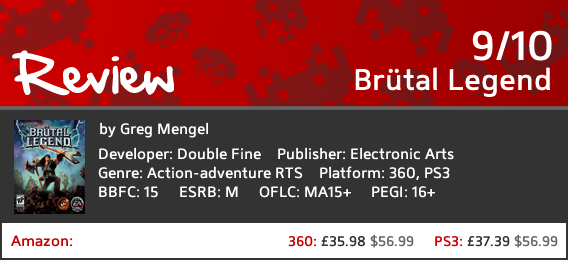
Ever wondered what it would be like if God of War, your local Renaissance festival, Jack Black, ridiculous cleavage shirts, The Legend of Zelda, Ozzy Osbourne, Warcraft III, Heavy Metal, Midgard, and this costume were all thrown into a cauldron, brewed for three to four years, and poured into a video game? You would get Brutal Legend, the latest free-roaming action-adventure game released by video game designer Tim Schafer, a man so popular that he may in fact get more hype from the gaming community when releasing a new product than Jesus Christ gets on Christmas.
Brutal Legend is the story of Eddie Riggs, a leather-donning roadie with biceps that would make a gorilla look ridiculous. His wish: to go back to an era when music was pure - the early 70s. When a set collapses on him, the mythical fire-beast Ormagöden does him one better, transporting him to a fantasy land filled with dangerous creatures and colossal monuments, archaic effigies to the Titans, ancient gods of Rock.

Brutal Legend's story is, without a doubt in my mind, the strongest aspect of the game. It's very, very, good. And refreshing. In an industry that is prone to place little emphasis on the importance of good writing in the design process, it's nice to see a game in which the gameplay is determined by the story, and not vice versa, while still keeping both parts balanced.

That being said, the story in Brutal is waaaaay too short. The average time of completion for the campaign that I've seen online ranges from six to ten hours. I finished in around eight, and immediately wanted more. Unfortunately, life after the campaign in Brutal is based on playing Lewis and Clark, exploring the world and picking up upgrades or achievements, not on completing interesting side-quests with the characters you have come to know and cherish. There are a few easter egg type interactions and missions to keep you occupied, but most are repetitions of one of four mini-games: race to the target, ambush the troops, guide the cannon, or man the turret. After fifteen 'ambush the troops' missions, I was ready to be done questing, donate my Xbox to charity, and spend the rest of my days in an Italian monastery without electricity. With ten more hours main campaign content to supplement a bland endgame, this game would have been truly legendary.

Playing Brutal Legend's 'hack-and-slash-meets-real-time-strategy' combo can be daunting at first, especially to hardcore fans of either genre, but after giving it a few dozen trie - during which you may angrily throw your controller, the coffee table, or the pet cat at the nearest wall - it gets fun. The trick to succeeding is to not treat the game like it fits into one genre or the other, but to adapt your style of play so it incorporates a bit of both. For me, a veteran of many a real time strategy war, this was tough. I wanted to create units and send them in to the front to fight gloriously for my cause while I stayed back at my comfortable stage (base), managing fans (resources), directing workflow, and getting fed grapes on an easy chair by scantily clad groupies. That ended badly.

In the game's multiplayer mode, which lets you square off against human players online or an artificially intelligent foe, you can choose one of three factions to wage stage war with: the Gothic and depressing Drowning Doom; Eddie Riggs' Heavy Metal themed human army, Ironheade; or Doviculus's legion of sadomasochistic demon followers, the psychologically disturbing Tainted Coil. Unfortunately, you cannot play as the beautifully shampooed and conditioned Glam Rock warriors of Lionwhyte that appear in the campaign. Their entire faction is like an ad for Head and Shoulders.

In terms of audio, well - it's a game about heavy metal, so as you can guess, it's loud. Loud enough to make your house plants die, have your girlfriend hand you a written warning to play it on mute after eleven or face the prospect of a life of chastity, and have you evicted from your apartment complex. So, basically, it's awesome. I thought so, and I don't even really like metal.

After hours of driving around doing side quests to a soundtrack of Death Metal, I often found myself turning off the Druid's Plow's tape deck and cruising to silence, if just to give my migraine a quick 15 minute break. During those peaceful moments I heard the beautifully crafted ambiance of the world. And I do mean beautifully. Every realm in Brutal has a specific set of sounds that sets them apart as unique and mystical places. Here, Double Fine did a terrific job. It's worth turning off the music now and then just to listen to the incredibly emotive, well crafted environments that the world offers. It's like a mini, virtual holiday through an album cover.

Being able to explore such a vast, awesome world kept me from turning off the system a couple of times. This was especially true after I'd beaten the campaign, when I was forced to complete a bazillion repeat quests to capture over half of the game's possible achievements. Quests like drag racing Fletus, the bitter and yet strangely sassy demon mechanic with an Irish accent, across every nook and cranny of the island, seventeen thousand times, just because. God, how I came to hate Fletus.

If you can think of a recent game with visuals even half as creative as those in Brutal Legend, and you convince me of that sentiment, then I will send you... erm... one American dollar. Mainly because I think it would be funny to send a single dollar across the Atlantic Ocean while paying over three dollars on international postage.
Brutal Legend is getting a lot of flack in the gaming journalism community for its short campaign, repetitive side-quests, and strange hybrid of a real-time strategy system (see Gabe and Tycho's mocking response). As I write this, its cumulative review score on GameRankings.com sits only slightly above 83%. 83%? Come on. With all the journalists who gave this game less than an 8.5 out of 10, and with Penny Arcade, I disagree. I never thought I'd say the latter. I can see where reviewers are coming from when they criticize Brutal's repetitive quests and short campaign. Those are serious annoyances that can make or break whether a game is just good, or whether it's legendary. And Brutal Legend is definitely not legendary, a fact which I find wholly ironic.

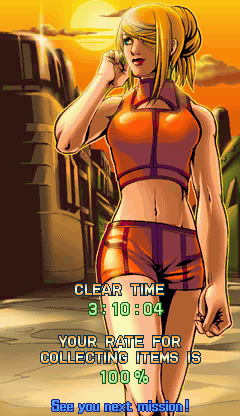
For that, it should be applauded - even its much debated real-time strategy system - not just because the idea of artistic and design innovation is a rare thing worth applauding in the current game industry, but because the ridiculous non-sequitur imagination of Brutal Legend makes it fun. I think I speak for a lot of people when I say that's all I really want in a game. That, and scantily-clad Samus after 100% completion.
Brutal Legend was an exceptionally fun game, and I can't wait for the sequel.*

*Dear Tim Schafer, EA, and Double Fine. Make a sequel, and hire me as a writer, with a salary of one million dollars. Or any other currency, it doesn't matter. Rupees work. Or Schafer Bucks. I've got this great idea where Eddie teams up with the ghost of the Carthaginian general Hannibal to fight off Cyborg Hitler's evil Robotoid Legion, and therefore saves Christmas. I'll call your people. Love, Greg.
Labels: Brutal Legend, Double Fine, Greg Mengel, Review
- Greg Mengel

The who-owns-what tangle originally began when Vivendi (Brutal Legend's original publisher) merged with Activision in 2007, in turn prompting Activision to abandon releasing the game. Double Fine then took up the project.
As a result, Activision sued Double Fine in order to halt Brutal Legend's scheduled October 2009 release date. In its suit, Activision alleged that the rights to Brutal Legend still belonged them despite stopping its prior release.
To further complicate matters, Double Fine counter sued, stating that Activision wasn't trying to protect the rights to Brutal Legend but merely trying to eliminate competition for the long-running Guitar Hero franchise. Double Fine also claimed faulty business practices in its suit. Apparently, EA failed to follow up on Brutal Legend's standing as what was supposed to be a sequel to Guitar Hero.
For the most part, publisher Electronic Arts has played a sidelines role in this battle. EA adopted Double Fine into its EA Partners program in 2008 to publish the then-rejected Brutal Legend, which CEO of EA John Ricitiellio called "a creative risk." A risk indeed: if Activision's suit had been successful, EA would have lost the publishing rights, and the Jack Black shred-fest would be propelled further out of reach for gamers once again.
Hopefully, more details regarding the settlement will be made available in the coming weeks. But I'm pretty confident that Brutal Legend's fiery trail through courthouses over the last two years will make its rightful diversion soon enough: into gamers' consoles.
Jacob
Labels: Activision, Brutal Legend, Double Fine, Jacob, Legal
- Anonymous
 Watching the second Developer's Commentary video from our friends over at GameTrailers, it's hard to imagine that Brutal Legend - the upcoming heavy metal themed, ass-kicking, speaker-destroying action-adventure title from Double Fine Productions - was almost buried by its first company, Activision, as one of the many casualties enduring by the gaming world during that emotional and frightening saga now known as the Activision/Blizzard merger of 2007.
The fact that the game still exists, and in what looks like a comedically pristine form, no less, is a testament that there are Gods of Rock in this world ...and Jack Black is their prophet.
Hit up the video below. It's 22 minutes long, so grab a coke or something. It's worth it. ...the video, not the coke. Maybe both.
...*cough*
Enjoy.
Greg
Labels: Brutal Legend, Double Fine, Greg Mengel, Video
- Greg Mengel
Subscribe to our content
and never miss a single thing

 subscribe to our monthly newsletter:

Our most recent writing

Our most recent reviews
Recent comments
All comments are subject to our commenting policy
Latest videos

Subscribe on YouTube

GGTL Classics
Some of the very best articles dug out from deep in the GGTL archives, written by some of our past and present wordsmiths alike.
Your continued use of this website and/or any others owned by Gamer's Guide to Life.com represents your acceptance and indicates your full understanding of all of our legal policies and terms. Our legal policies and terms are legally binding. If you in any way disagree with or refuse to be bound by any part of said legal policies and terms, you are advised to leave this website immediately.