 Follow us on Twitter: @ggtl
 Join our friendly community!


Latest news

 13.6.12

Military shooters are a tough business. Not because they're hard to make or incredibly rare to find - it's quite the opposite. The conflict at hand is that there are so many it's difficult to become seminal in a largely derivative format.
Spec Ops: The Line hopes to destroy that trend being a third-person military shooter with an emphasis on, wait for it... the narrative. Crazy as that might sound, Spec Ops is coming together beautifully and you'd do well to spend some time with it.
Spec Ops: The Line interview
As I stated, the military shooter pool out there has far too many participants doing the exact same thing. Normally I'd do the irrational thing and dismiss a title with a name like Spec Ops: The Line, but I'm happy I didn't make that decision. Spec Ops is a game with a dark story that has a central focus on a squad of characters who've been sent to the ruins of Dubai. Once a beautiful location, it's been ravaged by cataclysmic sandstorms and is now considered no man's land. Stationed in Dubai to assist with the evacuation before the sandstorms hit, an enigmatic figure known as John Conrad has vanished and it's your job to discover what actually happened.
It's important to note that Spec Ops knows the kind of situation its throwing itself into and lead designer, Cory Davis from Yager Development had this to say:
"Those games that are out there in our genre are great games, they do what they do extremely well but they're a lot different than what we are."
Different seems to be the key word to describe this game, but it's not so different as to scare away normal fans of the genre. Spec Ops plays like a conventional third-person shooter with cover, blind-fire and team banter making requisite appearances. The game feels very responsive as you'd expect, but once again, the big difference is the strong emphasis on the personalities of the protagonist, Martin Walker and his squad-mates. The closest game I can think of where you're more intimate with your squad-mates is Gears of War, but that's severely stretching it. You simply don't get that kind of emotion in this type of game, but Spec Ops promises it won't disappoint.

I could be wrong guys, but... that ship is supposed to be in the water, right?
Being a squad-based affair, you'd think co-operative play would be thrown into the mix. While co-op is definitely in, it's coming in a different way (there's that word again). Available for free to anybody that purchases the game, a separate co-operative campaign will be attainable shortly after launch. While it doesn't deal with the characters you'll be playing in the main narrative, the co-op acts as a pseudo prequel that definitely attaches itself to the story.
To further augment the emotion and intensity of the situations you're presented with, Spec Ops will also contain decisions that have a dramatic impact on the story. Speaking about why the co-op mode wasn't thrust into the main game, Cory Davis explains that these decisions would have probably made less of an impact if they went through with it:
"We don't want you tea-bagging your friend while you're making a decision as to whether or not an important character lives or dies."
It's an understandable move and one I can definitely respect. If you don't agree, just think about games such as Halo 3 and Gears of War 3. When you put two or more people together when a scene of significance arises, you just don't get that same emotion as you would if you were playing alone. Some games do this well, but it's something you definitely don't see work often.

You said blind-firing was for pansies, man!
Spec Ops will ship with a multiplayer component, but it will focus on squad-based gameplay and a more intimate experience with your companions. Expect a strong progression system along with a plethora of maps when it ships.
Yager has done a commendable job so far and I'm looking forward to experiencing a game with a strong story that isn't an RPG. Mass Effect 3 was the last action-RPG I played with an incredible narrative and I hope to add Spec Ops to that extremely short list. With co-op slated to come soon after and a multiplayer component to help hold down the game's value, there's little reason why anyone shouldn't bother checking it out. The game ships June 26th for PC, Xbox 360 and Playstation 3.
If anything, you can at least marvel at the game's impressive sand physics because, you know, they're totally worth that retail price.
Labels: 2K Games, Andrew Whipple III, E3 2012, Interview, PC, PS3, Spec Ops: The Line, Xbox 360, Yager Development
- Andrew Whipple III

The original Borderlands was a huge surprise back when it released back in 2009, expertly combining twitchy, satisfying FPS action with stick-and-carrot loot collection à la Diablo and Torchlight.
Here in 2012, 2K Games knows that it has a hit on its hands, and gave Borderlands 2 one of the largest booths at this year's PAX East. With so many gamers frothing at the mouths for a one-way ticket back to Pandora, will Borderlands 2 be enough to satiate diehard fans of the first entry whilst still gaining new ones? I went hands-on with the game in an attempt to find out.
Borderlands 2 interview
One of the first things noticeable when firing up Borderlands 2 is how much more polished the game looks. Whilst the original Borderlands' art style was celebrated as unique and colourful, it also sometimes gave characters and items a shallow, flat appearance. I have no such complaint with Borderlands 2; guns, enemies and environmental objects appear much more detailed than before, and the game's sheer graphical prowess practically spills off-screen and onto the carpet.
Of course, more has changed than simply the presentation. Demo players at PAX East were able to choose from two character classes: the Siren, a rogue-like character prominently featured in the first game who specialises in stealth, and the new Gunzerker, an enormous brute of a character who wields two guns at once and regenerates health—I opted for the Gunzerker. Players are given three separate skill trees to fill out with points they gain from levelling up; we received fifteen to start the demo, and I poured mine into anything that would grant larger magazines and faster reload speeds.

And all the fools who lead their foolish lives may find it quite... explosive.
Once we had chosen our class and skill-set, my demo partner and I were dropped into the middle of a toxic swamp, and not so much as five seconds passed before we were swarmed by over-sized killer mosquitoes and large, stomping behemoths made of crystal. Anyone hoping to faceroll through the game with a partner will be in for a rude awakening; teamwork is paramount to avoid being overrun, as well as revive any characters who fall in battle (which happened to me more frequently than I would have liked; thanks Nick!). If you can stick together and unlearn the corridor-shooting tactics taught by games like Call of Duty: Modern Warfare 3 or Battlefield 3, you may yet survive what Borderlands 2 has to offer.
Gearbox is promising a whole slew of new weaponry for Borderlands 2, and the guns I got to try out were all pretty sweet, including a submachine gun that dealt fire damage, a Gatling Gun-style repeated blaster that fired poison rounds and a two-chambered shotgun that turned anything on its business end into a warm pile of goo. Weapon drops in the demo were plentiful, ranging from a scoped, semi-automatic rifle (not terrible helpful against swarms of killer mosquitoes) to a quadruple-barreled shotgun straight out of Bulletstorm (much more effective). Each was satisfying to use, and should be a huge draw for players who exhibit magpie-like tendencies for collecting heavy firearms.
Impressions
Unfortunately, the demo ended far before I was ready for it to be over, and judging by how blink-and-miss-it my time with the game felt, Borderlands 2 should be just as enjoyable a time-sink as the previous one. Look for Borderlands 2 to strike out for more guns and more glory on 18 September in the US and 21 September in the UK.
Labels: 2K Games, Andrew Testerman, Borderlands 2, Gearbox, PAX East
- Andrew Testerman

The Spec Ops franchise has long lain dormant, with its most recent entry, the budget-priced Spec Ops: Airborne Commando, releasing all the way back in 2002.
2K Games and Yager Development are gunning to breathe life into the ailing license with Spec Ops: The Line, a follow-up and reimagining of the tactical shooter series.
Spec Ops: The Line is set in Dubai, following a major catastrophe and an order to lock the city down from outside interaction. Players control Captain Martin Walker as he attempts to evacuate Colonel John Konrad, a U.S. Army officer who stayed behind during the disaster. Yager has compared The Line's storyline to Joseph Conrad's Heart of Darkness, which should clue players in about what to expect from the narrative direction, as well as Konrad's reasoning for staying in Dubai.
Interview with lead designer Cory Davis
Gameplay takes place in the third-person perspective, as players guide Captain Walker through the remains of the famous U.A.E. city. In a callback to the series' tactical roots, players can issue commands to their two squadmates, a heavy weapons expert and long-range specialist. During my playthrough, I was able to highlight enemies and give my squad attack orders, either laying down cover fire and allowing me to get into a better position or simply sniping them from seven blocks away.
Similar to other modern third-person action games, Spec Ops: The Line sports a cover system, allowing Captain Walker to vault over and dart between bits of rubble and chest-high walls, as well as blindfire his weapon for a bit of breathing room. Unlike several recent cover-based shooters, weapons in Spec Ops: The Line require only a few shots before either the player or the enemy goes down, making positioning and teamwork between squadmates a priority for survival. Even fights with two or three enemies can go south in a hurry if not properly thought-through.

Firefights in The Line are surprisingly deadly, making tactics integral to success.
One feature Yager is touting especially strongly is its terrain deformation within levels. Post-disaster Dubai is plagued with frequent sandstorms, affecting visibility and even subtly changing battlefield layout. I didn't get a chance to see the terrain altered in any meaningful way during my time with the game, but several firefights were interrupted by fierce sandstorms, limiting visibility and causing me to look for enemy muzzle flashes in order to locate them.
Presentation in Spec Ops: The Line left me feeling conflicted. On one hand, I appreciate what the sandstorms bring to combat, and the characters were well-animated and -detailed. On the other, the game looks so darn brown; I understand that a game taking place in the desert is going to involve a certain degree of dust-shading, but by the time I finished with the demo, my eyes craved colour. Voice actors in the game bark their lines in gruff military fashion, which is fitting if unexciting.

Dubai is an absolute wreck, making parts of The Line a challenge to simply survive.
Still, the shooting and squad mechanics are pretty fun, and I'm still genuinely curious what else Yager's much-touted terrain deformation will do for gameplay. I won't have to wait much longer, either; Spec Ops: The Line is due for release 26 June in North America and 29 June in Europe.
Labels: 2K Games, Andrew Testerman, PAX East, Spec Ops: The Line, Yager Development
- Andrew Testerman

If time is your biggest enemy, you're probably shaken to the very core when games like Civilization V surface. But what do you expect when turns can take days, diplomacy issues spill over into reality and strategic movements constantly have you second-guessing yourself? With Civ V's first big expansion on the horizon, Gods & Kings, one of the PC's biggest time sinks threatens to become even greater.
Civ V players will be happy to hear that the entire development team that worked on the core game is also developing Gods & Kings. The game certainly looks as sharp and, as you might have guessed, the expansion is bringing with it a myriad of new features and units. Firaxis states there will be 27 new units, along with nine new wonders and nine brand new civilizations. Two of the new civilizations they showed off consisted of the Huns lead by Attila and Carthage, controlled by Dido.
Firaxis definitely knows their history and they're doing their best to represent what each civilization did well in the past. Each civilization can create unique units, so in Carthage's case the African Elephant was a no-brainer. Carthage can also take their units and traverse mountainous regions almost effortlessly and are able to create the unique water-vessel called a Quinquereme. Spoilers: they aren't friendly.
Since we're on the subject of naval warfare, Gods & Kings is emphasizing a large focus on naval combat. Firaxis didn't like how naval combat was so bland with limited choices in the vanilla game. Oftentimes players would just sit back and bombard a landmass from afar until they controlled it. That didn't strike the developer's fancy. To correct this, naval vessels are now categorized in ranged and melee groups, striking a better balance than just complete ranged.

The other, more important change is the brand new emphasis on religion. Players can now create their own religions and attempt to spread them throughout the land. It's definitely possible to convert cities, but it does take some time. What's really neat is that each religion can choose their own beliefs that are completely unique to that specific religion. For example, if you're the first one to gain religion in a game and you pick a certain religious belief, no one else in the game will be able to choose it. Ever. Your followers also can be assigned beliefs which generate specific rewards based on what you choose.
Using religion and faith as a new resource really changes how Civ V feels. The game was always deep and intuitive, but now it feels even better. There's also a new mechanic in the game that allows for great people or even prophets to be born. What you do with these people is up to you, but it just further accentuates the variety of options Gods & Kings can throw at you.
Ever wanted to know what someone was going to do before they did it? Perhaps you wanted to steal some enemy tech for your own purposes? If so, the new espionage system is just for you! The first civilization to reach the Renaissance will receive a spy. This spy can be thrust into the thick of it to perform multiple acts such as disclosing enemy positions, stealing tech and can even stage a coup. Higher ranked spies can even tell you what your allies are really doing, perhaps saving you from being stabbed in the back.

It's important to note that you can't build spies, so the ones you receive are extremely valuable and come by only as you advance to a new age. Be careful with them! Firaxis also made it a point to express their displeasure with how certain end-games sequences worked out. In the core game, sometimes people would hoard all their gold, wait until the end and then spend it all in one glorious turn, often netting them a victory. To combat this, Firaxis is toning down the value of gold at the end game. Hear that? No more exploits!
As you can see, Firaxis obviously hasn't been slacking. Gods & Kings is absolutely brimming with content and changes fans have been clamoring for. Come June 19th (North America, June 22nd for the rest) you can bet fans will be happy with this outcome.
Labels: 2K Games, Andrew Whipple III, Civilization V, Firaxis Games, PAX East, PC
- Andrew Whipple III

How do you make a story about shooting people interesting? Whilst video games have long been nearly synonymous with violence, they’ve never been as synonymous with shooting a gun as they are today. Games are often pixelated representations of conflict at its boiling point: they take place at a moment that has already exhausted every method of resolution not including the death of other human beings. Where is the room for a story in a conflict that’s always at its breaking point?
At first look, I’m inclined to be impressed by the new Bioshock Infinite trailer. There’s a lot of glitz and twists on the idea of aligning crosshairs, shooting and killing people. There are new mechanics to bring objects into existence from other dimensions, new guns to shoot at people, rollercoaster expressways to ride and riots to start. Technologically, these things have never existed in a video game before. We’ve been able to shoot people in the face for years now, but we’ve never been able to do it in a floating city, and we’ve never done it so fancifully in such a way.
That construction is what made me ultimately not care about the original Bioshock, a game about shooting people with flourishes that made it feel different. It too was full of things that, technologically, we hadn’t done before either. There were audio logs to listen to, plasmids to toy with, and an underwater city to explore. Bioshock’s uniqueness as a shooter came from its narrative twists, its commentary on utopian society, its Randian roots. So in the end, the most memorable and lasting parts of the original Bioshock were not all the ways you could kill people, but the atmosphere of its underwater city, Rapture, and the story surrounding your trawl through it.
I suspect Bioshock Infinite will work in much the same way, and that’s disappointing. In fact, it’s gotten to the point where I feel disappointed whenever I’m given a gun in video games. It's not as interesting to shoot people as the amount of shooting in video games would suggest. When a video game hands you a gun, it’s likely the developers’ conceit that it’s hard to entertain you and tell a story at the same time. How much easier would it be to instead let you just shoot everything in sight?
Surely, there's a way, but the problems are rife and deeply ingrained. For instance, telling a story about a character with a gun creates a discrepancy between the character depicted in a game’s cutscenes, and the character you paint during gameplay. This problem is infamous in the Uncharted series: Nathan Drake, a supposed everyman, who - in cutscenes - can love a woman, speak Latin and decipher hundred year-old treasure maps, is reduced to a murderous war machine in gameplay. For such an everyman, Drake has a lot of blood on his hands.
Why is it that, in video games, the most emotionally embracing and impactful moments happen only in non-interactive cutscenes? One of the best parts of the original Bioshock was its lack of cutscenes, creating a world that was immersive sheerly because it never took you out of it. What excites me the most about Bioshock Infinite is, like its predecessor, its tinges of ideas more interesting than merely shooting people, and the prospect that I may actually participate in them. Watching this trailer sparks some hope that perhaps Infinite can do something to end that disconnect between the character in cutscenes and the character in gameplay. Maybe I can do more than just kill.
My favourite part of this new trailer for Infinite is the part where Elizabeth comes across a dying horse. As she consoles the horse and discovers that she may be able to heal it, you’re given the choice to euthanise it. “He’s in pain,” says Elizabeth. “Not for long,” says Booker, the player’s character, as he cocks his pistol. I have killed a horse before in a video game - it happened fecklessly countless times in Red Dead Redemption - but I’ve never been put into an environment that encouraged much thought about killing one, nor given the choice to do it in front of someone pretty and naive, someone who cared about the animal in a way I thought foolish.

For that moment, Bioshock Infinite isn’t a game about shooting things with a narrative that surrounds it. In games where it is your primary task to shoot, the story will always play second fiddle to the task of killing. The player's mind will always be overflowing with the mental intricacies of the mechanics leading up to a kill, thinking more about cover, bullet drop, ammo management and enemy position than they ever will about plot crescendos, foreshadowing, characterisation or any other basic tenet of storytelling.
How wonderful, then, to have a moment in a shooter where the mechanic may still involve aiming a gun, but yet feel more than the standard face-off between me and the faceless enemy NPCs, managing my ammo or super powers, or even the basic task of aligning a reticule over a bad guy’s face. Instead, it’s something much more simple: a conflict about my capacity to care irrationally for an animal for the sake of another person, someone I might be beginning to care about. In that instance, Bioshock’s core gameplay of pulling the trigger becomes the narrative, rather than just being the bait that tugs you towards the it. For a moment, shooting actually tells a story.
Unfortunately, that instance takes up perhaps twenty seconds of the trailer. The other fourteen minutes are the more technologically-impressive displays of the ways in which Irrational Games have succeeded in making that basic task of killing other people more entertaining. By letting players move anywhere within a battlefield by way of the Skyline, the rollercoaster track that connects the city, killing people becomes a much more entertaining and dynamic affair.
Battlefields with open spaces aren’t new, but the scale and traversal mechanics of this one seem to be. It’s dazzling to think of the code behind such a presentation, something that can render a whole lively world while a player, an agent of chaos, rushes through it on his or her whims; a gigantic world responding to your every movement. It’s all on a scale larger and more explosive than we’ve seen before.
But time is not kind to that which impresses through scale. We will always be able to create a larger scale for ourselves, one that outdoes our previous efforts in every way. If we set out to create the largest, most technically-impressive world, that can handle thousands of computations at a single moment, it’ll be outdone by our next, bigger, technical feat, which handles millions of computations in moments shorter.
The original Super Mario Bros is one of the greatest games of all time, and perhaps the greatest to this day. It hasn’t endured that honour because it is technically impressive. Super Mario Bros was the dictionary for the ideas we reach for and expect out of games today: scaling difficulty, left-to-right platforming, moving from world to world, boss fights, and - most importantly - the princess in the castle. The idea of a journey towards an eventual end goal was not something we’d had before in video games, and we are now better for having learned that structure.
In the same way that Mario became remembered for its language of video games, I suspect Bioshock Infinite won’t be remembered for its language of killing people. For the most part, we are no better for the additions Irrational have made to our lexicon of murder. We can now kill people on rollercoaster tracks and use inter-dimensional ammo and shoot crows at people, but none of these are as interesting as deciding on a single pull of the trigger to end an animal’s life.
In all likelihood, Bioshock Infinite will not be a great game. It will be a good, mechanically-sound game that will, at the end of the day, be about shooting things, and there will be a story that happens around you and passes you by. You will spend most of your time killing things in Infinite, and there is nothing wrong with that. We have always been killing people in video games, and we will probably continue to kill people for the rest of video games’ existence. But maybe someday we’ll find a way to kill that's imbued with things that actually matter to us. I like to think that day will come - perhaps it can start with killing a horse.
Labels: 2011, 2K Games, Bioshock, Bioshock Infinite, Feature, Irrational Games, Parker Scott Mortensen
- Parker Scott Mortensen
We also reviewed Civilization V as a standalone game.
Heilir, brothers and sisters of the shield. Fill your mead horns and slaughter the livestock taken during our last raid; we have cause for celebration. Odin smiles upon us, for he has blessed our warriors with a new method of practicing for their bloody and glorious entrance through the Val-hall Gate, conscripting Firaxis Games on Midgard to heed his raven's call. Weight your hammers and sharpen your axes, fierce vikings, for battle against exotic and formidable foes can now be met in the international colosseum of Civilization V.
Warn the world - the fury of Old Denmark approaches.
Lesser nations? Wall your cities and hide your women - your Ragnarok comes.
In their latest DLC for Civilization V, Firaxis Games gives players the ability to lead an old Norse power, Denmark, into the international fray. Like the Polynesia civilisation offered as DLC before it, this new Danish civ represents not only the geographic nation of Denmark, but also the cultures of its Scandinavian neighbors, forming a true 'Viking civilisation' made up of Scandinavian culture as a whole.
Does this blanketing union of Denmark, Norway, Finland, and Iceland do justice to all five of those unique historical powers? Has Firaxis done justice to Scandinavian history with this DLC? Let's take a look.

Harald Bluetooth, king of all the Danes. He once killed a man for a sandwich... and he wasn't even hungry.
To create their Danish civilisation, Firaxis had to look primarily at the Viking Age, during which period Scandinavian raiders sailed by longboat to to nearly every corner of medieval Europe. For a few hundred years, early kings had practically no defence against these Northmen, who would sail quickly (by either sea or river) to a coastal town and sack it before a larger, slower royal army could arrive to provide protection. To implement this uniquely Norse capacity to strike amphibiously from bodies of water like lightning, the Danes enjoy the 'Viking Fury' special ability, which gives land units extra movement while embarked, a milder movement cost when moving from sea to land, and no movement penalty for pillaging a tile.
Viking Fury alone makes Denmark one of the most formidable military powers in Civilization V. When coupled with their special units, the blitzkrieg potential of the Danish civilisation becomes downright frightening. Both Berserkers, skilled amphibious viking warriors who replace the Longswordsman, and Norwegian Ski Infantry, excellent snow and tundra soldiers of Winter War fame, enjoy extra turns over the units they replace that allow them to cover substantial distances in a short period of time. With a navy to protect them as they embark, both can lead quick, effective invasions that will easily wipe unprepared players off of the map.
There are two ways to catalyse Denmark's unique abilities: conquering and exploring. Conquering is fairly simple; no matter how you start your game, choose scientific research so that you get Optics (and therefore embarkation), Steel (which unlocks the Berserker), and Rifling (prerequisite for the Norwegian Ski Infantry) as soon as possible. Whichever social policies you choose are really just a matter of taste, as long as you create an empire that can buy, train, or upgrade Berserkers and Norwegian Ski Infantry in high quantities once they become available. Once you have your army of special units, allow them to travel over water (you may want to train a naval escort) to whichever leader you'd like to wipe the smirk off the face of, cook up some microwaveable popcorn, and watch the nations crumble like sandcastles. Sandcastles being attacked by viking raiders. Your viking raiders. It's a good feeling.

Every Danish land unit embarks in classic viking longboats. This includes modern units like Giant Death Robots, which I imagine weigh at least 60-70 tonnes. It takes a special kind of heroic, foolhardy badass to storm a beach with waves of mechanised infantry, backed only by the naval equivalent of glorified wooden yachts.
Surprisingly, I've also found that Denmark's embarkation bonuses make it a great choice as a peaceful nation of merchant explorers allied with all the world's city-states. It works like this: build a navy of discovery, and send it out to discover all the city-states, natural wonders, ancient ruins, and potential trading partners (opposing players) your map has to offer. The downside of this tactic for any other civilisation is that it takes real time and effort to explore all of the ancient ruins discovered, as a land unit is required to dig around the remnants of old Troy and pillage its cultural, populatory, or monetary benefits, unless your Danish land units receive embarking units that allow them to island-hop from ruin to ruin relatively early on in the game. The benefits of exploration for Denmark can give it the cost-effective leg-up it needs during, say, the classical or mediaeval age, to help pay for either a reign of easily purchased buildings and peace, or an army of Berserkers with their minds set on war.
Like in its Polynesian DLC, Firaxis released a historical scenario along with the playable Danish civilisation. 1066: The Year of Viking Destiny puts you in the shoes of Harald Hardrada of Norway, Sweyn II of Denmark, William the Conqueror of Normandy, and the besieged Harold Godwinson of England, as they strive to either protect (Anglo-Saxons) or conquer (Vikings and Normans) the fields, hamlets, and cities of early mediaeval England.
From a strictly gameplay-centric point-of-view, this scenario is terrific. Each playable leader receives his own powerful special unit and ability, to cultivate a strategy around. Both Sweyn and Hardrara receive the amphibious, quick-moving Berserkers used by Harald Bluetooth in regular games, as well as the general embarkation bonuses of Viking Fury. William the Conqueror can both dig in with the Motte and Bailey improvement (a castle built by Swordsmen which provides +100% defence to any units on it and damages all enemy units adjacent to it by 3 health per turn) and unleash offensive hell on enemies with his Norman Knights, which receive the Blitz promotion (allowing them to attack twice per turn), to carve his place in history. Harold Godwinson protects his throne against all three threats eclipsing him, by enlisting the help of city-states (influence with them degrades at half the normal rate) and employing Huscarls, which receive a free Cover I promotion (+25% against ranged attacks) and boast a +50% combo bonus when facing mounted units.

How different would European history have been if he didn't win at Hastings? This scenario can make that happen.
The entire scenario is geared towards reckless war - allied city-states turn over direct control of their units to you; happiness, culture, and diplomacy are turned completely off; and the only way to beat the game is to complete the Domesday Book wonder in London (which can only be constructed after building six Domesday Shire Courts in English cities). With so many special units and abilities to choose from, there are numerous tactics that can be employed in order to take London and complete the Domesday Book before time runs out.
Never before have I seen a country as demolished as the England in this scenario. It's downright gratuitous. If you play as any of the invaders, you'll get a scripted note every so often saying, "Hey, you know that rapine and murder you keep writing home about? Well, Steve back here in the motherland wants in. I know, I know, Steve didn't want to come before... he said the whole idea of invading a foreign country was a waste of time. But he's changed his mind! And he convinced some friends to come along. Come on, check them out." Just like that, you'll receive six free, mincing, bloodthirsty units to unleash on whatever quivering English women, children, and sheep are left in its burning towns and fields, for absolutely no cost. The wanton destruction I caused playing this scenario three times left me quiet, philosophical, and in dire need of a shower, some community service, and a good pray to any dear and fuzzy god other than Thor, whose bidding I'd followed quite enough for one afterlife, thank-you-very-much.
Anyone who read our Polynesia DLC review knows that I have a huge problem with the lack of effort Firaxis has put into adding unique, scripted flavour to new Civilization scenarios. Paradise Found, the scenario released alongside Kamehameha and friends last March, was a huge let-down in that it tried so very little to recreate the legendary creativity and scripted fun of scenarios found in Civilization II. Everything was bare-bones, and that made the whole scenario feel dry and unfinished, like a deserted beta Firaxis chucked out at the world, in a failed attempt to justify its unreasonably high DLC prices. '1066' does a much better job of spicing up the scenario, even though it still falls nowhere in the standards of the scenarios of yore.

Ah, Stonehenge. After the seventh world war, when humans have long since been replaced by Robotnikoidian overlords, it'll still be hanging around, standing up straight like nothing's happened.
Seeing Stonehenge, or discovering a decrepit Hadrian's Wall north of York. Becoming allies of Welsh city-states and receiving Longbowmen before they were popularly implemented into the general British culture was fun, as was seeking out and conquering Ireland as the Normans instead of London, potentially making Dublin the high seat of an Irish Empire with the power of historical England. Though there are no creative, slightly-theatrical scriptings to go along with the conquering of Dublin or the addition of Welsh peasant longbowmen to your army, they still go a long way towards making the scenario especially deep and fun for history buffs hungry for a richer scenario, in which they receive dynamic, interesting, fun answers to all their 'what-ifs'. We want historical Easter eggs. 1066 is a quantum leap in the right direction.
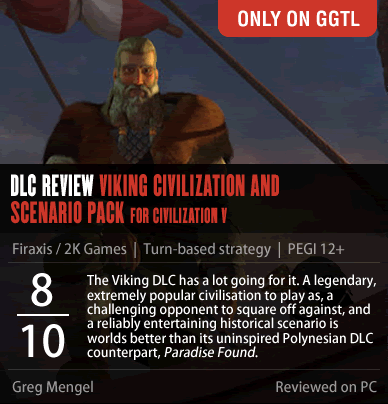
The Viking Civilization and Scenario Pack has a lot going for it. A legendary, extremely popular civilisation to play as, a challenging opponent to square off against, and a reliably entertaining historical scenario that - whilst not amazing by any stretch of the imagination - is worlds better than its uninspired Polynesian DLC counterpart, Paradise Found.
I tip my mead horn to you, Firaxis. It may be a little expensive, but this DLC will definitely grace my computer screen for months, maybe years, to come. Odin would be proud.
8/10 [?]
Labels: 2011, 2K Games, Civilization, Civilization 5, Civilization V, DLC, DLC Review, Firaxis Games, Greg Mengel, History, PC, Review, Sid Meier
- Greg Mengel

Game Information

Basic information
Bioshock 2
Developer: 2K Marin
Publisher: 2K Games
Released: 9th February, 2010
Platforms
PC
Xbox 360
PlayStation 3
Genres
First-person Shooter
Action-adventure
Certification
BBFC: 18
PEGI: 18+
ESRB: M
As it turns out, being a Big Daddy isn't that much different from being a human. Sure, from the outside, they look all big and bulky, lumbering and stumbling through the dark, wet and torn corridors of Rapture; but behind the diving suit there's not much change. But, then again, Bioshock 2 isn't about the Big Daddies. Or the Little Sisters. Or, even, the Big Sisters. It's about Rapture.Basic information
Bioshock 2
Developer: 2K Marin
Publisher: 2K Games
Released: 9th February, 2010
Platforms
PC
Xbox 360
PlayStation 3
Genres
First-person Shooter
Action-adventure
Certification
BBFC: 18
PEGI: 18+
ESRB: M
If you're even a slightly sane person, you'll have booted up Bioshock 2 with great expectations. The original Bioshock was unavoidably brilliant, gaining critical acclaim from all who dived into it. The stunning and awe-inspiring introduction to the underwater - and slightly leaky - Rapture immediately became one of those unforgettable gaming moments, destined to be featured in 'Top 10' lists everywhere. And now it's Bioshock 2's turn. Ohh, I wonder how they'll do it!
Well, after a slightly confusing cutscene; you're basically left on your own. Oh. Left for dead in the middle of Rapture, you get up (despite a bullet-sized hole in your face) with your trusty drill and after a few minute, gain a basic plasmid. From there, you shoot and zap things. Where's the plane crash, the terrifying darkness, the safety of a soft Irish voice? Bioshock 2 ditches all that, and instead throws you into the action. But wait - that's not a bad thing, as we'll discover.
The main change in terms of gameplay is that (OMG LULZ BBQ SHOCK HORROR!) you can use a weapon and a plasmid at the same time. Well done on picking up on the sarcasm, by the way. It sounds like such a small and minor change, that really shouldn't have been touted the way it was by 2k Games, but upon your first battle with a Splicer, you'll zap and shoot him dead quickly. And only after you do that do you realize that, actually, it makes a huge change. It feels so natural and organic, you'll hardly notice, but now you can ignite or throw or freeze anyone you want while also pumping them in the face with a chain gun. Bioshock 2 is mroe action-focused than the first, but now combat is almost gleeful, as you jump around spraying your plasmids (Eww...) around the place with your left hand as you shoot and stab with your right. Editor's note: not like that, you awful people.
What you're shooting and stabbing is, as ever, those ugly Splicers. Mutated by ADAM, these husks run around shouting incomprehensible babble and hurting you. Cannon-fodder, essentially. However, along with the new combat comes new enemies; Big Daddies of all forms, ultra-mutated Splicers who seem to have fallen in a vat of steroids and, of course, those Big Sisters. Even on Medium, these enemies take a while to drop, and while it's not usually a problem, if you're overwhelmed by a gang of powerful bad guys and you're running low on supplies, you can find yourself getting into a rather frustrating game of die, respawn, shoot them a bit, die, respawn, shoot them a bit. You can see how it might continue.
The most noteworthy new enemy is the Big Sister - an agile, aggressive and agrophobic (probably) upgrade of the Big Daddy. Sisters can come at any point when you're rescuing (not harvesting. You only harvest if you're a soulless freak) Little Sisters, meaning there's almost a tatcital edge to gaining ADAM. Each showdown is biblical and always incredibly tense as you throw down whatever traps and bots you have available.
Anyway, about that introduction. Yes, it leaves you a little empty. Soon, you're in full swing, completing objectives for the kind-voiced friend aiding you (sound familiar?), but you can help but feel that you've missed that big intro. This can plague you for a while, and as such, your enjoyment of Bioshock 2, at least for the first hour or so, is hampered. But then, you realise...
For me, this realisation came when I was offered the choice (Because we all know how much freedom you have in Rapture, right?) to either leave an old, unarmed lady who had been sending splicers my way for the best part of an hour unharmed, or to bash her stupid face off. Moral choices come around often in games, but usually there's a 'better' outcome, one where you do the right thing. Not here. She was old and tired and had little to live for, but I just didn't know if I could kill her. It took me a good minute to decide. Afterward, I thought to myself; 'That's odd - that never happened in Bioshock 1...'. And that's when you realise - this isn't Bioshock 1. This isn't close. Sure, same setting, same enemies, same plasmids, but in an industry where we're usually spoon-fed more of the same, Bioshock 2 does something incredibly impressive - does it's own thing. Imagine Bioshock 1 being the talented, intelligent younger brother touted as the star of his school, destined for great things. Bioshock 2 is the older brother who left school early, holds down a pretty low-paid job and doesn't get that kind of attention. But it's happy. It's not as fresh or invigorating or original as the original, but Bioshock 2 is it's own game; it doesn't try and follow the incredibly tough act set by the first, and instead offers you something new. There's no amazing intro, or astonishing plot twists, and Rapture feels pretty familiar by now; but Bioshock 2 brings some great things to the table, and you've got to learn to enjoy it for what it is.
As a whole, Bioshock 2 isn't as accomplished as the first. The engine it runs on is the same and now the game (I'm sorry to say) is just ugly. The water effects are nice, and the new weapons and enemies are innovative, but the story sometimes jumps through hoops and no matter how hard you try, you can't shake the fact you have been here before, and Rapture isn't as shocking as it first was. Oh, and there's a multiplayer, but frankly, with some really big hitters coming in the next few months, it's not going to hold your interest for more than a week or two. What you're paying for is a new look at Rapture, but while it gets bogged down in by-the-books objectives, some annoying die/respawn/die loops and poor looks, it still has the power to bring a smile to your face.
8/10
Chris
Labels: 2K Games, Bioshock 2, Chris, Chris Hawke, Review
- Chris Hawke
Subscribe to our content
and never miss a single thing

 subscribe to our monthly newsletter:
Our most recent writing

Our most recent reviews
Recent comments
All comments are subject to our commenting policy
Latest videos

Subscribe on YouTube

GGTL Classics
Some of the very best articles dug out from deep in the GGTL archives, written by some of our past and present wordsmiths alike.
Your continued use of this website and/or any others owned by Gamer's Guide to Life.com represents your acceptance and indicates your full understanding of all of our legal policies and terms. Our legal policies and terms are legally binding. If you in any way disagree with or refuse to be bound by any part of said legal policies and terms, you are advised to leave this website immediately.