 Follow us on Twitter: @ggtl
 Join our friendly community!


Latest news

 13.5.12

Last December, Destructoid’s Jim Sterling broke the story that Kingdoms of Amalur: Reckoning would feature a seven-part quest line, hidden behind an online pass.
Sterling called the practice "slimy and unjustified" on his personal Twitter account, and the topic quickly became a hot-button subject amongst savvy internet-dwellers wishing to offer their tuppenceworth on EA's new favourite money-making strategy. Part of the anger stemmed from the fact that Kingdoms of Amalur’s online code was restricting access to single-player content already on the disc, instead of online content, like previous games with EA Online Passes.
This is not the first time this year that a kerfuffle has been raised over single-player content restrictions. Last September, Warner Bros. Interactive and Rocksteady Studios came under fire when they sealed off several playable sections of Batman: Arkham City featuring Catwoman behind an unlock code. The move came under fire from users who felt they were being cheated out of the full experience, especially from the perspective of gamers who may not have an internet connection for their console, or anyone who might try to buy the game used.
Unfortunately, online passes are likely here to stay, especially seeing as publishers are trying their utmost to head off used-game sales. What started as a justification to recover operating costs for online servers has turned into yet another way for EA to coax a little more money out of its customers. And, beyond EA and Warner, THQ has also used online passes for Homefront and both of its UFC games, whilst Activision has as yet chosen not to follow the online pass route.
A hefty amount of digital ink has already been spilled on the subject of online passes, forming everything from reasonable discourse to righteous indignation. Some see online passes as a regrettable but understandable business decision, a reasonable push-back against used-game sales. Others feel they punish a significant part of their consumer base, and provide gamers with a worse experience; after all, typing in a new code every time one buys a new game gets very old, very quickly.
On a side note, I’m not certain that used-game sales cut into profits quite so much as publishers say they are, but I bet the fact that one of the world’s largest game retailers depends so heavily on used games sales doesn’t help.
I used to be reasonably tolerant of online passes; as a gamer who tries to purchase new games and support developers, rather than retailers, it didn’t affect me too heavily. Most of the games using online passes were sports games: the likes of Madden and FIFA, games I wouldn’t usually play but would likely purchase new if I did - new rosters, after all. However, online pass implementation has become much more ubiquitous - and, one could argue, much more stupid - in recent months. Entering each new code becomes more tedious every time, and the content hidden behind these codes has grown from bonus, thank-you-for-playing content to important, central portions of the game as a whole.
Perhaps my worst experience with online passes came when I rented Battlefield 3, for what was supposed to be a review. I ploughed through the campaign in one five-hour session (my preferred method for tight, focussed FPS campaigns), and after watching the credits roll, I sat down for a few rounds of multiplayer, excited to spend more time with one of my favourite online series in recent years. Instead, I was greeted with a screen that told me I needed to buy a brand new copy of the game in order to try the multiplayer at all.
I was shocked. Not only was the game depriving me access to arguably the reason to purchase Battlefield 3, but it wouldn’t even let me try it out and decide if it was right for me. Rather than spend an extra ten dollars on top of the eight dollar rental, I returned the game, frustrated and unsatisfied - at least online sports games like Madden allowed a seven-day free trial for online modes. And the sad thing is, I decided not to purchase Battlefield 3 in the end, because I wasn’t sure whether I’d enjoy the multiplayer; without an adequate chance to sample it, the purchase became too great a risk, and caused me not to follow through.
On the other hand, I can understand why publishers use online passes, despite how much they're inarguably awful. 38 Games' Curt Schilling recently talked about why they chose to implement their 'day-one DLC', saying that, as a new series in a crowded market, they wanted to stand out and provide extra content to gamers who would buy it new; after all, if they don’t sell enough copies, the studio may not be around long enough to deliver a sophomore effort.
To me, it really comes down to expectation. Amalur is an absolutely massive game, and as sucky as it is to miss out on a seven-quest cycle, there’s still a huge amount of content already available for playing. In terms of Batman: Arkham City and its infamous gated content, I rented the game shortly after it came out, and during the time I played it, not once did I feel ripped-off for not being allowed to experience Catwoman’s sections. Batman’s main storyline was so fun and well-paced, I never felt like anything was missing from the experience, making Catwoman’s sections truly feel like 'bonus' content.
Perception is also a big part of this discussion. There are those who feel that, because both Catwoman and the seven-part quest are on the disc, they should be available right out of the box, lest the experience be otherwise 'incomplete'. Yet, for some reason, removing the content from the disc and forcing players to download it through Xbox Live or PSN seems to make it okay. Perhaps we’re all hardwired to expect a more 'transactional' feel when purchasing digital items, and the physical distance the data travels and the time needed to acquire it perhaps make the content more worth the money than if it were simply unlocked from the disc. For me, if the experience feels complete (like in the case of Batman), anything extra is worth the extra money.
A similar situation happened last year with Gears of War 3, when Epic revealed that their game had a good amount of on-the-disc DLC. Their justification? They had already drawn up and followed a projected budget for the main content (single-player campaign, multiplayer, co-op, etc.), and the DLC followed a separate budget, making both sets of content two different sets of costs. The $60 purchase covered the main game’s budget, while the on-the-disc purchases would cover the cost to design, develop and test the DLC.
Also - and this makes me part of the problem - I would much rather have buy-new incentives that are actually worth ponying up the money for. Remember the Cerberus Network, EA’s free-DLC service from Mass Effect 2? Remember how awesome your new equipment was, and how engaging your new party felt? Of course not; they were all terrible. If I’m resigned to expect extra content from buying a game brand new, that content had better be worth the money I spent over buying it used. There’s a thin line between withholding content that’s worthwhile and keeping players from experiencing the game to the fullest, but the latter feels so much more satisfying than discovering your 'bonus content' was an extra pea-shooter and two differently-coloured T-shirts.
I’m not trying to be an online pass apologist; they add new layers of difficulty to customer experiences, and they could easily lead to a slippery slope of paying for even greater and greater chunks of content. Still, I know there’s a middle-ground that can be attained, in rewarding players who buy new without penalising those who buy games used, and hopefully developers can find that happy medium in the future. In the meantime, let’s get back to complaining about something that is really irritating. Like pre-order DLC.
Labels: 38 Studios, Andrew Testerman, Batman: Arkham City, EA, Kingdoms of Amalur: Reckoning, Online Passes, Opinion, PlayStation 3, PSN, Warner Bros., Xbox 360, Xbox LIVE
- Andrew Testerman
 In 2007, Bioware (famous for Baldur's Gate and Neverwinter Nights) introduced us to their latest creation, Mass Effect.
 It transitioned into a trilogy of sci-fi action roleplaying games, taking place on Earth and many other locations throughout the galaxy - whether or not they truly exist is up for debate, naturally. Initially, we're introduced to Commander Shepard, a character whom players can craft to be who they want; Shepard is fully customisable in terms of male/female, changing his/her hair, facial features, and background - to an extent of course. We followed Commander Shepard as he/she went after a rogue Spectre named Saren Arterius in the first instalment; battle the Collectors, an alien race hell-bent on abducting entire human colonies to aid the Reapers, in the second instalment; and the trilogy comes to an end as the Reapers bring the battle to Earth for the final conflict.
For some background information, the Reapers are a race of mechanical beings who come into the galaxy after hibernating in an extra-galactic dark space every 50,000 years to completely obliterate all living species to start anew. The Reapers are believed to be the Ramante - or the anti-life - a form of the plague which came as the companion to life. This is prophesied with the Reapers' intentions to cleanse the galaxy of all living species so that it can start anew; in Mass Effect 3, it is revealed that the Reapers consider themselves to be the order that handles the chaos of the universe.
In Bioware's final instalment of the trilogy, the storyline is focused on Commander Shepard and his/her battle with the Reapers. The story is much more serious than that of the previous two games, and the tone is less humorous than the others, though there is plenty of comic relief throughout the game. We're given more information on the Reapers and their aforementioned purpose, and even though we're left with some unanswered questions, it's done in a style that leaves it open for fan interpretation, something many fans fail to realize and complain about vociferously. However, Bioware has confirmed that they will be releasing free downloadable content that ought to satisfy the disappointed fans.
It's indeed true what fans are saying about the game's ending; your choices throughout the game do not directly influence the ending as they have in the previous games. Commander Shepard's story comes to an end regardless of the decisions you make, but the method of the closing of his/her story can be changed depending on how prepared your character is for the battle with the Reapers. For instance, if you spend enough time exploring other galaxies and collecting war assets, your "Galaxy at War" readiness will improve, thus influencing the methodology of the ending, but not directly impacting the outcome. SPOILER ALERT: regardless of what choices you make, Commander Shepard will most certainly die, but the result of Earth and the living species will change slightly. However, depending on how your GAW readiness is percentage-wise, you might see a cutscene at the end of your game where Commander Shepard's body is shown under rubble and he/she takes an inhaled breath, showing that he/she is [barely] alive, but Shepard's story still comes to an end.
Not too long after the intense introduction of the game, you'll be back as the Normandy's captain and make your way around the galaxy saving lives, executing missions and preparing your squad for the fight on the homeworld. Since the primary goal of the game is to gather a personal army to take to the frontlines against the Reapers, much of the game revolves around recruiting missions. But that's not as bad as it sounds; you won't be running around the Citadel doing favours for people in order for them to join your cause. Still, with the galaxy and every life at stake, you'd think people would be more willing to dive through the door to the Normandy and help in any way they can. But where would be the fun in that? In classic Mass Effect style, you'll roam the galaxy and help people in need, collect information on the Reapers, Cerberus and the Illusive Man, and miscellaneous side quests to aid you in your quest - all in classic mission form.

Expect to troop across the galaxy in search of the best and brightest to help fight the Reapers.
Since the primary concept is of gathering an army you'll be updated with your current Effective Military Strength in the Normandy's War Room. Your total strength shapes very little of what happens in the final battle, so you might reconsider spending hours on side quests, unless you truly want to experience everything the game has to offer. Doing so would be wise, though, as the time taken to perform the side missions ends up feeling rather rewarding. Most of the side quests amount to little more than planet scanning, but fortunately it's less tedious and more interesting Mass Effect 2. However, exploring the galaxy does become cumbersome, as the Reaper invasion is in full force and too much time spent on the galaxy map causes the Reapers to detect and come after you. Should they capture the Normandy, you're presented with a rather disheartening "Critical Mission Failure" Game Over screen, prompting you to load from your last save. The N7 missions are basically the multiplayer maps with some story thrown in. Needless to say, these feel very lacklustre. At least the critical path missions are some of the best in the series.Having only six squadmates (seven if you either purchased the N7 Collector's Edition or purchased the day-one downloadable content) is lacking when compared to the previous games, especially considering the necessity to build up an army of sorts in this instalment. The seventh character, a Jamaican-accented Prothean named Javik, is rather important; the weapon Shepard is trying to build on the side of gathering an army was originally designed by the Protheans, but they were wiped out by the Reapers before they could actually build it.
Mass Effect 3 adds a new feature that we've never seen before in the series: multiplayer. It offers fun distraction from the campaign, even though it's just like Horde Mode in Gears of War 2, with waves of enemies assaulting you and your team, minus Horde's depth. The strangest part of Mass Effect 3's multiplayer is that it's actually a key component that ties into Commander Shepard's war effort and Galaxy at War readiness, which assists in getting the "best" ending.

If you want the game's best ending, playing a few rounds of multiplayer might be a prerequisite.
Thankfully, the shooting has been improved substantially. Combat rolls are finally in place, along with a new heavy melee feature unique to each class that allows you to pick up and instantly kill the enemy parallel to your cover spot. Weapon weight is also heavily integrated into combat; your encumbrance corresponds to how quickly your powers recharge, so choosing your weapons carefully is more important than before. Also, each weapon can be customised with modifications that can be installed on weapon benches. Finally, hacking has also been removed, and now Shepard will automatically hack a door or safe him/herself.
The game also gives you the choice of choosing three modes at the start if you don't import a previous save; "Action", "Story" and "RPG". It's highly recommended to not play the "Action" mode, as it basically eradicates all dialogue choices and leads to a more dumbed-down game.
One addition I like is the Xbox Kinect integration. You can speak out dialogue choices, command your squad during combat and even use it to open doors, pick up weapons or examine datapads. The only flaw is the Kinect's sound sensitivity; be prepared to keep all other noises silent, or else it might interfere with your attempt to communicate via the Kinect.
Using the Unreal Engine since the first game, Bioware has improved upon the series' looks with each new instalment. It may not look significantly better than the last one but the faces look more detailed, lip-syncing is superior, armours and weapons are slightly more detailed and the overall look is crisper, though the texture pop-up still exists and characters often disappear from conversations. Hair still looks hideous and, disappointingly, your human allies all seem to have better hairstyles than you.
As always, the soundtrack is amazing and very well put together. Never once does the audio feel out of place or inappropriate. Luckily for those who purchased the N7 Collector's Edition, a digital copy of the soundtrack comes included.
All in all, Mass Effect 3 is an amazing conclusion to a well received and brilliant trilogy that will undoubtedly go down in gaming history. All we can hope for now is a few Commander Shepard references in Bioware's future projects.
Labels: Bioware, EA, Mason Sylvia, Mass Effect 3, Review
- Anonymous

Endings are a funny thing. Being the very last piece of the overall package, it's often this final bit will leave the longest lasting impression of your entire adventure. It's the one point where everything you've done, all the decisions you've made, the places you've gone, the relationships you established, the nations you spared, all coalesce into an emotional tidal wave that brings a sense of closure to your experience. For some, Mass Effect 3's ending defied these core principles and in doing so rendered itself incapable of bestowing an appropriate finale upon its fans. Should BioWare submit to those demanding for immediate change or is the ending fine the way that it is? We sound off within.
EDITOR'S NOTE: This article contains massive spoilers for Mass Effect 3 as well as Half-Life 2. If you wish to preserve the integrity of the story for yourself, please do not read further. You have been warned.
Failure to complete an acceptable ending can collapse even the strongest of stories, ousting a loyal fan-base and shelling any chance of redemption in their eyes. Moreover, we come upon the scenario ME3 has laid before it; a seemingly inescapable situation in which fans have been clamoring for a 'true' ending, one that brings more closure to the trilogy. While ME3 did contain 16 variations in endings, the way they all ended didn't vary enough for the fans, nor did it bring to light answers that immediately beg to be answered. What of the detonating Mass Relays? Are the fleets of the galaxy doomed to remain in the Sol system for all time? Why was the Normandy fleeing from the final battle? What happened to Shepard and his crew? These are only a few of the questions that were never openly answered and have sent the internet into a berserker rage.
Before we takes sides and begin arguing semantics and such it's important to note that through all of this, and good majority probably don't want to hear this, but BioWare is the one running the story. They are the ones responsible for the inception of Mass Effect, the universe, characters, everything that we, the fans, love and respect about the series. Knowing that, let's get down to business.

You know it's always a start to something great when you can light somebody on fire... with bullets.
Having finished the full game in the opening week, I was completely blown away by ME3. Its presentation, emotional themes, excellent gameplay and unparalleled dialogue truly stand out as some of the best we've ever seen in gaming. Never has there been a console game that has allowed us to carry our character and the decisions they've made over the span of three games (and possibly more). Mass Effect is the first true 'epic' of this generation and I don't think anyone is contesting this. Actually, I don't think anyone is questioning the quality of the game up until it ends. That ending is the catalyst to our entire discussion and quite frankly, I'm disappointed with how the majority have been taking it.
When a game is crafted by a development team that deeply cares about every aspect of their product, it spills over into that fictional world we all temporarily inhabit. While ME3 contains flaws and hitches on every level, the rest of the game is so well defined that those faults are easily forgiven. Could the side missions have been less superficial and more physically involving? Absolutely. Could the mission structure, progress and indicators been more profound? Definitely. ME3 has weaknesses, but we can't get hung up on items like this when we're presented with some of the best dialogue, characters, narrative and cinematics in gaming. I'm not asking you to forget about the game's issues, on the contrary please remember them, but no one should allow an enigmatic ending to exponentially ruin the whole game for them, especially if they enjoyed the core experience. If it were truly this easy, then even the most notable games of all-time would be utter crap by way of a single error or unexplained notion. That's not fair to anyone.
How many games have concluded on cliffhangers? How many games have elaborated on an information rich universe to only provide a few answers to the most sought after questions? Renowned title and legendary shooter Half-Life is a perfect example. Over the course of both games and episodes, we still have absolutely no idea who the G-man is. Actually, he's never even referred to by name as 'G-man' is slang for government man. His random appearances throughout the games are incredibly mysterious and his intentions are largely unknown. When HL2 ended, the G-man stopped time and with it the massive explosion, all just to talk to Gordon Freeman before the next set of events unfolded. The screen faded to black and that was that until Episode One released. Talk about a cliffhanger; I never saw people creating a Retake Half-Life movement after this ending surfaced and its arguably a much more ambiguous story than Mass Effect could ever come close to.

One thing's for sure though, these dudes want to murder your family.
Anyway, much like the Reapers, the G-man operates with intentions we can't and shouldn't know the origin of. It's a mystery and it isn't a bad story-telling device as it allows for interpretation and foreshadowing to play out by word of mouth. Upon completing HL2, you are driven to talk about the ending and its meaning. Your urge to discover what's really going on becomes viral as you discuss the events with friends and maybe even chat up some like-minded fans on the forums. This kind of interpretation is a powerful device, which is why Valve's plot for the Half-Life series, while completely in the unknown, is genius. It gives you enough of a theme that allows for clear objectives like the preservation of humanity, but also a sense of urgency and ambition to find out what the hell is going on. ME3 works much in the same way, but gives more clear-cut answers to desired questions. While we know what the Reapers are here for, we don't know why they absolutely must complete their task, who created them or why they've gone about things the way they have. We just know they must be stopped.
Let me use some more classic examples of popular media that used interpretation to tell a story. How about Pulp Fiction? What was in that briefcase? They never tell you, but they never needed to. You know what's in it. Other films like The Wrestler, Shutter Island, Inception, all of these films never openly tell you what really happened after the final scene fades away, but they didn't need to. This kind of mystery in the narrative creates a much more powerful emotional attachment to those involved than simply showing them what happened. Paying attention throughout the duration of the film is your most powerful resource when searching for the answer and this is also the case with ME3.
ME3's ending can be pretty hard to grasp, especially if you're relatively new to the series or just aren't deeply involved in the over-arching story. The final sequence contains Shepard and company leading a final charge to the beam that will supposedly get them to the Citadel. Harbinger, the rather angry main Reaper, is standing in your way and vaporizes everything in front of you with a massive blast; your world goes dark. It's here where I believe ME3 takes a bold shift into the unknown and the internet calls it the 'Indoctrination Theory'.
After Harbinger's blast, ME3 changes. If you've been paying attention throughout the duration of the game, even the series, you should know the events that follow that fateful explosion are different for a reason. This is where Shepard is truly tested, where your mind is played with to represent something the series has showcased since its creation - indoctrination. How else would Anderson make it into the control room before you? Why is Anderson moving strangely, puppet-like during your confrontation with the Illusive Man? Why can't you control your actions and decisions like Shepard normally could? What are the black wisps on the edges of your screen and why does Shepard grimace in pain, clutch his head and hear a Reaper noise repeatedly? There's millions of other questions and oddities that provide overwhelming evidence that something else is at hand.
This video gives the best evidence along with an incredible explanation about why indoctrination makes sense.
With all of that said, the internet didn't want to hear it. To them and other infuriated fans, ME3 committed to a lethargic ending that didn't explain anything and left too much room for interpretation. Could BioWare have provided a better indication that you were, in fact, indoctrinated? Perhaps, but I am personally against further elaboration. Imagine the whole final sequence where you are fully aware that your Shepard is under the influence of the Reapers and battling for his sanity. Your encounters, decisions, thought process, everything would be altered and have a cataclysmic impact on that final moment. The 'Catalyst,' or child Shepard sees, would automatically be seen as a threat and everything it says would be thought as a ploy to get you to do what it wills. By only providing subtle clues of your indoctrination, BioWare manages to put you in a situation where you think you're doing the 'right' thing, but in reality you're conforming to the Reapers' agenda. Brilliant, I say.
How are people not seeing this? I'm not quite sure. Maybe the majority wanted a simple good/bad/ugly ending scenario or maybe people went into the game already wanting to hate the ending. I can't be certain, but when an ending shows you this much difference within multiple characters and environments, one would think that you'd stop and take a moment to think about what's going on. What hurts me more than people proclaiming the ending as lazy and abhorrent is the notable media outlets that are further fueling the fire for this pointless internet crusade. People are jumping aboard a ship that has no destination and websites like Kotaku are partly to blame. Kotaku recently wrote an article entitled 'Fail State: Why Mass Effect 3's Ending Was So Damn Terrible" and it covers exactly what you think. I indulge those reading this article who have an open mind to read this spiteful work and realize its ignorance.
During that final sequence, when you first are transported to the Citadel, as the player you should know that something is up. Even if you don't, when you reach the control room with Anderson and the Illusive Man it should all become overwhelmingly obvious that greater forces are playing a role. How could you not know? Shepard is pointing a gun at his friend and colleague and shoots him because the Illusive Man wills it. Why would Shepard do such a thing? My theory has already been provided, but here's what Kotaku had to say:
"Anderson gets shot. That's...unfortunate, I thought. No sooner has his body hit the ground, though, than the Illusive Man points the gun at me. Again, a Renegade prompt, again, I leave it, because that's not how I play. He shoots me. Game over. I was speechless. I was being forced to take a Renegade option, even though this was the polar opposite of the Shepard I had built over the trilogy. Why was there no Paragon option? Why had the binary system built to power the games suddenly not working? Why tell me there's a choice when it's not a choice at all?"A short time later, the writer further elaborates on his displeasure with this statement:
"Swallowing the need to be a little meaner, I reloaded, shot him as quick as I could, and sat back as the endgame began to play out. When the time came to make THE ULTIMATE DECISION, I was again floored. This time, because the decision had suddenly become unclear. I had no idea which was the "good" ending I was after. All three choices I'd been presented with seemed ambiguous. Which was surely another creative decision on BioWare's part, but a poor one, because this one interfered with the trilogy's most basic assumption: that you can build the story the way you want to. That's why every single choice you made previously with regards to Paragon or Renegade pathways was so obvious; because it needed to be. People were invested in building their character the way they wanted to."I've shared this much with all of you because this is the kind of ignorance that's not acceptable on any level. While I respect anybody's opinion, a thought process like this one can only be stated as wrong.

Even Tali is upset with the way people have been taking the ending.
The writer proclaims that the Paragon/Renegade system failed to work during the encounter with the Illusive Man, but it was working, just not in the way he was used to. The system set in place for Mass Effect isn't based on good or evil, it's the way Shepard goes about his job. Making Renegade decisions is oftentimes more aggressive and it sometimes results in greater good than choosing Paragon. Remember Garrus's loyalty mission in ME2? If you don't allow Garrus to kill the monster that slaughtered his men, you're a terrible friend. That's my opinion, but in case you decided to reason with the murderer, an interrupt appears. While not Renegade, if pressed it keeps the target close to you, not allowing Garrus to take the shot. The man was with Garrus for a long time and knowingly sold information that betrayed Garrus, getting every single person in his squad killed. While the option for saving him ostensibly seems like the 'good' way out, going against Garrus's will is also to be thought about.
Everything isn't always clearly labeled like this writer believes it is or should be, which is why when he says "that's not how I play" I immediately become aggravated. Blindly selecting the Paragon/Renegade commands because 'you want to be a good/bad guy' isn't just foolish, it's plain wrong. Even if you're the nicest guy in the universe, if someone threatened to kill someone close to you, forced them to their knees and then swung the weapon around to aim it at you, would you just sit there and allow him to take your life? Of course you wouldn't. Your dialogue selection brought you to that point and when the situation calls for it, sometimes you have to make the hard choices. My Shepard is mostly Paragon, but I have a healthy serving of Renegade adorning my bar as well. This is part of the reason why Mass Effect can be so magical.
You can build Shepard whatever way you want to, but this goes back to my initial claim that BioWare is the one in charge of the story. The writer didn't like the ending because it was too ambiguous to him and the choice wasn't completely clear. So what? A game ending can't be good now because the choices aren't black and white? This isn't something you can hold against the game because it was its intention all along. It's like influencing a book Stephen King is writing. Sure, he might ask his fans to give him an idea of what to write about, but once he has the core idea down it's now Mr. King's story to craft. We're going through ME3's story like Mr. King is going through his writing process. We can influence the direction of the story, but we're really being taken through an elaborate, structured story someone else decided upon. It's important not to forget that.
ME3 still allows us to mold a character to our specifications, but every Paragon/Renegade decision wasn't completely obvious, especially when one decision carries over into another game. Sometimes you have to go with your gut as there are no indicators of what you chose is right or wrong. This is something else I greatly respect about the series.

Whatever armor you're wearing, doesn't effect the outcome of the game. Can you believe it!?
Another reviewer I respect quite a bit, Angry Joe, also shares his hate for the endings of ME3. You can watch his "Top 10 Reasons Why We Hate Mass Effect 3's Endings" and immediately see that this whole indoctrination idea completely flew by him. The points he addresses are valid ones, but again, these are points of interpretation that don't immediately need to be explained to be accepted. Alright, the DLC for ME2 Arrival showed a Mass Relay blowing up, destroying an entire star system. What happens in ME3 isn't a giant asteroid hitting a Mass Relay, it's a device specifically designed to change the energies within the relays, shooting forth whatever it was to quell the universe of the Reaper threat, also dismantling the relays. What's so hard to accept about that?
Angry Joe nit-picks and says he wanted to see more involvement in the final battle from the assets you garnered throughout the game. He wanted to see the Rachni sweep in and attack the Reapers, he wanted to watch as Grunt's squad jumped in and hammered home a few enemies. The thing is, the final battle is a wash. We never see any of those capital Reapers die, only the lesser ones and while I do agree that I would have liked to have seen some more of those assets kick in, seeing everyone come together for one purpose was enough for me. At no point where we ever going to see Samara and Wrex single-handedly destroy a Reaper, it never went hand-in-hand with the situation everyone was in nor the canon of the series. There wasn't any possible way anyone could beat the Reapers, all of this was just a diversion to slow them down for the Crucible to be put in place.
If there's one thing these websites and more have in common, it's that every single one believes they were stripped of player choice. With everything I've said, I call shenanigans on this one.
Gamefront wrote an in-depth article entitled, "Mass Effect 3 Ending-Hatred: 5 Reasons The Fans Are Right" and it's a good read if you share in the same thoughts. Their number one reason was that player choice is completely discarded. Like Angry Joe and Kotaku, Gamefront believes that the final sequence takes away everything Mass Effect ever stood for and does not allow you to commence the final cinematic with the proper tools in place. They believe you should have been given more options to select, you should have been able to clearly know which path to take and Angry Joe simply hated the fact that he was introduced to a new character at the last minute of the game, the image of the child, the 'Catalyst'.

After the final events of the game play out, even Joker doesn't know where to go.
The thing is, the 'Catalyst' isn't a new character, it's Harbinger grabbing a familiar image in your mind and talking through it. Being indoctrinated and having dealt with the Illusive Man only moments ago, you have no idea what's real anymore and then you're sucked to the surface of the Citadel with no space-worthy gear? Come on. The pieces through this entire ordeal have been screaming to be noticed. Not understanding the choices the 'Catalyst' gives to you is part of the whole plan and you, as the player, are the one that needed to be paying attention.
Specifically, the choice argument points directly to BioWare's advertising and messages such as this:
"EXPERIENCE THE BEGINNING, MIDDLE, AND END OF AN EMOTIONAL STORY UNLIKE ANY OTHER, WHERE THE DECISIONS YOU MAKE COMPLETELY SHAPE YOUR EXPERIENCE AND OUTCOME."Being blinded by rage, I can understand how people immediately point this directly at ME3's endings. While they hardly vary, statements like this aren't talking about ME3 by itself. They're addressing the entire series and what you've done to get to this point. ME3 is an ending altogether and Penny Arcade agrees with this statement. You've literally shaped your story from nothing but scraps and, in ME3, you have the ability to end centuries old conflicts and resolve even older issues. These are decisions that are completely up to you, the player to find and complete or ignore. Saying that, a statement, like the one above, only applying to the direct ending of ME3 is ignorant in itself.
Admirable as these websites think they are being for fighting for the beliefs of gamers everywhere, all of them jumped aboard that hateful, hateful ship because they didn't understand the end of the game. They came together because they didn't get the ending they wanted and now this sense of entitlement has stretched throughout the vast expanses of the internet. Condescending as that may sound, it's the truth. BioWare has paid a painstaking amount of time and detail to get everything you've done over the course of three games perfect. Do you think they'd slap together an ending scene that had almost no correlation to the overall story? Sure, there are developers out there that could do that, but there isn't a single point in the entire game that fails to address your adventures in previous installments of the series. It's incredible work.

Through it all, there's still a large degree of mystery. Something contemporary games often avoid.
If BioWare were to conform to the will of the masses, it could spell much worse things for gaming. However, even Dr. Ray Muzyka acknowledges the hate, but still hasn't committed to altering the endings as he stands by his studio's work. If some of you just took the time to take a look at the greater picture, I think we'd all be better off. BioWare has broken no promises and delivered a unconventional ending to a one-of-a-kind series. With all of the loose ends still dangling about, BioWare sure did tie up a vast majority of the ones that have been around since day one. I'm looking forward to finding the answers to what ME3 left behind.
With all of the videos, links and arguments I've presented here if you still aren't convinced then you likely will never be. All I ask is that you take the time to look at this game for what it is, an end to Shepard's story, not an end to the Mass Effect universe. Angry as you might be, it's everyone's job to be observant, creative and imaginative when it comes to the more elaborate narratives. Not everything is set to be answered in full and with all signs pointing to Shepard's indoctrination as the twist to the ending, it's truly something anyone with an open mind can appreciate.
Labels: Andrew Whipple III, Angry Joe, Bioware, EA, Gamefront, Half-Life 2, Kotaku, Mass Effect 3, PC, PS3, Xbox 360
- Andrew Whipple III

Mass Effect 3
Developer
BioWarePublisher
EAPlatforms
Xbox 360, PlayStation 3, PCReviewed on
Xbox 360Genre
RPGCertificate
PEGI 18+, ESRB MA few years ago, when Mass Effect 2 hit store shelves, I was so impressed with it that I didn't think it'd be possible to outshine its incredible, refined mechanics - I was wrong. From start to finish, ME3 is an absolutely captivating tale about love, loss, hope and hate. The decisions you've made, the people you've met, everything you've accomplished in the previous games comes full-circle and there's no turning back now. I know it sounds like I'm blowing ME3 up here, and that's because I am.

Wrong way pal!
As you've come to expect, the strongest point in the series is located within the narrative. Having been fully invested since the very first game, I can say that BioWare's uncanny skill at weaving an intricate story cannot be commended enough. Ostensibly, ME3 is about an alien force who wants to eradicate the galaxy because they can, but it's far more than something so seemingly bland. ME3's situations, dialogue and personality behind every character is what makes every drop of interaction so meaningful as these scenarios expand the story itself. What do the Reapers want? Why do they perform this 'cycle' every 50,000 years? The conclusion is shocking, but do yourself a favour, if you haven't played any previous Mass Effect games - don't start here.
One of the key points BioWare has made about ME3 is the major decisions you've made in the past. The good news is that these choices are a huge factor and definitely influence the way your game will play. For instance, if you're unfortunate enough to have certain characters die off from the first game, you'll miss some monumental cut-scenes and classic dialogue that relates directly to the central plot. More impressive though, is how minor characters and unimportant people you interact with influence your surroundings. On more than one occasion I found myself speaking to someone I helped during a routine mission in the previous games. Even your teammates name drop characters, giving the game a much more dynamic feel.
Speaking of being dynamic, ME3 sports the best cut-scenes I've ever witnessed. Characters move around the rooms they're in, commit to different facial animations, look around and touch objects, it's practically like watching a movie. The game also brings back the excellent dialogue interruptions and, as usual, they're always fun to perform. Although, the thing I'm most appreciative of definitely has to be the humour buried within such a dire narrative. It's largely in part to Garrus and EDI, but there's some other characters who said and/or did various things that had me laughing throughout the game's duration. ME3 is the new gold-standard for creative and intelligent cut-scenes.

Different ammo types can get you the advantage. Unless you get rocketed.
The jump from Mass Effect to ME2's combat system was huge, and in a lot of ways the jump is also quite large into ME3. The same systems are largely intact, but the combat in general has been tuned to the point of perfection. Headshots are now possible, cover is no longer a chore to navigate and a brand new physics engine has been instituted, making it incredibly satisfying when ending your adversaries' lives. The guns are also fun to use and feel great, letting a variety of superb sounds escape when fanning the trigger. Playing as an Adept, I didn't use too many weapons as my biotics were my primary tool of chaos, but even they created some wondrous, satisfying explosions. Melee combat has also been tweaked and depending on your class you'll be able to deploy an Omni-Blade or just straight up channel your biotic energy into some kind of super-punch. It's pretty awesome.
In direct relation to the gunplay, BioWare has heard the call for more customisation ala the original ME. Unlike ME2 which literally had just a handful of weapons, ME3 employs a long list of well over 30 unique guns. While I thought they'd all be similar in a way, I took the time to fire each one and they most certainly are all one of a kind. The cool thing about this, besides the variety, is that now any class can use any weapon without restriction. Want to be a shotgun-wielding Adept with a backup sniper rifle? Go for it. Then again, the new weight system might have you hold back some of your crazy ideas.
The weight system is pretty simple, but adds some extra depth to certain classes. To put it simply, the more guns you bring to battle, the higher your cooldowns for your abilities will be. As an Adept, I'd switch my weapons around just for an occasional change, but I usually rocked a heavy pistol of some sort. By only carrying this, along with my upgrades, my power cooldowns reached the bonus cap of +200%, making it possible to spam my moves in many situations. However, if you're more of a gun person you can modify every single weapon in the game with a multitude of different devices. Making your gun lighter, more accurate, having it deal more damage, the ability to see through smoke, punch through cover, there's a ton of options to choose from and whatever you decide to augment is also reflected in the model itself. That's right, say this scope you found makes your gun more accurate, simply attach it at a work bench and your gun will now have a physical scope on it.

One of the calmer moments in the game.
I always found the talent systems for the first two Mass Effect games a little off-putting. I didn't like how you had to pump so many points into things you didn't actively use or, in ME2's case, how you couldn't reach the maximum level in most of your skills. ME3 fixes all of these issues, giving you six different tiers of each ability with multiple choices of how you want to build them along the way. There's also bonus powers you can attain by conversing with your squad mates and if you felt like you screwed up somewhere, there is a reset switch for all your talents. I swear, it's like they've thought of everything.
Great as everything is, some may find the more condensed character roster a bit disappointing. Even if all of your squad members survived the suicide mission in ME2, you really never get to use them as you did in the past. At first it might seem like a crime to omit such interesting and compelling characters, but once you begin meeting back up with your old friends you'll come to appreciate the way BioWare has re-instituted them. Since the galaxy is dealing with the Reapers on every homefront, it only makes sense that all your friends can't be chilling with you aboard the Normandy. Yes, yes, it's too bad you can't get Wrex back into your squad but believe me when I tell you that his constant appearances, cinematics and dialogue more than make up for it.
It may also come as a sort of shock, but ME3 doesn't contain any mini-games whatsoever. There's no more locks that need picking, servers that need hacking or planets that require hours of probing. Actually, the scanner and probe system do make a return but it's been entirely overhauled. Instead of scanning random planets for their resources ala ME2, ME3 gives the Normandy a new pulse aura.
Upon entering a new system, you can tap a button and the Normandy will unleash a radial pulse that reveals important areas in that section. If a planet is highlighted you can then perform a scan on it, but there's only ever a single item per planet and there's a compass that tells you exactly what direction it's in. If you use this pulse while in a Reaper controlled sector though, they can invade the system and come after you while you're looking for items. All this means is that there's a demonic robot noise, the things come in after you and if you want to survive then you need to just exit the map. I get BioWare's trying to represent the invasion, but it's far too easy to evade the Reapers and even if they do catch you the game just reloads upon your entrance to the system. You lose, maybe, 10 seconds of your time. Harsh, I know.

A fitting end to a thrilling trilogy.
The big new feature for the campaign is the focus on war assets or what you're bringing into the final confrontation. As you progress through the game you'll convince those around you to commit to fighting the Reaper threat. As you discover various objects, complete missions and recruit people to join the fight, your asset number increases. These assets also increase a bar that displays your effective military strength to combat the Reapers. It's not hard to fill the bar up, but if you're one of those people who don't like to burden yourself with completing every little thing in the game, you can jump into the multiplayer to help increase your assets.
Multiplayer? In my single-player game? Believe it. Actually it's not at all that bad. Galaxy at War is a four-player co-operative experience that pits you against waves of enemies (where have I seen this before?). Its emphasis relies heavily on good teamwork and the combat in ME3 is good enough to make the mode worth checking out. Sure, it has its fair share of problems with imperfect hosting and feeling extremely grindy after a while, but its sole purpose is to serve as a minor distraction. At least playing the multiplayer nets you campaign bonuses to make it feel more worthwhile. Completion of maps grants a percentage increase in your efficiency rating, which effectively means your bar for the final confrontation will gain a multiplier. Again, it's not necessary to play the multiplayer to get the best endings to the game, but it's nice to have something as a decent distraction from the main story.
Mass Effect 3 is a master-class in story-telling that comes second to none. Its refined combat, deeper customisation and personable characters make the experience worth it from start to finish and that goes double for the people who've been with the series from day one. While it may be the final entry in the trilogy, you can bet that this isn't the last we've seen of Mass Effect 3. So grab your gear, sit back and enjoy one of the best games of this generation.
10/10 [?]
Labels: Andrew Whipple III, Bioware, EA, Mass Effect 3, PC, PS3, Review, Xbox 360
- Andrew Whipple III

It's been well over 20 hours since I was first introduced to the opening credits of Mass Effect 3. Since then there's been no shortage of cinematic moments, intense combat and emotional dialogue. ME3 is definitely what you expect and so much more. While the bulk of the game has been cleared, there's still so much to do and even more to look forward to.
The more I play ME3, the more I realize BioWare really took into account everything we loved and hated about the series. The Mako missions, identical buildings, scanner sweeps, all of those frustrating mini-games, practically everything has been eliminated that one could consider a waste of time. A decision like this might seem a bit unnecessary, but I endorse this move as it has made the final game in the trilogy the most exciting and the one with hardly any fluff.
The customisation I mentioned in my first diary has deepened significantly. I've only bought, maybe, two weapons from stores in the whole game and I'm running around with more than 25 weapons in my inventory that are all unique and fun to shoot. Since I'm an Adept, I really don't use weapons often but the ones I do use are worth the time spent tinkering around with. The modifications I can make to these weapons have also increased as I've been introduced to several new items. Some allow me to fire without using a thermal clip and there's some really useful mods that cut the weight of a weapon in half. I've only ever seen two slots for mods in a weapon, but my favourite part of customising is seeing the change in the weapon itself while you do it. Adding a scope for increased accuracy? You better believe a scope will be attached. Want more damage? An extended barrel will be attached to your weapon. Going into it, I expected to make some tough decisions but I didn't realize some of my choices would also carry over to my arsenal and what to bring/how to modify them. Brilliant, I say.

You will be killing dudes. A lot of dudes
Being so deep into the story now, I can safely say that there's nothing disappointing about the dialogue. If anything, this is the most involved I've ever felt with the Mass Effect universe. Whether that might be because it's the last in the trilogy is up for debate, but I give the credit to the writers on this one. Every confrontation, every conversation has a certain weight about it that makes it personal. How the characters you're speaking to move, their body language, facial animations, everything is presented in a way that you simply can't bear the thought of missing a drop of dialogue. Of course I won't ruin anything here, but get ready for some of the hardest decisions you've made in a video game. The line of what's right and wrong is mighty blurry this time around and I can't support it enough.
It seems the vehicle segments have been completely stripped from the game this time around. I'm not against it as the combat is just that damn good, but it is something I noticed. I should also mention that character-wise, there's a lot of funny bits buried away. On multiple occasions I found myself laughing out loud at some of the things said to Shepard or just at some of the things people did around the ship. Mass Effect 3 doesn't force you to check back in with every character time and time again, but you certainly are rewarded for doing so.
Whatever Anderson says, you do it.
In my previous entry, I mentioned the Galaxy at War and assets you collect throughout the course of the game. How this system works is up to your efficiency in exploring and collecting items you can use in the war on the Reapers. Every person who joins your cause is put into your assets, which is really just a collective number to demonstrate the amount of 'power' you have. This number will increase a bar that basically tells you what kind of endings you can receive. The multiplayer also gives you assets and increases your readiness rating, which is just another way to increase your military strength. If you don't want to gather all the assets to get your bar to the max, multiplayer is another option. Sure, it may just serve as a minor distraction, but it's nice to have that co-operative material available when your friends continue to harass you to play with them.
This will do it for our diaries on Mass Effect 3. Come back tomorrow to witness our full-scale review on the game and what we truly thought of the whole experience. Thanks for being here with us!
Labels: Andrew Whipple III, Bioware, EA, Mass Effect 3, PC, PS3, Xbox 360
- Andrew Whipple III
When something as big as Mass Effect 3 hits and you finally receive your copy, the excitement surrounding the impending experience is nothing short of palpable.
It's no secret that the Mass Effect universe is something I personally reserve as one of the best fictional story-driven environments in a game. The characters, the dialogue; everything is on-key, and there is always an absolutely colossal amount of lore to wade through. It's so much that, sometimes, I feel that literally submersing myself in the information is the only way that I'll truly sate my hunger for more of BioWare's tale.
You understand by now; I was excited, but I'm more excited to share the beginnings of my journey through what I hope will be one of the better games that I'll play this generation.
ME3 begins right where the game's demo does, and while I've already played through the demo multiple times, the opening cinematic is no less inspiring. I give tremendous credit to the design behind this introduction, as it truly sets the mood and a defined tone for what the entire game will be about. Despite Shepard's warnings and the beliefs of the people, the legend of the Reapers has come to fruition, and Earth is under siege. It's too late to do anything about defence, as you witness entire columns of ships and buildings being vaporized right in front of your eyes. Seeing the Reapers move around in the backdrop gives an incredible sense of scale to the ominous, perhaps unbeatable foe that will eventually have to be confronted. Cue cinematic shots, explosions and a lot of running, and you have a solid opening that should grab any kind of gamer.
This guy has no idea Liara has Singularity. No, I'm not telling you what that is!
Soon after the demo portion ends and we get into the uncharted territory of the game, I feel right at home with the controls and the experience. Like the second game, ME3 expands on the conversations and you can definitely tell that they've amped up just about everything regarding the dialogue. I'm about seven hours in right now, and I haven't had an issue with any voice-acting or set-piece; it's all superb quality. You still have your snap-decision dialogue buttons to somewhat interrupt an ongoing conversation, and you still have the traditional renegade/paragon responses if you feel you have to go down only one path. Options are available and I'm glad they haven't shirked any of the interesting dialogue. If they did, it wouldn't really be Mass Effect, right?
The combat is something that feels familiar but altogether different this time around. By different, I don't mean bad; quite the contrary. This is, hands-down, the best combat out of all the games. How? Why? Well, I always felt that the original Mass Effect was an RPG trying to be a shooter, and that extended into ME2. ME2 was definitely better for improved shooting mechanics, but compared to what ME3 offers, it doesn't come close. I'd say that the closest way that I can describe ME3 to you, combat-wise, is that it has evolved into a shooter with RPG mechanics. Some of you might scowl at that remark but it's not a criticism in any way. The shooting feels fluid, guns have weight behind them and the sounds they emit are pleasing and very well done. Depending on your weapon, the kick is greater this time around and - this is my favourite thing - you can select any weapon at any time, without being restricted to a single weapon or weapon type only.
Playing an Adept in ME2, I found my restriction in weapons somewhat annoying. Yes, I primarily use biotics for my attacks, but I do like to change it around every once in a while, so it was a bummer that I didn't start out being able to use sniper rifles. In ME3, I can use whatever I well please, but there is a catch: weight. BioWare has implemented weight as a mechanic that you can use to your advantage in several respects. You see, the more weapons you have on you, or the heavier a weapon is, the longer your cooldowns will be. If you play as a class like a soldier, who primarily uses assortments of projectile weapons to take down your opponents, cooldowns aren't as important to you as they are to an Adept. So having more weapons gives you the options you might enjoy, but your cooldowns are going to take forever. The best part, though, is that if you hardly carry anything on you, then you receive a cooldown bonus that can go up to a maximum of +200%. Being an Adept in ME3, I can literally use my biotic powers exclusively without firing a single shot. That's awesome.
Shepard is who you want him to be. Sorta.
Back to the combat, I should mention that Shepard's health now works akin to that in Resistance. Your health is segmented, so if you lose a partial bar then it'll eventually regenerate if you stop taking damage. However, if you lose a whole bar, it won't regenerate unless you use some medi-gel. On a related note, the physics of the game have significantly improved. I have first-hand knowledge of this, because I can throw and dangle my enemies all over the battlefield, and let me tell you, it's glorious. Upon being killed, enemies crumple in more realistic ways, and you can even get headshots this time around. You could shoot the heads of things in ME2, yes, but in ME3 their heads actually come off. Cover is also not so much of a burden either; it still isn't perfect, but I definitely didn't find myself getting stuck on too much cover for no reason. Oh, and you can also sprint indefinitely now. Thank the heavens!
As far as talents go, a lot and a little has changed. It's still the same talent system from previous games, but it's more condensed and personal now. Where ME2 had you choose either single target damage or area of effect damage for maxing out an ability, ME3 gives you very unique options for reaching the end of an ability. Throw, for instance, can net you the nifty ability to throw two biotic bursts out at the same time, meaning you can throw two people instead of just one with a single shot. I could talk about the abilities forever, but just know that every ability is unique and powerful now. Also, practically every character has grenades. I guess it was about time that Mass Effect embraced them, but at least every character gets unique takes on them. We're talking lift, inferno, frag and sticky types of grenades amongst others, but it's important to remember that they're limited in quantity!
Gun customisation is back from the original game, but not in exactly the same way. You can modify each gun, but each has limits to how many mods you can throw onto them. If you find a weapon bench, you can take mods out as many times as you want and even put them in a different weapon. I haven't run into too many that I haven't had to purchase, but they are present and I'm glad they are. Also, whilst I was amongst the crowd who thought we needed more of a variety of weapons in ME2, this game embraces the first title's mentality and gives you a plethora of different guns. They usually don't come cheap, but you can even upgrade the standard guns you have to mark II, III, IV, V, etc, which definitely gives each weapon more of a feel.
You'll still have to cut through armour to shoot the driver out of the cockpit. Yes, you can actually do that.
Overall, the feel of the game has improved dramatically. I like how ME3 plays, and I'm really enjoying the way that the story is progressing right now. There's some kind of Galaxy at War mini-game that I believe the whole game will revolve around. From what I gather and have experienced, you will be recruiting people of all shapes and sizes to commit to the war effort. You don't actually have to go over and recruit someone into the military for this to work. Actually, it's a pretty casual process; for instance, you can approach a couple that are arguing and you'll be asked to support a certain person. Depending on which you choose, you'll gain reputation or even perhaps gain a war supporter. Once I know more about it I'll elaborate further, but it looks to be a pretty intensive process.
I have run into a couple of glitches, but nothing game-breaking. In a few conversational sequences, my Shepard kept looking around in a very unnatural way. I've also had a few scenes where a giant blotch of colour covers the backgrounds of the game, but only for a few seconds. Strangely enough, upon importing my game, the face of my imported character was completely wrong. I only use the default Shepard face as is, but I thought it was strange the face was the same as first one you select in the 'customise' screen.
That's the rundown of some of the core mechanics of the game, how the function and of some things that have changed. I hope you found this informative and interesting to read. Please let us know what you think in the comments and we'll have another post shortly.
Labels: Andrew Whipple III, Bioware, EA, Mass Effect 3, PC, PS3, Xbox 360
- Andrew Whipple III

I try to stay away from open-world games.
I appreciate the charms of their huge, sprawling environments, and I understand what attracts people to them, but they've never held sway for me. I prefer my games focussed, linear and respectful of my time. I want bang for my buck, and I like moment-to-moment gameplay that keeps me on the edge of my seat. After resisting the likes of Red Dead Redemption, Fallout 3 and Grand Theft Auto IV, I've finally met my match with EA's newest fantasy RPG, Kingdoms of Amalur: Reckoning.
Except it isn't for the reasons I thought. Whenever a game gets into my head, as Kingdoms of Amalur has, it's because the story has firmly snared me in its tendrils, or because I've bought so heavily into the game's world. Instead, I'm counting down minutes on the clock until I leave work, raring to go home and fire up my Xbox 360, because Kingdoms of Amalur is so bloody fun. It's both exciting to play and engrossing to explore, and it renders me incapable of playing for less than two hours at a time.
Kingdoms of Amalur: Reckoning is an action-RPG from developers Big Huge Games and 38 Studios, a games company founded by former Boston Red Sox pitcher, Curt Schilling. Kingdoms of Amalur's design is informed by open world RPGs like Dragon Age: Origins and The Elder Scrolls, which fits, given that its executive designer, Ken Rolston, was also the lead designer on the latter series, working on both Morrowind and Oblivion. Like those games, Kingdoms of Amalur is all about exploring, levelling, and combing each and every dungeon for epic drops.
At the outset of Kingdoms of Amalur, your character wakes up amid a pile of corpses, and soon learns that they've been brought back to life by a magical artefact called the Well of Souls. That's not all, though; it seems as though your character is unaffected by the hand of Fate, a very real and present force in Kingdoms of Amalur, and your destiny is completely yours to decide. It's your task to find out what killed your character in the first place, and why Fate cares about you even less than Americans care about football.

Kingdoms of Amalur's fiction comes from the mind of author R.A. Salvatore, whose catalogue of fantasy literature includes the Forgotten Realms series of Drizzt Do'Urden books. Similarly to Mr. Salvatore's previous works, Kingdoms of Amalur's lore comes thick and Tolkien-y, and wastes no time in presenting players with halflings, dark god-kings and names in dire need of a pronunciation guide (amongst them: Ljosalfar, Alyn Shir, Dalenfarth; a race of elves, a person and a region of land, respectively). I find the game's intense dedication to popcorn high-fantasy tropes endearing and entertaining, even though it often seems borrowed from an overly-enthusiastic fourteen-year-old's favourite Dungeons & Dragons: 2nd Edition campaign.
After a brief opening tutorial, players are dropped into the main world with complete freedom to explore, taking quests or simply ambling about and taking in the scenery. It's usually during this section that open-world games lose me, but Kingdoms of Amalur does a good job of leading players along, cataloguing sidequests and keeping everything organised during the course of play. Not only that, the game also implements a very forgiving and flexible fast-travel system, cutting down on wasted time and letting players dive right into the action; travelling slowly and stopping every now and then to smell the flowers, however, is not without its perks, particularly not when the game looks so great.
Kingdoms of Amalur's art style comes from graphic novelist and artist Todd McFarlane, best known as the creator of dark antihero, Spawn. McFarlane gives Kingdoms of Amalur a brightly-coloured and slightly-cartoony vibe not unlike World of Warcraft, resulting in a completely different feel than games with a more 'dark fantasy' bent, like Dark Souls or Skyrim. I've only just finished with Kingdoms of Amalur's first main area, but so far I've enjoyed running amidst its giant trees and swimming through its many lakes.

Where the game truly shines, though, is during its action-packed, fast-paced combat. Kingdoms of Amalur's enemy encounters feel akin to stylish action games like Devil May Cry or God of War, with mid-air juggles, dodge-rolls and split-second blocks and parries fuelling the fun. Players are given freedom to pick from a large roster of weapons, choosing standard-fare equipment like swords and bows, or opting for more unique equipment like faeblades, wrist-mounted daggers capable of delivering more quick cuts than Tony Scott [1], or chakram, magical ringed blades that return after having been thrown like flaming boomerangs.
Magic usage is just as accessible and intuitive as mêlée fighting, as players can also hotkey a number of different spells to the face buttons, from lightning bolts, to healing charms, to a magic harpoon that pulls enemies in for further beatings (eliciting a loud "Get over here!" from me whenever I cast it). Finally, as a last-ditch effort, players can fill up their Fate Meter and enter into Reckoning Mode, granting players increased strength, slowed down enemies and an experience boost after having performed an over-the-top, gory finishing move. Combat in open-world RPGs tends to bore me greatly, but in Kingdoms of Amalur, enemy encounters are fun enough to actively seek out, making even the most tedious fetch-quests feel invigorating.
Another of Kingdoms of Amalur's selling features is its class system. Players deposit ability points gained from a level into one of three different categories: might (sword- and warrior-related techniques), finesse (bow- and rogue-related) and magic (self-explanatory). Kingdoms of Amalur offers players a good deal of flexibility when crafting their character, whether they want to concentrate purely on one category or mix and match. I opted for a combination of all three, giving me access to powerful long-range arrows, strong up-close sword strokes and crowd-clearing fire and ice spells.

Players also acquire skill points upon levelling, which can be spent on attributes like alchemy, persuasion, and stealth. Some, like lockpicking, give players greater success in Amalur's minigames, while others, like dispel, can offer different dialogue options. I poured all of my points into blacksmithing and sagecrafting, letting me forge my own weapons and armour and imbue them with powerful gems. Best of all, Kingdoms of Amalur lets players reassign their skill and attribute points at very little cost, letting them experiment with different play styles and find the one that works best for them. Freedom of choice is the name of the game, and you're encouraged to play.
So far, I have had the time of my life with Kingdoms of Amalur, but I do have several complaints as well. There is no option to turn off the mini-map, which can lead to ignoring the environmental art in favour of chasing after quest markers (think Detective Vision in Rocksteady's Batman games). Also, choices made by the player aren't reflected very well in the game, which is odd given the fuss that everyone makes of your Fate-proof demeanour. Lastly, while I do appreciate Amalur's goofy fantasy vibe, I currently have no idea whatsoever about what is going on in the main story, which is as thin and tasteless as a crêpes made of papier-mâché.
Still, these are only small gripes about one of the most engrossing and life-eroding games I've played in some time. It's by no means perfect, and veterans of The Elder Scrolls and Dragon Age might be put off by the game's shallow world-building and storytelling, but for me, Kingdoms of Amalur: Reckoning is an effective blend of epic scope and satisfying moment-to-moment gameplay, and I can't wait to put in another thirty hours. And, perhaps, thirty more after that.
Labels: 38 Studios, Andrew Testerman, Big Huge Games, EA, Feature, Kingdoms of Amalur: Reckoning, PC, PlayStation 3, Western RPGs, Xbox 360
- Andrew Testerman
Mass Effect 3's release is imminent and with it a cascade of unmanageable reviews from every site in the known universe. Suppose you're interested in something more specialized than just a standard review though. Suppose you could read about all of our exploits, thoughts and opinions while traversing the final installment to BioWare's epic trilogy. Interested? Welcome to our new, exclusive feature on GGTL - the Mass Effect 3 diaries.
Over the course of the next week or so, I will be playing through Mass Effect 3 in its entirety as well as jumping into the multiplayer experience. During this time I will be making posts detailing my play-through, talking about the changes BioWare has made and overall giving you an up to date opinion of how I feel about the game. All of this, of course, will lead directly into the official review but this is your chance to interact with us while we're playing through a game we actually intend to review!
Why are we doing this? We thought giving you all the opportunity to discuss with us your opinions about the title as well as sharing ours would give a unique twist on the inevitable review. We also felt that if you're on the fence about purchasing the title, then this would give you inside information that would be rather hard to get out of a standard review. Also note that we will try and keep these diaries spoiler free, but if there is in fact something potentially harmful to disclose, we will warn you.
All you need to do is revisit the site every other day and we'll have some juicy information, lists and critiques you can't find anywhere else. We welcome your discussion and questions about the game in the comments and thank you for sticking with us!
Labels: Andrew Whipple III, Bioware, EA, Mass Effect 3, PC, PS3, Xbox 360
- Andrew Whipple III

It's only a matter of weeks now until we get our hands on the conclusion of the Mass Effect trilogy, and that time isn't approaching fast enough.
Fortunately for our own sake, BioWare has blessed us with a demo of Mass Effect 3 today, which you should go and download right now. However, maybe between your last minute Valentine's Day shopping and your busy schedule you aren't going to find time to immerse yourself in a simple taste of what's to come; that's where we come in.
Join us on Wednesday, 15th February at 8pm EST for the livestream in North America via our Twitch.tv channel.
Just like our Diablo III livestream, though, we haven't forgotten about our main folks over in the UK! Your livestream will be at 6pm GMT on Friday, 17th February
Commentary will be provided by yours truly, and Linford Butler will join in on the action on Friday's stream. Get ready for some dead aliens, because... well, that's just what I do.
Labels: Andrew Whipple III, Bioware, EA, GGTL Live, livestream, Mass Effect 3, PC, PS3, Xbox 360
- Andrew Whipple III

Can you remember the last time that a brand new intellectual property got you excited? For me that was Demon's Souls, back in 2009. The truth is that every single year there's a plethora of new brands, like Demon's Souls, that appear on the market. Unfortunately, few truly make it, and even if some get that taste of success, oftentimes the game will soon after quietly fade into obscurity.
Kingdoms of Amalur is hoping to break this formula with its audacious attempt at melding several genres. What kind of fate awaits 38 Studios' first title? That's up to us. And I'm here to tell you why you need to care.
Take one look at Amalur. It doesn't seem very special, does it? A third-person RPG akin to Fable, with an unmistakable MMO vibe? If you were like me, you wrote this game off right from the start. However, 38 Studios released a demo for the game and I decided to see it for myself. As the demo finished downloading, a friend and I were entirely prepared to sit down and bash the game. I mean, it was just going to be another derivative fantasy world with a terrible subtitle, right? Reckoning? Hah! But something magical happened as we began traipsing through Amalur; we had absolutely nothing berating to say.
My personal anecdote aside, Amalur is surely one of the biggest surprises in recent memory. Its intrepid design philosophies follow a unique path by attempting to mix several genres that normally wouldn't ever be whispered together. It takes open-world cues from The Elder Scrolls series, a questing system similar to World of Warcraft, dialogue options from Mass Effect and Dragon Age, combat mechanics from the likes of Devil May Cry and Fable, and a whole lot more from other various titles. Say what you like, but this kind of over-ambitious design is what can kill a game. Amalur's vision is certainly grandiose, but as ridiculous as it seems on paper it comes together in a package that is extremely enjoyable and accessible to absolutely everyone.
Unfortunately, just being fun isn't good enough for a game to continue its natural progression into DLC and then, perhaps, a sequel. Developers need the coin, and if something doesn't sell then we simply don't see it again. If you couldn't already tell, Amalur is a myriad of ideas and gameplay functions that come together in one beautiful motion. More than that, it's something we haven't seen before, something brand-spanking new, and we owe it to the developers to give it our attention.

Why do we owe it to 'lower-class' developers to support their games? Think about it. If we don't show interest in companies extending their reach into unused regions, which allows them to experiment with other imaginative ideas, we'd get what we've been getting every year - more Call of Duty. That isn't to say in any way that the this particular series is terrible, but since it has become a multi-billion dollar juggernaut it's been obvious that the games have been degrading in quality over the years. Yet people are still buying them. As this trend continues, Call of Duty will eventually meet the fate of both the Guitar Hero and Tony Hawk franchises. Both were phenomenal in their own right, and both were completely wiped out as a result of pure over-saturation and diminished quality. Saying that, there's no reason to embrace something that's sub-par in the quality department, but Amalur is far, far from that.
The biggest reason I'm such a proponent of this game is how much effort 38 Studios has put into it. Huge names like R.A. Salvatore, Ken Rolston and Todd McFarlane are all on board the Amalur train and, as with the examples above, it's obvious that the developers have learned from contemporary games about what works and what does not. Implementing these features is one thing, but making them work and actually enjoyable is something else entirely. You also cannot forget the demo, which is what sold me in the first place; how many games give you a feature-length demo with an open-world to do what you want with after the showcase has ended? Not even Red Faction: Guerrilla's original demo allowed its world to be traversed, and that game was all about roaming around. If that's any indication, these guys want you to explore their game; to do what you want, when you want. For that, I have immense respect.

Playing into the hand of ignorance and literally judging a game by its cover, like I did, can condemn a series in a heartbeat, and that's why a game like Amalur really deserves your attention. Is it the be-all and end-all RPG of all-time? No. Of course not. But Amalur is a familiar world set with seminal design, and it's fun to boot. Ignoring something like this only brings harm to the industry as a whole and yes, I know that the retail prices for games hurt nowadays, but just ask yourself what you're picking up this year.
Give Amalur a chance. Because we all know what happened to Okami. And I do not want to get into that again.
Labels: 38 Studios, Andrew Whipple III, EA, Feature, Kingdoms of Amalur: Reckoning, PC, PS3, Xbox 360
- Andrew Whipple III
Sleeper hits like the original Dead Space are proof that the horror genre, inadvisably, is undead. Complete with satisfying shooting, space curb-stomps and legitimate scary moments, Dead Space 2 is more of the same with some augmentations. It isn't a reinvention of the wheel, but the original Dead Space formula was already a sound enough one, which didn't require many tweaks to its already commendable horror/shooter setup. Throw in some new competitive online action, and there's something for just about everyone in Visceral's little monster.
It's been about three years since the game's protagonist, Isaac Clark, last combated the parasitic Necromorphs that riddled the dark corridors of the first game. Having been out of commission for unknown reasons, Isaac awakens on a moon orbiting Saturn, just as the Necromorphs begin their rampage of terror... again. Fortunately, he'll have some new toys and friends to help him along the way.
Admittedly, the story behind Dead Space 2 isn't a strong one. Waking aboard a mysterious space station, only to see the Necromorph threat already in full swing, was a bit disappointing. The first game built up the unveiling of the infection, making the threat feel that much more terrifying, along with some pretty astonishing moments. In its defense, the threat was already identified in the original game, so it'd be hard to control those emotions so fluidly this time around. That's not to say that the narrative behind the game is bad, but it isn't until you get well beyond the halfway mark that you begin to understand the issues behind-the-scenes. Even then, it's a very predictable and contrived string of events that didn't leave me surprised in the least.
Despite the lack of ingenuity in the story, I found the characters this time around to be much more personable. I'd say 'likeable', but who can you like in deep space when you're surrounded by necrotic aliens who want your brains? Exactly. The normally-mute Isaac actually debuts with fully-fledged dialogue and stand-alone personality; this one manoeuvre is mostly responsible for my positive reaction to characters, since Isaac can now interact with the people around him by engaging in actual conversation. Before, Isaac was basically in the backseat as other characters ran the show with their dialogue, commanding you to do what they willed. No longer.
Just as all sequels do, Dead Space 2 spices up the combat with some nifty new gadgets and techniques. If you played the first game, you'd know that the shooting/combat was fun and responsive, but Visceral wanted you to feel at a disadvantage, being an engineer and all. That focus has changed with the sequel, or so they wanted you to think. Saying that, Visceral was touting Dead Space 2 as being more centred around offense and 'badass' weaponry, when really it plays identically to the first game. The only actual military-grade 'weapons' you have is the Pulse Rifle and the brand-new Seeker Rifle, a normal rifle with a zoom feature that I found largely useless. Other than that, all of your previous weapons from the first game make a return here, including my favorite, the Force Gun.
Being able to wield four weapons certainly throws some unnatural variety into your dismembering ways, but don't get stuck using only the old-school guns. If I could give out a recommendation, try some of the new stuff out, such as the Detonator and Javelin. Just as it sounds, the new Javelin gun is actually quite fun to use. Obviously, stapling a crazed creature with several razor-sharp limbs to the wall is great enough, but when it doesn't quite work like that, you can always hit the alt-fire and watch as your target gets crispy from concentrated electrification. The Detonator is also nice because the mines you fire explode on contact, or can be set tactically to prevent those nasty beasts from creeping up on you. I can't tell you how many times I'd be fighting one creature, only to see seemingly random limbs go flying past me, from another trying to be stealthy. It's a pretty awesome feeling.
Visually, Dead Space 2 is excellent; its clean-cut interface returns unscathed from the original, and the space environments are simply breathtaking. Beautiful as some of the scenery is, Visceral never loses sight of the fact that Dead Space 2 requires a mostly solitary and violent atmosphere in order to remain relevant. Rooms are stricken with bodies and excess blood, and the plethora of blinking and fading lights certainly aids in that claustrophobic feeling. Speaking of claustrophobic, Isaac can now enter grates in walls to get to and from certain areas; it isn't the innovation of the century, but it does make sense for a game like this.
One of my favorite parts of the original game centred around the Zero-G space events. Unlike the first game, which required you to jump from place to place, Dead Space 2 gives you full control of how you move. This decision aids in the creative nature of certain puzzles, and navigating them is a fun, but often tense, endeavour. For obvious reasons, combat is also much more fun this way.
Fun as it is, Dead Space 2 is not without its quirks and deficiencies. It didn't happen very often, but sometimes whatever device I was lifting using Kinesis would just up-and-vanish for no reason. There were also a few rooms where one or more of the Necromorphs would be running in place perpetually, even when I blew their limbs off; don't ask me how. But perhaps the worst issue is something Visceral put into the game on purpose. Due to a bug that happened around the time of the game's launch, Visceral unlocked all of the bonus suits and weapons right out of the gate, also making them free to purchase. This provides a problem; you could start the game with some souped-up weapons and armour that would otherwise be inaccessible to you, making currency almost irrelevant and the game infinitely more easy. Unfortunately, there's no possible way to disable this 'feature'.
Once your romp through the Sprawl comes to a close, there's always the 'New Game+' option. Diving into 'New Game+' will let you carry over everything you've built up in the previous campaign into a new playthrough. There's also a new Hardcore game mode, which features the toughest enemies, minimal health pickups and - get ready - it'll only allow you to save three times throughout the whole game. The entire game. If that doesn't do it for you, and playing through the game again doesn't get you excited, then you could always jump into the brand new competitive multiplayer. Except, you actually really shouldn't.
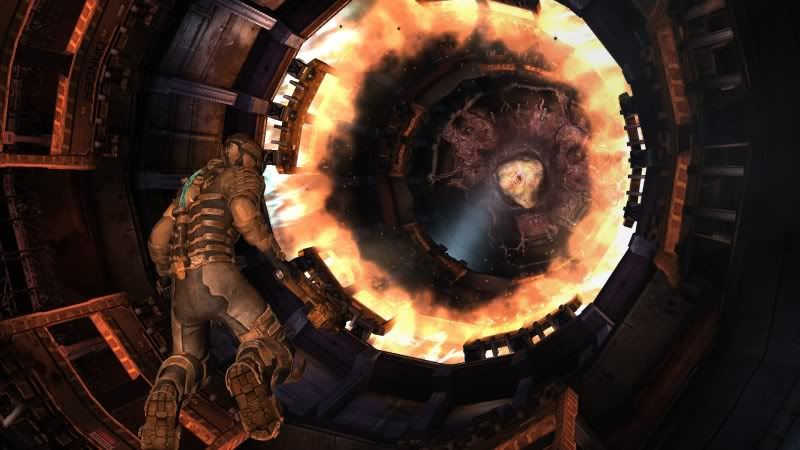
Dead Space 2 is a single player game, and that is a known fact. Implementation of a multiplayer mode was only a selling point to try and get more sales: "you can shoot 'dudes' online now!" Terse as this statement is, Dead Space 2's multiplayer is a welfare version of Left 4 Dead, where you play either the humans or the Necromorphs. Unless you have nothing better to do, I'd suggest staying very far away from this forced component.
Visceral has successfully brought Dead Space into the much-coveted position of solid, noteworthy games of 2011. Whilst its horror atmosphere and premise may not appeal to everyone, its solid shooting mechanics, outstanding visuals and brilliantly-paced design should. Here's to Dead Space, a horror series that the industry should be looking forward to seeing more of.
8/10 [?]
Labels: 2011, Andrew Whipple III, Dead Space, Dead Space 2, EA, PC, PS3, Review, Video, Video Review, Visceral Games, Xbox 360
- Andrew Whipple III

For me, every aspect of the Harry Potter franchise has been incredibly inconsistent in terms of quality. Whether it's the books, films or games, every time you think "yes, they've nailed this", a subsequent entry will probably leave you wondering what on earth went wrong. The books became somewhat convoluted with nonsense towards the end; the films have struggled more and more to turn the books into some sort of engaging or interesting spectacle; and the games have bizarrely got progressively worse as the technology has improved. The first few games on the PlayStation were charming, somewhat open-ended platform/puzzle games. The move to the PlayStation 2 era saw them take a disappointing step towards third-person action, and despite briefly flirting with a surprisingly well done open-world formula in Order of the Phoenix, the current generation of Potter games have become dull, tedious third-person shooters.
It shouldn't really be too much for Potter fans to expect a decent game from EA Bright Light, to send the series out with a bang. As it turns out, the developers have barely managed to send it out with a whimper with Harry Potter and the Deathly Hallows: Part 2.
It's hard to imagine that someone who hasn't either read the book or seen the film will play this game, and that's clearly what the developer thought as well when it came to telling the story. There is practically no narrative development at all. Characters will talk and chat about things that were - even as someone who had just seen the film that morning - leaving me scratching my head somewhat. The story-telling is practically non-existent, and doesn't really provide you with the basic gist of what's going on. The opening level sees you fighting your way through the caverns underneath Gringotts Bank, but unless you've seen the film, you'll have absolutely no idea how or why Harry, Ron and Hermione have ended up in such a place. It's as if someone threw the movie script into a bonfire, and any bits of paper that survived were used to craft the story for the game. The film's most memorable storytelling moments, such as Snape's memories, are not even referenced in the game. It's an absolutely botched attempt at telling a story, and for EA Bright Light to treat such dearly loved source material with so little care and attention will no doubt anger long-standing fans of the wizarding world.

The script is also littered with some absolutely woeful dialogue, and equally poor voice acting. Whoever takes on the role of Harry in this game makes the wooden Daniel Radcliffe seem like an Oscar-winning acting legend; that's how poor it is. The memorable moments from the film that were supposed to represent real drama are included in the game as stiff and boring cutscenes, with awful dialogue and laughable voice acting. They aren't helped by the fact that the character models just look plain creepy, almost like Madame Tussauds replicas of the actors having just begun to melt. Facial animation is distressing, to the point that it almost looks funny. The character likenesses are actually passable but, on the whole, they definitely fall on the wrong side of uncanny valley.
Unfortunately, the gameplay and level design lives up to the lacklustre presentation of the story and visuals, with derivative combat mechanics and repetitive level layouts coming together to create something that really doesn't feel like the magical world so many people have come to love. Rather than the the creative and imaginative environments of Hogwarts and other locations from past games, you'll be fighting through dank caverns, boring towns and the castle itself has been relegated to empty corridors and rubble. The environments are just plain dull, and the way in which the levels themselves are designed is incredibly repetitive. Predictable and boring use of cover is a key issue of the landscape, whether they're columns, walls or rocks, and the whole game simply ushers you through in a linear direction, as you move from boring combat encounter to yet another boring combat encounter.
Throughout the majority of the game, you'll be controlling Harry, with Ron and Hermione at your side, but the game tries to freshen things up by letting you play as other characters such as Neville Longbottom and Professor McGonagall at set points during the story. However, there is no difference in playing as these characters other than their appearance, which just makes it feel like a cheap attempt at fan service. There are no unique spells or combat moves, so each character is effectively just a skin. There's also no co-op play, which seems like an obvious element to include since you have other characters with you at all times. It probably wouldn't have made the game much more fun, but it would at least have made it quicker to complete; a good thing when the game is so bad that you just want it to end as quickly as possible. I completed the whole thing in just short of four hours, even shorter than Modern Warfare 2 took me, and the end simply couldn't come quickly enough.

All you do in Deathly Hallows: Part 2 is fight and run, and perhaps occasionally stop to collect an utterly pointless collectable. The collectables simply distracts from the main path, and the running only gets you to the next mind-numbingly dull battle. The combat is just plain boring, even though the developers have clearly been inspired by the likes of Gears of War, so much so that each spell is basically the equivalent of a widely-recognised weapon from such a game. You have a spell that acts much like a grenade launcher and one that seems to resemble a colourful machine gun; it really is the most uncreative use of the Potter license I can remember experiencing. Remember levitating objects with 'Wingadium Leviosa', or stunning enemies with 'Petrificus Totalus'? There's none of that here; each spell is just a slightly different way of killing someone. The only variation between the spells is that some can be more effective when dealing with certain situations that others; for example, there's a spell for dealing with enemies at long range. Honestly, though, it's basically just a colourful sniper rifle.
Combat is just incredibly unfulfilling, and not at all satisfying. Spells feel weak, as your Death Eater enemies will simply go up in a puff of smoke. The enemy AI is almost non-existent, as they will often just stand still waiting for you to kill them. Cover means you're basically indestructible, and I ran through the entire game whilst dying only once. And that was only when I was trying to shove Hermione out of cover to get her killed, because - quite frankly - the game itself was boring me to tears by that point. All the combat scenarios come straight out of the 'generic gaming clichés' box, with most of them taking the form of cover-based shooting. Occasionally, though, you'll run towards the camera whilst shooting behind you, as the game struggles to feel 'cinematic'. It fails miserably.
There's nothing to break the monotony, and none of the film's more creative set pieces are used. You don't get to ride the dragon out of Gringotts, nor are you able to fly a broom through the Room of Requirement. You do get to experience the flooding of the Chamber of Secrets, but it's been handled as if EA have no respect for the source material, akin to the rest of the game. Even the battle with Voldemort is painfully dull, as you just shoot puffy little spells at him until he falls over. And, then, you fist pump the air. Because it means the game is over and you can throw it away.

Just because I'm not completely heartless, I'll say something slightly positive: the game does make use of some of the music from the films, which is just about the only good thing I can say about it. There is also a relatively nice montage of every prior Potter game in the series just before the credits roll, but this just served to make me ask "What on Earth have you done to this series?" Because it used to be quite enjoyable.
Quite frankly, I cannot think of one person on this planet who'll find even one ounce of enjoyment in Harry Potter and the Deathly Hallows: Part 2. For gamers, this is an absolutely shoddy attempt at a third-person shooter, with boring combat and repetitive level design, that make it an absolute waste of your time when you consider the other games available in the genre. Even for Potter fans, though, this game is simply a waste of your money; the game treats the original stimulus with no sense of respect, with a botched script, poor visuals, awful voice acting and a measly four-hour runtime. The best thing you can glean from this game is the fact that it represents the end of the series. For those of you who are desperate for some Potter videogame fun, stick to the LEGO games.
2/10 [?]
Labels: 2011, 360, DS, EA, EA Bright Light, Harry Potter and the Deathly Hallows: Part 2, Lego Harry Potter, PS3, Review, Tom Acres, Wii
- Unknown
Subscribe to our content
and never miss a single thing

 subscribe to our monthly newsletter:
Our most recent writing

Our most recent reviews
Recent comments
All comments are subject to our commenting policy
Latest videos

Subscribe on YouTube

GGTL Classics
Some of the very best articles dug out from deep in the GGTL archives, written by some of our past and present wordsmiths alike.
Your continued use of this website and/or any others owned by Gamer's Guide to Life.com represents your acceptance and indicates your full understanding of all of our legal policies and terms. Our legal policies and terms are legally binding. If you in any way disagree with or refuse to be bound by any part of said legal policies and terms, you are advised to leave this website immediately.