 Follow us on Twitter: @ggtl
 Join our friendly community!


Latest news

 24.4.11


When the weather is warm I don’t want to play video games. My desire to sit glued to the TV wanes during the summer months. Life has more whimsy, more spontaneity and more nuance - not only does it seem a shame to lock myself inside during this time, but video games hardly seem like the right outlet for a sense of whimsy: doing something I do every other day of the year.
I once wrote an article about how video games are on a collision course with irrelevancy. I genuinely believe in everything I said in that article but its deficit was that it lacked specifics. I intentionally avoided citing many examples of what I found to be both vapid and worthwhile in video gaming because I have a difficult time touching on a topic and not digging down full steam.
I want to spend some time sharing video games I think are more than what we typically expect; titles that can be deep, expressive, exploratory, and even beautiful. It’s during these upcoming months when I’m most willing to expand my tastes; it’s summer, so let’s be more carefree, more expressive, more lustful, more sexy, more fun and more empathetic. Let’s be more everything.
Small Worlds
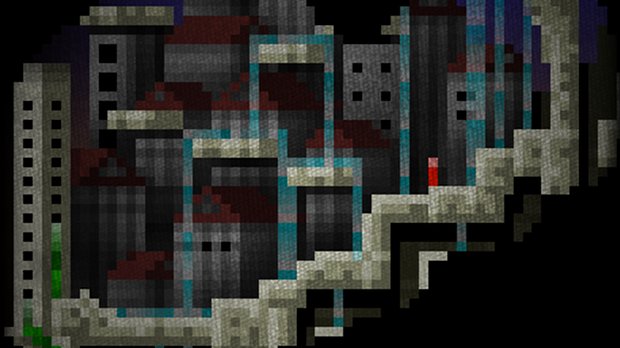
Open world games have lost their novelty for me since Super Mario 64. In their inception, they promised exploration, implying ostensibly limitless discovery. It was less a descriptor of how much freedom the game afforded you and more a promise of a world worth investigating every inch, not blowing everything up.
Nowadays, the term “open-world game” carries with it that very connotation of wanton destruction. Games like Just Cause and Red Faction unleash players into high-octane explosive playgrounds where environment and exploration are secondary to unrestricted fun. Destructive fun. The danger in that approach is that it abandons one of the core pleasures of being loosed into an imagined space - the simple joy of exploration.
Small Worlds exemplifies that core exploratory pleasure of open-world games. It’s a flash-based indie game about a series of 2D pixelated areas with no goal other than to discover what is around you. You play as a small anthropomorphic bunch of pixels that initially finds himself (or herself) encased in a glass bubble. The only visible way out is a tunnel through the floor. You can see nothing else. Your character is mostly surrounded by darkness, and soon finds that his or her only real option is to escape out of that opening. As you leave your hatch, you uncover more from the darkness as it gives away to a network of tunnels. The more you uncover, the more the camera pans away from your avatar, revealing the extent of the environment you’ve discovered. And there’s a lot to discover.
Small Worlds impresses because it’s a small indie game that executes the ideas behind open-worlds as well as, if not better than, any proper big-budget title. This should be a learning experience: whether you’re scaling buildings, driving stolen cars, or just running around, one of the biggest joys of an open-world environment should be the opportunity to simply exist there. There should always be a persistent sense of discovery.
There are blockbuster games that touch on this sentiment today. Red Dead Redemption crafted a western landscape that wasn’t necessarily always interesting to look at, but felt so legitimate that it was a pleasure to inhabit when the game required you traverse it, and was always good to allow appreciation for a sunset or a slow, winding basin trail. Likewise, Fallout 3’s environment was depressing, but its atmosphere was distinct, complete with its own self-deprecating tone and mid 20th century motif. Even Just Cause 2, with its emphasis on explosions and naive destruction, brandished an island with hidden pockets of peace where the ability to destroy suddenly halted in favour of a few fleeting moments of serenity.
Sometimes, it takes a bare-bones approach to distill the essence of what makes something valuable. Small Worlds takes this approach and encapsulates our basic ideas of exploration in a way that presents them equal to any element, quietly pleading game developers to take note.
Everyday Shooter

I generally loathe twin-stick shooters. Geometry Wars and the like just make me sick - I can’t deal with the amount of challenge those games ruthlessly pile on, and I don’t like feeling like the game is trying as hard as it can to make me fail, as though it were making fun of me. I don’t play games to be pummeled with challenge just for challenge’s sake.
The exception to this distaste is Everyday Shooter. Though it plays like most other twin-stick shooters, it’s in the area of presentation that Everyday Shooter becomes more than a trawl through bullet hell.
While it is definitely a video game, Everyday Shooter occasionally errs towards being a creative tool. One of the core concepts in Everyday Shooter is dynamic response: enemies are abstract geometric shapes that weave and swerve, not necessarily to destroy you (though they will), but also in rhythm to the beat and tone of the soundtrack, which is entirely guitar-based. When enemies are destroyed, guitar riffs and twangs plunk to signal victory; when combos are initiated, the riffs compound and complement each other as the combo increases. In a sense, enemies in Everyday Shooter function more as notes than hard obstacles. It’s synesthesia.
The design of Everyday Shooter a fairly simple system to interact with, but it’s built with some meaning behind it, adding a genuine sense of discovery to an otherwise tired game. It’s not a game I zone out while playing - it’s a game I can't help but think about.
Everyday Shooter differs from other abstract music games because it is less predicated on expression and more about the exploration of mechanics. While games like Electroplankton center around creating music, Everyday Shooter focuses on discovering music. Every level is different in its presentation of graphics, sound, and chaining system; level 4, for instance, has enemies that are more erratic, and they hide behind clouds of murk until you’re close. I kept dying on this level until I learned to be more patient in my movement and carefully hit smaller enemies, triggering smaller, quicker notes before advancing to the bigger baddies, which trigger large payoff riffs. This took a long time to figure out.
What does it mean in the context of creating music that I have to rub up against the enemies before I can even see them? What does it mean when the music itself is practically eluding me?
Everyday Shooter is a game that reorients your motivation to play while you’re engaged in it. It gives you a taste of what it’s like to contribute to something beautiful, and then it makes you fight for that right to contribute. There’s a struggle for creation here, a gem of euphony buried in the game’s mechanics.
When you finally unearth it, it’s nothing short of precious.
Mirror’s Edge

I first played Mirror's Edge during a stage when I was utterly bored and unimpressed by video games. I had bought a 360 in an effort to fertilize my interest in gaming, and Mirror’s Edge was just what I just happened to pluck off the bargain bin. It may very well have been one of the best quickfire purchases of my life. Mirror’s Edge is a game of simplicity, serenity, and most of all, beauty.
You probably know, but Mirror's Edge is a first-person parkour/free-running game for PS3/360 that mainly takes place on the rooftops of an urban-paradise. It's essentially a platformer with a focus on speed and fluidity of motion; the goal is to get from point A to point B as fast as possible.
Every time I play Mirror’s Edge I’m impressed. Not necessarily by the tightness of the mechanics or how much fun I have when I play (it’s often very frustrating), but by the way I feel when I play the game.
The caveat is that I’m one to be inspired by aesthetics, how nicely things look and feel, and that may not be the case for everyone. But I find Mirror’s Edge striking. It’s a game highly focused on environment and your interaction with it. You navigate a minimalist world muted in white, accentuated with drips of only the most vibrant colors that come to define particular areas: a soft swatch of green fills a massive cargo boat, hard yellows tense an ascent through a treacherous atrium, and a deep blue coats a skyscraper in the ultimate moments of the game. It’s a world that uses extreme simplicity to focus your attention.
In high school I was reading some venerated classics. The Great Gatsby, Our Town, The Grapes of Wrath, Kafka’s work, etc. And amongst those, I was playing Mirror’s Edge. All these works swirled in my mind and became a well of inspiration for me as I started to write my own fiction. I drew heavily from the feelings and images Mirror’s Edge swelled in me. There was suddenly beauty in walls and ceilings, vibrant color could bring me to tears and make me wistful. I wrote stories about lovers in elevators and swooned over the crunch of death that follows leaping off buildings.
It was like a virus. The serene minimalism and the way you interact with it infected my sense of beauty and mixed with my previous notions of what was aesthetically pleasing. I could hardly focus on tasks because I missed the simplicity of that world. It was the one time in my life when I genuinely yearned to relinquish myself to an imagined universe that seemed so much more profound, so much more a pleasure to inhabit than our own.
To me there is an ineffable quality to Mirror’s Edge. Something about its design is special in a way I can’t clearly express, partly because it’s personal and partly because the game itself is adequate explanation. That's something that makes me want to hang on to a copy long past its release, long into the future.
Labels: 2011, Everyday Shooter, Fallout 3, Indie, Just Cause 2, Mirrors Edge, Open World, Parker Scott Mortensen, Red Dead Redemption, Small Worlds
- Parker Scott Mortensen

Gaming. It is a past-time which is not only time-consuming, but can also be ridiculously frustrating, hugely expensive, addictive and full of gory shooty bloodiness. With such high price tags and demands on our time, it's a wonder that we even play games, let alone write about them.
Thing is, games are more than merely short-term entertainment. They, like any other form of media, tell stories, create worlds and allow us to experience danger and action safe in the comfort of our squashy living room chairs. And, as such, we'll always manage to find that extra fifty pounds in order to pre-order that latest announced title, before playing it in a freezing cold house because you could no longer afford to keep it heated.
Without further ado, the following list gives some insight into my favourite games of the last year, that I'd be prepared to sleep rough, go without food or wrestle a mole rat for. Read, and jouirez-vous.
5: Just Cause 2

You can call me old-fashioned, but there's something about grapple hooks that just never gets tiring. Add in a mahoosive game world - which takes three weeks and a Ray Mears-esque survival instinct to cross - some guns, free-roaming gameplay and a cheesily over-acted storyline, and you have Just Cause 2: a sandbox shooter with just enough 'liberate-poverty-stricken-country-from-unjust-corrupted-government' storyline to give at least some context to the mindless violence.
It is, in some ways, like a Carry On: a complete shambles, but one which just keeps you coming back, addicted like you're on some sort of audio-visual ketamine. It's cheesy, yes - incredibly so - but what it does, it does very well.
Just Cause 2's shooting feels solid (even though enemies seem to be able to take bullets to the chest as if they're sponges made from feathers and fairy-dust), abilities such as the grappling and skydiving are nice and the sandbox design gives a real sense of scale that far surpasses anything else I've really played: you really feel like a single person, stuck on a massive archipelago of foreign islands against a country's entire military.
It might not be awe-inspiring, and it certainly isn't revolutionary, but it's a blast nonetheless.
4: LEGO Harry Potter: Years 1-4

The meaning of the 'Lego' brandname - 'play well' - has never been more applicable to a game than when it comes to LEGO Harry Potter: Years 1-4, the plastic-brick version of the murderous baby who ruthlessly slayed the poor, innocent, saintly Lord Voldemort, before arrogantly swanning about, scar atop head like some grotesque power symbol, repeatedly attacking members of the friendly hobbyist group known as the 'Death Eaters' for some sick sense of fun, and generally being an arrogrant little...
As I said in my review of the game, Traveller's Tales have done a commendable job of porting the Harry Potter brand - a famously tricky one to get right in videogames - into a game that is not only fun to play, but is fantastically comic, charming and family-friendly.
Yes, it has some problems, but they're few and very far between. It plays excellently, as do all the other LEGO-brand games, with some truly wonderful little details and additions; the humour is clean, clever and genuinely laugh-out-loud; the Potter canon is excellently implemented and the LEGO aesthetic gives everything that happy-go-lucky, innocent glow that you saw the world through when you were little.
LEGO Harry Potter: Years 1-4 is my 'Games of 2010' recommendation for fans of the boy wizard, fans of small, Danish plastic bricks or fans of games.
3: Need For Speed: Hot Pursuit

Generally, I wouldn't count myself a fan of racing games. First of all, they bore me out of my head; and secondly, there's something about the thought of having my various limbs ripped off me in an 142mph crash of crumpling metal, plastic and glass that doesn't appeal to me all that much.
There have only been two games which overcame the aforementioned issues preventing my enjoyment of racers. The first, needless to say, would be Burnout Paradise, the sandbox racer that conspired in every way to endlessly punish you with metally, crashy death for the slightest mistake. Criterion did everything right with Paradise, and created one of the only racing games that I have consistently returned to since purchasing it.
And then Criterion took all that knowledge, and one-upped Paradise, thus creating the second racing game I enjoyed: Need For Speed: Hot Pursuit.
The classic 'cops vs robbers' chase situations are done perfectly, and the game has such a realistic sense of speed and danger that excitement is outweighed only by the adrenaline pumping around your veins. The Autolog system is fantastically developed and works really well, looking at online gaming from a whole new angle. It's a polished package that left a lasting impression with me, and is certainly one of the best handling, best-looking racers of the last year.
2: Assassin's Creed Brotherhood

I could talk about - and have talked about - the Assassin's Creed series until I am blue in the face. When the third game in the series, Assassin's Creed Brotherhood, graced our screens, I was ready to cry from the rooftops about it, like the Renaissance heralds you'll find scattered around the game's locales.
I didn't, of course - mainly because getting onto my roof is such a damn hassle - but instead decided to get down to reviewing the game. And I certainly found alot to say on it, with a gargantuan review which came close to doing accurate justice to what is, undoubtedly, a truly excellent game.
Whether I could ever do proper justice to a game like Assassin's Creed Brotherhood, though, is beyond my ability to predict. As usual, the combat is to the utmost level of quality, the parkour aspects are as good as it ever was, and the additions to the series - particularly the multiplayer, but just as much the little things - make it a stellar title and one which nicely opens up the door for further series expansion.
1: Fallout: New Vegas

Where the genius lies in the Obsidian-developed Fallout titles is difficult to pinpoint. Personally, I consider Fallout - and, narrowing that down, Fallout: New Vegas - to be the perfect storm: a combination of devastating elements which, when they come together, create something electrifying, exhilirating. Fallout: New Vegas is a force to be reckoned with.
I think that part of what makes New Vegas so inexhaustively excellent is that, at its core, it is the most subjective game I've ever played.
Allow me to explain. Every person I know who has played either New Vegas or its little, less-refined brother, Fallout 3, cite a different reason for why they fell in love with the series. Some say that the combat is what attracts them so much. Others cite the post-apocalyptic, dystopian society in which the game is set as the key factor in what sets Fallout apart. Either way, it's a game that seems to impact people differently, and it allows people with very different play styles to access the game and still enjoy it.
For me, the thing that I always find enthralling is the depth and deft weaving of Fallout's storyline and canon, combined with the unique moral choices which shape the course of the storyline differently for each person. Different choices in different situations can have drastically varying consequences, which creates some unique emotional and moral dilemmas which just aren't available in any other title. The storyline is generously smattered with sly hints to earlier Fallout titles, as well as the general canon of the game (which, if you didn't know, is huge: see The Vault, the Fallout wiki to see just how much the series packs in).
The game also has a good level of replayability, due to the diverse multitude of locations, characters and loot to find on your stumblings through the wastes of the Vegas area. Starting a new game from the beginning and, instead of following your original path from your first playthrough (usually to the first objective), can lead to a very different experience of the game, with the discovery of new places, people and quests. Fallout: New Vegas is jam-packed full of variety and the unique choices through the game serve excellently to ensure that every gamer has a very different experience of the same game, whilst still delivering the goods.
New Vegas isn't without its problems, but they're the same ones that plagued Fallout 3, and no-one seemed to care then. The game will often stutter, there are issues with 'popping' due to the short draw distance for detail objects, game crashes aren't unheard of, and companions can often be a hindrance rather than a help. However, when playing New Vegas, the bugs are often outweighed by the mere awe-factor that at least I felt during play.
Still, what is the opinion of an unknown, lowly, independent games journo like me worth? Well, perhaps these quotes from well-known critics will be able to quell your fears about the game, and show you just why Fallout: New Vegas deserves my top-spot in my 'Games of 2010'.
"The fact that the many issues with glitches and bugs weren’t ironed out of this release would be unforgivable if the core game wasn’t so tirelessly compulsive and complex. [...] If you don’t mind working around them then this could be a game of the year contender."
- Peter Chapman, TheSixthAxis.com
"Fallout New Vegas is a fantastic game that in its vast, interesting, flavour-filled world has something for everyone. I could say that I’ve not loved the last thirty hours, and don’t expect to spend another thirty more, but ‘It’s a sin, to tell, a lie’."
- Reece Warrender, Console Monster
"While New Vegas is unmistakably built upon the fundamental gameplay and structure laid out in Fallout 3, it’s a formula that any student of that game will be happy to see repeated, and Obsidian’s numerous embellishments result in what is, in many respects, a deeper and more compelling experience."
- gamesTM
"Fallout: New Vegas is the game that many wanted Fallout 3 to be. It's harder, more ruthless, better written and more morally ambiguous. It's a game we’ve been wanting to play for more than a decade, a real modern re-imagining of the Fallout series, complete with that deliciously black humour. [...] If Obsidian were to make another Fallout game, we certainly wouldn't say no."
- Keza MacDonald, IGN UK
"Fallout: New Vegas is an expansive and complicated RPG that encourages you to see and do as much as you can. This is an explorer's game, always lavishing new and interesting quests on you and giving you a lot of flexibility in how you approach many of them. It builds upon Fallout 3's mechanics in interesting and esoteric ways, making it a comfortable evolution to one of 2008's best games. [...] Fallout: New Vegas is periodically awesome and consistently compelling.
- Kevin VanOrd, GameSpot
Fallout: New Vegas is a game which, despite the common bugs, never fails to impress. For the ridiculously cheap amount you can get it for now, its an investment that will tide over twenty or more hours of gaming time with its incredibly deep storyline and variety.
Cheapest Fallout: New Vegas prices:
£13.99, Amazon.co.uk
£26.99, Play.com (UK)
£16.99, Play.com (UK)
Labels: 2011, Assassin's Creed, Assassin's Creed II, Fallout, Fallout: New Vegas, Games of 2010, Just Cause 2, Lego Harry Potter, Lego Harry Potter: Years 1-4, Linford Butler, Need For Speed: Hot Pursuit
- Linford Butler

With Just Cause 2 only weeks away from release, people have been gearing themselves up for the sandbox blow-'em-up by messing around on the demo. And, of course, a lot of messing around always involves a bus or two...
On PC, a user has managed to get 20 dual hooks and tie them all to buses, just waiting to fall of a rather steep cliff. As you can imagine, he sets the first one rolling, and they all topple down. It beautifully shows of Just Cause 2's amazing graphics, brilliantly over the top physics and..some bus sex?
You can watch the video here.
The game's out on the 26 March.
Labels: Chris, Chris Hawke, Just Cause 2, PC
- Chris Hawke

Yet another take on the genre comes in the form of the Just Cause series. It takes from almost every other type of free roamer. The insane stuns from Crackdown and destruction from Mercs, mixed together in one big pot of manic action. The first game was rather successful... bar a few problems. One of which was the vast amount of unpopulated land you had to travrse.
The sequel is way into development and is heading to PC, Xbox and PS3 at the start of 2010. So far, is shaping up pretty well using the Avalanche Engine 2. And Avalanche have decided to put their fans into the game.
A current competition is running on the viral site for Just Cause 2. All you have to do is fill in the form and one of the 5 generals could take your name in game. Yes that right, people could be getting commanded by YOU! Or at least a virtual character with your name.
Heres a link to the site. Its about half way down the page. Good Luck!
Jacques
Labels: Competition, Jacques Hulme, Just Cause 2
- Anonymous
Subscribe to our content
and never miss a single thing

 subscribe to our monthly newsletter:
Our most recent writing

Our most recent reviews
Recent comments
All comments are subject to our commenting policy
Latest videos

Subscribe on YouTube

GGTL Classics
Some of the very best articles dug out from deep in the GGTL archives, written by some of our past and present wordsmiths alike.
Your continued use of this website and/or any others owned by Gamer's Guide to Life.com represents your acceptance and indicates your full understanding of all of our legal policies and terms. Our legal policies and terms are legally binding. If you in any way disagree with or refuse to be bound by any part of said legal policies and terms, you are advised to leave this website immediately.