 Follow us on Twitter: @ggtl
 Join our friendly community!


Latest news

 21.11.11


Squaresoft, one of Square Enix’s pre-merger companies, has made some of the most celebrated games of all time.
Arguably their best work was produced in the mid- to late-90s, on the SNES and PlayStation. Of their many classics, few are in as high regard by gamers as Final Fantasy VI and Chrono Trigger for the SNES. Released a year apart from one other, in 1994 and 1995 respectively, both FFVI and Chrono Trigger have had a resounding impact on the RPG genre. Both titles are fondly remembered even today, and remain mainstays on many gaming publications’ 'Greatest Games of All Time' lists.
Of the two, though, Final Fantasy VI is often remembered as the better, placing higher on the same Greatest Games lists, and enjoying greater notoriety than Chrono Trigger’s relative level of obscurity. This cannot do. As someone who has played and loved both titles, I can say without reservation that Chrono Trigger is the crown jewel of Square’s SNES catalogue, and better than Final Fantasy VI in many respects.
You ask for a reason? Here are ten of them.
1: Combat is much more fun

Whilst the story in Final Fantasy VI is rightly adored, at the end of the day, games are meant to be played, and this is where Final Fantasy VI starts to lose some steam to Chrono Trigger. Compared to the stiff, lifeless battles in Final Fantasy VI, Chrono Trigger boasts an exciting, dynamic take on the Active Time Battle system. Characters actually seem to occupy the same physical space as enemies, and the small idle animations give each monster and ally a feeling of life, rather than an ornate, but ultimately static, picture of opponents. Also, whilst FFVI bestows each character with different abilities for use in battle - Locke can steal, Cyan can use Sword Tech, etc. - none of them are as fun to use as the Inventive Tech system, a variation on magic that allows different characters to combine their powers into an über-attack.
2: Better-looking characters and backgrounds

Perhaps it isn't fair to call out an older game for looking worse than a newer one, but Chrono Trigger’s sprite work is easily superior to Final Fantasy VI’s. Whilst series stalwart Yoshitaka Amano’s lovely art direction isn’t necessarily worse than Akira Toriyama’s work on Chrono Trigger, the world and characters in Chrono Trigger look much better-realised, with brighter colours, more environmental detail and far more expressive character sprites for each of the cast. Modern consoles will become more and more powerful as time goes by, but there will never be a day when Chrono Trigger is not a beautiful game.
3: Leaner, more-focussed experience

Final Fantasy VI is an epic, grand tale of many characters, locations and plot points, taking anywhere between 35 and 60 hours to complete, depending on your level of thoroughness. Chrono Trigger, whilst telling a story spanning across time, has fewer characters and locations, making its play time something more like 15 to 20 hours (again, dependent on thoroughness).
Why is this a plus? Chrono Trigger has much better pacing throughout, and its comparable brevity makes it easier to revisit (more on this later). Final Fantasy VI is replete with well-written characters, each of which are fleshed out (yes, even Gau...), but it’s easy for members of the cast to get lost in the sauce. Chrono Trigger - whilst not necessarily featuring characters as complex - features fewer characters painted in broader, but no less loving, strokes, resulting in a more memorable cast of digital thespians. Perhaps it’s personal preference, but I would rather have a slightly shorter, more-focussed game I could replay often (see also Super Mario RPG), than a sprawling, overly-long game that I would never want to sit through again (see also Final Fantasy VII).
4: Greater sense of imagination and place

The steampunk vibe of Final Fantasy VI is undoubtedly pretty damn cool. Steam-powered armour, subterranean castles and an Orwellian research facility for magic contribute to FFVI’s sense of aesthetic. That said, there are just as many bland, generic towns dotting the map face are there are memorable locations. Chrono Trigger’s world is smaller than FFVI’s, but it presents six variations of each location, depending on when you visit it. These range from prehistoric mud huts, to lively modern fair grounds, to post-apocalyptic domes. FFVI’s appeal lies in the subtleties of the locales, whilst Chrono Trigger’s settings are distinct from the moment the player steps foot in them.
5: Visible enemies

Let’s face it; one of the most tedious parts of JRPGs is the random encounter. No one likes being lost in a dungeon and exploring the place, only to be interrupted by a new battle every four or five steps. Like many JRPGs at the time, Final Fantasy VI suffers from this problem. Unlike many JRPGs at the time, Chrono Trigger - thank goodness - doesn’t. Every monster roams about the dungeon, allowing players to choose when they want to fight - if they want to fight at all. Granted, some areas are impossible to get through without first defeating some enemies, and foes will occasionally spring an ambush, but for the most part, there is no fighting in Chrono Trigger that is out of the will of the player.
6: Player impact on the world

Final Fantasy VI lets players follow along with its well-told and entertaining narrative, but they’re never given a chance to really impact the world with their decisions. Near the end of Chrono Trigger, players are offered a host of optional sidequests throughout different points in time. These quests, whilst not essential in order to finish the game, create visible changes within the game world, letting players alter history, and sometimes the result is not always what the player was expecting. There are also a few other moments of player choice-impact scattered throughout the main quest, but far be it for me to spoil them here.
7: 'New Game +'

Perhaps the single greatest gift to RPGs, and one of the greatest to gaming as a whole, is 'New Game +'. For the uninitiated, 'New Game +' is the option to start a new game, but retaining all previous experience, equipment, money and items collected on your first playthrough. Not only does this offer a great opportunity to absolutely destroy challenging sections of the game, but, in Chrono Trigger, it also gives way to...
8: Multiple Endings

Why bother to go through Chrono Trigger at all once it’s been beaten? The promise of new endings, of course! Chrono Trigger features thirteen different endings, which vary depending on when players decide to challenge the final boss, a challenge which can be undertaken at almost any time from the outset. Endings vary based on who is in the party and during which events the boss is fought. The endings range from good, to bad, to out-and-out strange, with the weirdest breaking the fourth wall entirely. An excellent incentive to relive the title’s finest points, multiple endings give Chrono Trigger an added sense of personality, as well as a stratospheric ceiling of replay value.
9: Many, many small presentation- and gameplay-related reasons

Again, perhaps it’s not fair to condemn a game for not having the small fixes made by its successor, but it’s these small fixes that make Chrono Trigger a much better-playing game. Characters in Chrono Trigger can move in eight directions, feeling much less stiff than the north-south-east-west mobility of Final Fantasy VI. Rather than having to equip an item to run, players can simply hold down a button to move faster. Characters that go unused in battle still level up (though they don’t gain new Tech abilities). When going from exploring to a battle, the game stays on the same screen, instead of breaking the flow and transitioning to another one. Chrono Trigger possesses numerous small fixes that ultimately add up to a better gaming experience, and one that has aged much more gracefully than its more highly-praised brethren.
10: Magus

C’mon.
That isn't to say that Final Fantasy is somehow a bad or inferior game. Far from it. Final Fantasy VI’s grand, epic story and deeply memorable score are just two of many reasons to love it unreservedly. That said, I hold Chrono Trigger closer to my heart, and it will always be my favourite over Final Fantasy VI. Fortunately, both are available on the Wii’s Virtual Console for a measly 800 Wii Points (around $8, or £5.60), giving gamers a better opportunity than ever to experience two of the greatest games of all time. Want to really decide which is better? Snap them both up, and decide for yourself.
Do you think Chrono Trigger is the better of the two, or does your heart lie with Final Fantasy VI? Let us know in the comments, or Tweet us your opinions via the Gamer's Guide to Life.com Twitter account.
Labels: 2011, Andrew Testerman, Chrono Trigger, DS, Final Fantasy VI, Game Boy Advance, PlayStation, Super Nintendo
- Andrew Testerman

Yesterday, Nintendo announced they will be drastically cutting the price of the Nintendo 3DS from $249.99 to $169.99 starting in August. This comes as little surprise, considering the 3DS’s already-slow sales, and the PlayStation Vita’s similar price for significantly more hardware. The upcoming price drop, along with the Vita’s rumoured 2011 launch, paint a rosy picture for handheld gamers come this autumn. Some in the industry, though, still wonder if it’s all too little, too late.
Gaming on iOS or Android has taken a good chunk out of the portable market (Nintendo has basically said so itself), and it bears asking if consumers want to carry yet another device around when their phone can already do the job. Why break out the DS and fire up Dragon Quest IX when Cut The Rope is just a few taps away?
Personally, I think they’re apples to oranges, and here’s why.
Let me begin by saying that I quite enjoy mobile gaming on my phone. The Tetris app was one of the first things I bought when I got my Droid 2, and I’ve got through many a waiting room with the help of Peggle. I appreciate the convenience of playing a game when I only have five minutes to spare, and agree with the assessment that the handheld gaming landscape has improved since the iPhone helped usher in a new paradigm of gaming on the go.
That said, I don’t believe that the DS and PSP will fade into obscurity, simply because I can play a few rounds of Angry Birds in the time it takes me to actually start a game on my DSi XL. Whilst less convenient than their phone-based brethren, games on handheld consoles like the DS and PSP still possess several qualities that titles found in the App Store or Android Market do not.
For starters, games found on DS and PSP generally offer meatier, more substantial experiences than phone-based games. True, titles like Infinity Blade and Zenonia 3 push closer to the sort traditional, deeper gameplay found on handheld consoles, but games like that are few and far between, and many of the top-selling titles on the App Store are short, time-killing experiences. By contrast, games like God of War: Ghost of Sparta or Castlevania: Order of Ecclesia provide full gaming experiences whilst still being suited to the portable realm. Though iOS and Android devices offer many options when it comes to gaming, a good deal of them are small, intermittent affairs.
And, really, it’s just as well. Whilst it’s easy to decry iOS and Android games as simplistic and lacking in depth, that fact is that deep, 'full' games like Uncharted or Super Mario World would not fit as well into the phone gaming space, when every level and gameplay moment has the potential to be interrupted by a simple phone call. As nice as it would be to have a multitude of Metroidvania or RPG titles in the phone gaming space, many who play phone games don’t always have the patience or time for a developing experience in the same way as they might on another system.
Then there’s the matter of phone hardware itself. One of my pet peeves about my phone is charging it more than once a day if I’m using it heavily. What with talk time, text messaging and internet browsing, I’m generally lucky if I can make it until the afternoon without plugging in my Droid, and extensive gaming can only further drain the battery. If I’m on a road trip or a plane journey, I generally feel better about using my DS for gaming simply because I know that, when I arrive, I won’t be stranded with a dead mobile phone. Also, whilst companies like Gameloft can do their best to emulate console controls on a touchscreen, 'core' games like shooters or precise platformers generally feel better with buttons; there’s a reason why people are making such a big deal about the Vita’s second analogue stick.
Nowhere is it written that this surge of activity in the phone gaming space will mean the death of Nintendo and Sony’s stake in the portable realm. Rather, it means that gamers have a greater breadth of content to choose from than ever, with room on the market for both the casual experiences on mobile phones and in-depth experiences on DS and PSP.
Labels: 2011, 3DS, Andrew Testerman, DS, Feature, iPhone, Mobile, PlayStation Vita, PSP, Vita
- Andrew Testerman

For me, every aspect of the Harry Potter franchise has been incredibly inconsistent in terms of quality. Whether it's the books, films or games, every time you think "yes, they've nailed this", a subsequent entry will probably leave you wondering what on earth went wrong. The books became somewhat convoluted with nonsense towards the end; the films have struggled more and more to turn the books into some sort of engaging or interesting spectacle; and the games have bizarrely got progressively worse as the technology has improved. The first few games on the PlayStation were charming, somewhat open-ended platform/puzzle games. The move to the PlayStation 2 era saw them take a disappointing step towards third-person action, and despite briefly flirting with a surprisingly well done open-world formula in Order of the Phoenix, the current generation of Potter games have become dull, tedious third-person shooters.
It shouldn't really be too much for Potter fans to expect a decent game from EA Bright Light, to send the series out with a bang. As it turns out, the developers have barely managed to send it out with a whimper with Harry Potter and the Deathly Hallows: Part 2.
It's hard to imagine that someone who hasn't either read the book or seen the film will play this game, and that's clearly what the developer thought as well when it came to telling the story. There is practically no narrative development at all. Characters will talk and chat about things that were - even as someone who had just seen the film that morning - leaving me scratching my head somewhat. The story-telling is practically non-existent, and doesn't really provide you with the basic gist of what's going on. The opening level sees you fighting your way through the caverns underneath Gringotts Bank, but unless you've seen the film, you'll have absolutely no idea how or why Harry, Ron and Hermione have ended up in such a place. It's as if someone threw the movie script into a bonfire, and any bits of paper that survived were used to craft the story for the game. The film's most memorable storytelling moments, such as Snape's memories, are not even referenced in the game. It's an absolutely botched attempt at telling a story, and for EA Bright Light to treat such dearly loved source material with so little care and attention will no doubt anger long-standing fans of the wizarding world.

The script is also littered with some absolutely woeful dialogue, and equally poor voice acting. Whoever takes on the role of Harry in this game makes the wooden Daniel Radcliffe seem like an Oscar-winning acting legend; that's how poor it is. The memorable moments from the film that were supposed to represent real drama are included in the game as stiff and boring cutscenes, with awful dialogue and laughable voice acting. They aren't helped by the fact that the character models just look plain creepy, almost like Madame Tussauds replicas of the actors having just begun to melt. Facial animation is distressing, to the point that it almost looks funny. The character likenesses are actually passable but, on the whole, they definitely fall on the wrong side of uncanny valley.
Unfortunately, the gameplay and level design lives up to the lacklustre presentation of the story and visuals, with derivative combat mechanics and repetitive level layouts coming together to create something that really doesn't feel like the magical world so many people have come to love. Rather than the the creative and imaginative environments of Hogwarts and other locations from past games, you'll be fighting through dank caverns, boring towns and the castle itself has been relegated to empty corridors and rubble. The environments are just plain dull, and the way in which the levels themselves are designed is incredibly repetitive. Predictable and boring use of cover is a key issue of the landscape, whether they're columns, walls or rocks, and the whole game simply ushers you through in a linear direction, as you move from boring combat encounter to yet another boring combat encounter.
Throughout the majority of the game, you'll be controlling Harry, with Ron and Hermione at your side, but the game tries to freshen things up by letting you play as other characters such as Neville Longbottom and Professor McGonagall at set points during the story. However, there is no difference in playing as these characters other than their appearance, which just makes it feel like a cheap attempt at fan service. There are no unique spells or combat moves, so each character is effectively just a skin. There's also no co-op play, which seems like an obvious element to include since you have other characters with you at all times. It probably wouldn't have made the game much more fun, but it would at least have made it quicker to complete; a good thing when the game is so bad that you just want it to end as quickly as possible. I completed the whole thing in just short of four hours, even shorter than Modern Warfare 2 took me, and the end simply couldn't come quickly enough.

All you do in Deathly Hallows: Part 2 is fight and run, and perhaps occasionally stop to collect an utterly pointless collectable. The collectables simply distracts from the main path, and the running only gets you to the next mind-numbingly dull battle. The combat is just plain boring, even though the developers have clearly been inspired by the likes of Gears of War, so much so that each spell is basically the equivalent of a widely-recognised weapon from such a game. You have a spell that acts much like a grenade launcher and one that seems to resemble a colourful machine gun; it really is the most uncreative use of the Potter license I can remember experiencing. Remember levitating objects with 'Wingadium Leviosa', or stunning enemies with 'Petrificus Totalus'? There's none of that here; each spell is just a slightly different way of killing someone. The only variation between the spells is that some can be more effective when dealing with certain situations that others; for example, there's a spell for dealing with enemies at long range. Honestly, though, it's basically just a colourful sniper rifle.
Combat is just incredibly unfulfilling, and not at all satisfying. Spells feel weak, as your Death Eater enemies will simply go up in a puff of smoke. The enemy AI is almost non-existent, as they will often just stand still waiting for you to kill them. Cover means you're basically indestructible, and I ran through the entire game whilst dying only once. And that was only when I was trying to shove Hermione out of cover to get her killed, because - quite frankly - the game itself was boring me to tears by that point. All the combat scenarios come straight out of the 'generic gaming clichés' box, with most of them taking the form of cover-based shooting. Occasionally, though, you'll run towards the camera whilst shooting behind you, as the game struggles to feel 'cinematic'. It fails miserably.
There's nothing to break the monotony, and none of the film's more creative set pieces are used. You don't get to ride the dragon out of Gringotts, nor are you able to fly a broom through the Room of Requirement. You do get to experience the flooding of the Chamber of Secrets, but it's been handled as if EA have no respect for the source material, akin to the rest of the game. Even the battle with Voldemort is painfully dull, as you just shoot puffy little spells at him until he falls over. And, then, you fist pump the air. Because it means the game is over and you can throw it away.

Just because I'm not completely heartless, I'll say something slightly positive: the game does make use of some of the music from the films, which is just about the only good thing I can say about it. There is also a relatively nice montage of every prior Potter game in the series just before the credits roll, but this just served to make me ask "What on Earth have you done to this series?" Because it used to be quite enjoyable.
Quite frankly, I cannot think of one person on this planet who'll find even one ounce of enjoyment in Harry Potter and the Deathly Hallows: Part 2. For gamers, this is an absolutely shoddy attempt at a third-person shooter, with boring combat and repetitive level design, that make it an absolute waste of your time when you consider the other games available in the genre. Even for Potter fans, though, this game is simply a waste of your money; the game treats the original stimulus with no sense of respect, with a botched script, poor visuals, awful voice acting and a measly four-hour runtime. The best thing you can glean from this game is the fact that it represents the end of the series. For those of you who are desperate for some Potter videogame fun, stick to the LEGO games.
2/10 [?]
Labels: 2011, 360, DS, EA, EA Bright Light, Harry Potter and the Deathly Hallows: Part 2, Lego Harry Potter, PS3, Review, Tom Acres, Wii
- Unknown

It’s 2000, and I’m driving down the interstate with my mother. Canyons and trees pass my window, and the road rushes beneath us with great speed, but I’m locked in mortal combat with a Club Master in Pokémon Trading Card Game for my Game Boy Color. I’ve been down three prizes the whole match, but I’ve finally managed to turn the tables on this Electric-type-using card shark, defeating him with my Sandslash. Throwing up my hands, I recline in my chair, gazing at the beautiful landscape flying by, relishing my victory.
Portable gaming has been a staple of my virtual diet for nearly fourteen years, and is as dear to me now as when I first picked up my trusty Game Boy at the age of ten. If there’s a time when my love of all things handheld comes to the front, though, it’s during the June-through-August period when the sun is shining, the birds are chirping, and it’s too damn hot to go outside. That’s right; summer is my time for gaming on the go, and arguably the best time for anyone with a knack for portable gaming.
The most obvious reason why consoles like the DS and PSP see more play from me during summer is because, historically, people tend to travel more during the summer months. Whether it’s a flight to see distant relatives, or merely a long car trip to see the Biggest Ball of Twine in Minnesota, portable games play an invaluable role in staving off boredom during extended periods of travel or sitting around. In some cases, they even add to memories of the trip; I find myself looking back on vacations past and remembering how much fun I had with certain games in certain places.
It’s 2003, and I’m dockside at Lindbergh Lake. My parents are vacation, so I’m staying with my grandma in their absence, and we’re spending the day at the family cabin. The Ataris’ 'So Long Astoria' blares from my Discman, and the orange early-evening light tells me the sun is just starting to descend towards the mountains. I pull my sunglasses back down my face and get back to my game, Super Mario Advance 2: Super Mario World for the Game Boy Advance. I look around at the many trees surrounding the lake, and back at the Game Boy screen, where I start a level in the Forest of Illusion. I smile to myself as I imagine what sorts of adventures I would have if our trees were teaming with Goombas and Piranha Plants.
Depending on the game I’m playing, I’ve even found aspects of my vacations are affected by what I’ve been rocking on my DS or PSP. If I’m playing a JRPG like Legend of Heroes or Pokémon, unfamiliar locales become strange and foreign lands to explore, where - in the right mindset - something as mundane as a trip to the grocery store can take on a quest-y aspect. If I’m playing a fighting game, new city streets and clearings become potential grounds for my character to lay some smack down. If I’m playing a platformer, you’d better believe I’m spending my time looking for those nooks and crannies where hidden collectables are sure to be found. Perhaps it sounds a bit mental, but a little imagination helps keep my vacation time fresh, and I channel my games for inspiration.
It’s 2006, and I’ve just woken up in my family’s hotel room. I can’t believe how lucky I am at having the chance to holiday in Italy for my stepdad’s family reunion, but the airline misplaced our luggage, and now we don’t have the requisite plug adaptors needed for our electronics. After dressing, I switch on my DS as I wait for the elevator. I take in the cool, mocha-colored tiles and spindly metals of the elevator shaft before starting the only game I know I can enjoy while conserving battery life: Brain Age, which I bought at the behest of the many gaming publications I follow. As I tap the large, disembodied face of Dr. Ryuta Kawashima, I groggily reflect that it may even help to wake me from my tired torpor before the day begins.
Portable games can also be similar to summer books. By now, umpteen “Summer Reading” lists have made their way onto various news sites and blogs, suggesting several books for vacation-goers to chew through during their leisure period; books of epic tales, true stories, pulpy thrills and new ideas. As gamers, we too have access to rich narratives, escapist pleasures and enjoyable time-wasters, all accessible from the palm of our hands. Perhaps gaming publications should put out a “Summer Playing” list, for gamers looking to kick it by the pool or camp out under the stars.
Then again, a summer playing list could come in handy for any gamer for one simple reason: the drought. Whilst movie studios treat the summer season as an excuse to through summer tentpole after summer tentpole at filmgoers, game publishers have historically been tepid about releasing their precious triple-A franchises outside of the holiday season, leaving the June-through-August season barren and empty, with only a few notable exceptions. During this time of seldom releases, players can catch up on notable handheld games they may have missed whilst on holiday (and this year, we’ve had some good ones).
It’s 2007, and I’m sitting in car with my best friend. After eight hours of driving and rest stops, we’ve finally reached Salt Lake City, and are setting up our tents at the KOA ground we rented. Dilated Peoples are pumping out of the stereo as everyone takes a break, tired from the trip but excited for our day at the Warped Tour the next morning. I’m finding my Zen place, unwinding with my copy of Planet Puzzle League for the DS. Dragging and shifting differently-coloured blocks around, I feel myself becoming aware of my friends outside, the rhythm of the music, and the camaraderie we’re all sharing in the calm before the oncoming storm. The blocks reach the top of the screen, and I close my DS and move towards the campsite, ready to sleep and meet the Warped Tour madness in full effect tomorrow.
Even for players who don’t normally play DS or PSP, summer provides ample opportunity to experience the joys of gaming on the go. Whether it’s exploring new lands whilst lying on the beach, going for a high score during family downtime, or simply trying to get through six hours of extended air travel, portable games are at their best during the season of high temperatures and vacation time, and summer simply wouldn’t be the same without them.
It’s 2010, and I’m back at the lake. The weather has been unseasonably rainy for the past two days, and my family is huddled by the fireplace. It’s dark outside, and there’s mist over the mountains, giving the warm interior of the cabin a cozy feeling. My mom is reading a Dan Brown novel, my friend flips through an old Carl Barks Donald Duck comic book, and I’m wrapped in a blanket by the window, playing Lumines for the PSP. The bright colours and hypnotic pulse of the music provide a cheerful distraction to the grey exterior as everyone finds their own ways to entertain themselves. I glance out at the water one more time, reflecting on how fortunate I’ve been to have such amazing experiences with my family and friends, and thankful for all of the fond memories I’ve experienced with the help of portable gaming.
Labels: 2011, Andrew Testerman, DS, Feature, Gameboy, Portable, PSP
- Andrew Testerman

"If Michael Vick was sent to prison, Ash Ketchum should be in fucking jail."
These words, slurred in my direction by an inebriated forty year-old Asian woman at a suburbanised, Mexican-themed bar in Denver, Colorado[1] last autumn have echoed in the hollow halls of my consciousness like a never-ending game of morality pong. After hours of sleepless nights, they brought me to one conclusion.
Ash Ketchum isn't just a dog-fighter... he's a slave owner.
For those of you not living in America, Michael Vick is an American Football player, who was sentenced to hard time for running an advanced dog-fighting ring. He bought man's best friend, trained and bred him, and charged him into a pit containing a similarly historied canine to do battle. For forging a pack of cuddly, fun-loving Growlithes into a bloodthirsty, dangerous Arcanine death-legion, he was rebuked with hard time in jail by a system of law that deemed such actions immoral.
Image source. Thanks again, YTMND.

Cut to the society Ash Ketchum lives in. Not only does it tolerate animal fighting rings, but it encourages them! Upon turning eleven, alpha children are given their very first Pokémon, the largest building and cultural center of every town and city is its gym, and Pokémon Balls are handed out by the state alongside propaganda pamphlets encouraging impressionable younglings to "Catch 'em all". On resorts and beach cabanas, lei'd Pokémon clean up party vomit and serve fruity beverages. The cultural foundation that Ash runs excitedly from gym to gym on, is composed of forced Pokémon labour.
So when Ash orders his electric rat to give a trembling Geodude its fifth concussion in a week, he isn't cuffed and taken down to the station; instead, he's congratulated and given a merit badge. For doing what Michael Vick was sent to prison for - training beasts to savage each other in a ring - Ash is celebrated.
...but are Pokémon really just beasts?
On the left, Chess Grand Master Bobby Fischer. On the right, fiercely fu-manchu'd Alakazam. To match Alakazam's IQ, Bobby Fischer's must be multiplied twenty-nine times.

According to Bulbapedia, the mysterious psychic Pokémon Alakazam boasts "...an IQ (Intelligence Quotient) that exceeds 5,000, making it the most intelligent non-legendary Pokémon."
Five. Thousand. Know what the average human IQ is? Between 70 and 130. Alakazam is a god.
Middle-class Pokémon also impress. Chansey works as a Registered Nurse in just about every Pokemon Center, a task that takes two to four years of academic study for humans and requires an advanced understanding of over six-hundred and forty-nine unique Pokémon anatomies.
Squirtle and Pikachu show impressive social and cognitive thinking skills. Despite the fact that they have evolved without advanced vocal chords, both Pokémon can convey their thoughts and desires in conversation by expertly inflecting their voices while repeating their own names, like so:
Trainer: "Are you feeling okay, Squirtle?"
Squirtle: "...squirtle."
Trainer: "Would a caramel apple make you feel better?"
Squirtle: "sQUIRTLE sQUIRT!!"
Trainer: "I knew it would. Hey, Squirtle, how do you feel about Muammar Gaddafi's supposed 'reign of terror' in Libya? Should Obama be supporting his European allies on what many have called yet another act of imperialist aggression towards the Muslim world, while he still has troops stationed in Afghanistan?"
Pikachu: "PikAAAAAAA, pi! PI!"
Trainer: "That's why I didn't ask you, Pikachu! Because you're a racist! A dirty, Canadian racist! Go on, Squirtle."
Squirtle: "Squirtle squirtle sQUIR, squir Squirtle squirtle squirtle, squir Squirtle squir. Squirtle-squir squirtle, squir squirtle sQUIRtle squirtle Squir, squir sQUIRTLE... SQUIRTLE-SQUIRT!!"
Trainer: "Squirtle, that was completely unrelated, and you know it. Muammar Gaddafi's reign of terror has nothing to do with the growing GDPs of many South American countries."
Squirtle: "Squirtle SQUIR SQUIR Squirtle-Squirt."
Trainer: "I disagree with what you have to say, Squirtle, but I'll fight to the death for your right to say it."
Squirtle: "Squirtle squirtle squirtle......."
Trainer: "What about my mother?!"
Squirtle: "SQUIIIIIIIIIIIIIIIIIIIR."
Trainer: "Wow, somebody wants their Pokéball extra cold and scary tonight."
Squirtle: "Squirtle squir."
Trainer: "Agreed. Let's end this conversation so Greg can continue his article."
Pikachu: "Pikaa-"
Trainer: "Pikachu, I swear to God, I will feed you to Charizard if you don't shut up. Let's go."
[fin]
Ahem.
Oh, Ash! What a great day! I just love it when I don't have to beat Staryu with the Obedience Hose!

Pokemon are many, many times more intelligent than Michael Vick's dogs. If you judge the worth of a species by its intelligence, then many Pokémon are just as worthy as humans (if not more so).
...and yet, Ash and thousands of other trainers enslave, train, and fight them.
...and yet, they enjoy no basic rights.
...and yet, they can't vote to abolish their suffering.
If it walks like a Psyduck, and talks like a Psyduck, then it's a Psyduck. Pokémon training is slavery.
Enter Pokemon Black & White's newest antagonists: Team Plasma, led by their infamous terrorist-king, N. As a child, N was forced by his father to live in a habitat of abused Pokémon, where he learned to despise humans. As he grew up, N felt that it was his moral obligation to liberate all Pokémon from the shackles placed on them by a society of trainers, vowing to fulfill the Unova legend of a human who fought side-by-side with legendary Pokémon to end... this.
Once N reached adulthood, a mysterious man named Ghetsis sought him out and, struck by his strength and determination, crowned him king of his terrorist Pokémon-liberation front, Team Plasma. With a veritable army of liberators under his command, N began a series of swift and effective attacks against the Pokémon training society, stealing trainers' Pokémon and using them to set hordes and hordes of other Pokémon free. It's during this campaign of Pokémon-pilfering that N meets your character.
As a strong-willed Pokémon abolitionist willing to do whatever it takes to end Pokemon enslavement, N is an incarnation of John Brown, the 19th century revolutionary abolitionist who answered the question of American slavery, with a response he knew would attract the long gaze of the public eye: violence.
John Brown, circa 1856. Unanimously voted South Carolina's "person we'd most like to get a flat tyre" in 1859.

I, John Brown, am now quite certain that the crimes of this guilty land will never be purged away but with blood. I had, as I now think, vainly flattered myself that without very much bloodshed it might be done.
- John Brown, written on the day of his death
John Brown's raids into pro-slavery lands sent the South into a panic. When the soon-to-be-made-a-state territory of Kansas was overrun by an armed Southern militia, John Brown led his own band of fanatical ideologists into the region, cornered the leaders of the opposing group, and hacked several of them to death at swordpoint. But that wasn't enough for Mr. Brown. In 1859, he led yet another raid into Southern territory, this time assaulting the nation's federal arsenal in hopes that he could lead a slave revolt, divvy out the weapons he found, and cut through the South with an army of freed slaves. His plan failed, and he was executed, but it became a crying call of the imminent American Civil War.
In Black & White, your character represents the South during the Bleeding of Kansas. Apparently[2], he runs into both Team Plasma and N every time you turn a street corner to buy a corn dog[3]. Each time you face N, he unleashes a different set of Pokémon to take on your group. We can assume that this is because
a) he's setting his old sets free after every battle out of guilt for using them to fight in the first place, or...
b) he's somehow convinced the Pokemon he frees to join his fight. After all, he's fighting for their freedom.
b) he's somehow convinced the Pokemon he frees to join his fight. After all, he's fighting for their freedom.
Unfortunately for N, your pro-slavery dream team of minions stomp his Pokémon to the curb time and again, just as the South did against John Brown.
Though he won a few minor skirmishes, John Brown's armed abolitionist revolution was largely symbolic; concretely, it changed nothing. Slaves continued slaving. Slave owners continued owning. But it did plant yet another seed of doubt in the mind of the American nation... was it possible for two sides to stay united when they routinely shot each other over a single issue? Was owning and controlling human beings a cause worth fighting - even dying - for? Was the participation of their ancestors in the trans-Atlantic triangular slave trade immoral, as it gave European slavers a reason to forcefully enter West African villages and "Catch 'em all?"
"Four-score and seven years ago, our forefathers used black magic to encapsulate a fire-breathing dinosaur pup in a metallic spheroid..."

The Pokémon series, like the American Civil War, is a play on human morality. What was fun when I was twelve - catching, parenting, and having adventures with all the pets I could dream of - suddenly seems wrong. Pre-bellum Southerners who cared and provided for their slaves often felt as though they were giving their "property" a better life than was offered by a harsh, free world, just as I felt that the training and care I offered my Pokémon was a better fate than they would meet fending for themselves in the wild. If I had come into contact with Team Plasma during those days, it might have inspired me to think on the deeper questions of ownership, morality, and human rights. I sincerely hope that kids playing Black & White find themselves contemplating those subjects after their umpteenth run-in with Team Plasma and N.
Many playing Black & White have stated that they feel as if their character is the antagonist. That's understandable, but I don't believe it's the point of Team Plasma's inclusion. As I stated in an earlier footnote, I haven't played Pokemon White, nor Black. My history with the series ends with the now-long-forgotten Pokémon: Yellow. That said, I find the existence of Team Plasma, who may be considered terrorists by some Pokémon fans and crusaders by others, to be utterly praiseworthy. At its core, Pokémon is a light, fun stage for human morality. By adding N and bringing his philosophy of Pokémon liberation into the forefront of Pokémania, Nintendo has added another foot or two of depth to what is otherwise a shallow philosophical pool.
I'll say this now so as not to feed the trolls: people playing Pokémon are not subconsciously hoping that the South will rise again. They are not harbouring secret wishes to become slave-owners. They have never conspired to kill Abraham Lincoln. They are simply enjoying the innocent setting and engaging gameplay of a charming, lighthearted series that has captured the hearts of millions since its inception over a decade ago.
Gotta love Team Plasma. Gotta love Pokemon. Gotta catch 'em all.
Footnotes
[1] No, it was not Casa Bonita. Yes, Casa Bonita really exists. To sum it up: bad food and chiseled cliff divers.^[2] Rather than spending hard earned money to stimulate our economy, I'm watching a friend play the game over his proverbial shoulder. Many thanks, Joseph Josephiah Jehosephat Gunselman III.^
[3] Not a real expression.^
Labels: 2011, Black, DS, Greg Mengel, History, Nintendo, Pokemon, Retro, State of the Union, The Pokemon Company, White
- Greg Mengel

Two Sundays ago the gaming industry was graced with a brand new bundle of joy: the latest handheld from Nintendo, the 3DS. The 3DS has been the talk of the industry for some time now, and the focus of technical folk everywhere for its promise of glasses-free 3D gaming. Impressions of the console have been mixed, ranging from rather positive to somewhat negative, though apparently it has sold fairly well since its initial launch. As a lover of portable gaming, I’ve been thinking about its launch carefully, and I’ve decided I’m going to do the same thing I did when the original DS launched in back 2004: wait.
Make no mistake, I’m pretty stoked about what the 3DS brings to the table. I am a mild appreciator of a well-done 3D effect (I have embarrassingly caught myself musing how awesome Final Fantasy XIII would look in 3D), and the prospect of not having to wear glasses only sweetens the deal. There’s also the fact that the 3DS is undeniably more powerful than the current DS, and much more able to handle intense 3D graphics (we’re talking polygons) that modern gamers seem to enjoy. Not to mention the gyroscope, twin cameras, analog stick that actually works, and any other manner of technological enhancements brought on by the new hardware.
There are a number of known caveats with this new handheld, however. The battery life is said to last anywhere from three-to-five hours, which, by my calculations, lands it firmly in the realm of the Game Gear, and just barely lasts longer than the PSP. There is also an apparent cavalcade of warnings on the side of the box, all the better than to keep the system out of the hands of the child it was presumably bought for. Lastly, and perhaps most significantly, the 3DS is a whopping $249.99; though not quite as shocking as when the PSP debuted for that back in 2004, it’s still a good chunk of change to invest in order to play PilotWings Resort.

These are the superficial complaints, the flaws that can be levied against the system by anyone who has read about it. The real issues holding me back from purchasing a 3DS, though, are a bit more personal, and I’d like to explain why this lifelong fan of portable gaming is taking a powder* from Nintendo’s biggest hardware launch this year.
The most obvious reason, perhaps, is its anemic lineup of launch games. A few months ago, many in the industry were speculating on how the 3DS could have the strongest collection of Day One software ever, with a 3D remake of The Legend of Zelda: Ocarina of Time, a reboot of the Kid Icarus franchise, and several other titles worth their weight in drool. What did we actually get? Super Street Fighter IV 3DS, and Nintendogs + Cats. Or, as I like to think of them, games I’ve already played. True, it would be nice to be able to throw down Shoryukens on the road, or to look after a digital kitty during the daily commute (I’m much more of a cat person), but these are merely extensions of experiences I’ve already had, rather than a new killer-app that the 3DS can truly call its own. Though they may be fun, system-sellers these titles are not.
Secondly, I don’t think I can properly convey how inconvenient that three-to-five hour battery life is. I’m rather old-fashioned from a tech standpoint, and perhaps my largest gadgetary peeve is charging my smart phone more than once a day if I’ve been using it heavily. With three-to-five hours of potential usage, it’s as if Nintendo doesn’t want me to play with the thing, forcing me to concentrate on how long I’ve been using the machine, rather than getting lost in the gaming experience. Plus, I live in Montana, which has roughly the landmass of Japan, and I need a handheld to have a good, strong battery life for weekend road trips to visit family around the state.

Another reason I’m content to wait is much more me-centric: I just bought a DSi XL last year, a decision that ranks up with buying an iPod three weeks before Apple announces new models (which I have also done). I absolutely love my XL and its enormous screens, and I want to justify my buying decision as best I can by hanging onto it; I pussyfooted around for nearly a year before upgrading to the XL, and I will not so readily surrender my purchase and throw away my money to upgrade to a platform with whom my interest is merely academic. Melodramatic? Perhaps. But even in the short time I’ve owned my XL, it’s travelled around with me quite a bit, leading me to grow quite fond of it, and I’d rather keep my sentimentally-attached handheld than swap it our for a new one, thank you very much.
Lastly, and perhaps most cynically, I’m waiting for the almost inevitable upgrade that Nintendo seems to do with all of its handhelds. The Game Boy Advance saw the GBA SP release slightly more than two years after its backlight-less older brother, and the DS Lite (which is where I hopped on the bandwagon) dropped about a year and a half after its chunkier predecessor. While the 3DS is nowhere near needing an out-of-the-gate hardware upgrade as the other two systems I mentioned (seriously, did they even look at the DS Phat before they shipped it to the public?), I’m confident that Nintendo will continue to iterate on its device, just like it has in the past. Besides, by the time the 3DS Lite ships, its library should be so full of good games, I’ll have no choice but to buy it.
There’s always the chance that, by choosing to sit this one out, I will completely miss out on a new epoch in gaming; maybe by the time I’ve decided I want a 3DS, the novelty of 3D gaming will have passed, and we’ll be on to bigger and better things (I’m calling it now: portable Kinect). Still, even if I am missing the 3D boat, I’m okay with that for now. I’m still playing catch-up on all of the great DS games that I haven’t played yet, not to mention cutting my teeth into Pokémon White. There’ll definitely be a day when I’ll waltz into Target and plunk down my hard-earned coin for some glasses-free three-dimensional goodness, but for now, I’m too busy having fun with my DSi XL to notice all of the fun I could be having with the 3DS.
Labels: 2011, 3D gaming, 3DS, Andrew Testerman, DS, DS2, DSiWare, Handheld, Nintendo
- Andrew Testerman

Nintendo is notoriously good at keeping information close to their chest, giving all of the media the old "Nintendo does not comment on rumours or speculation" comment. Hard as they may try however, they can’t completely control those who seem to have their hands on development kits, and therein lies the rub. Apparently “trial” kits having been given to The Pokémon Company, along with a select few other Japanese developers, who have let slip a couple secrets about the inevitably upcoming handheld.
The most predominant rumour is the apparent “tilt” function (a la iPhone), but more advanced than a simple accelerator. Though I doubt Nintendo would ever try to call it an “iPhone killer”, since the iPhone is more a communication and application device, while Nintendo’s primary focus has always been on the games. This type of upgrade could encompass all sorts of features, from shock detection to dual accelerators and multiple axes. We will have to wait for official word from Nintendo (which will probably come in teaser snip-its much like they did before the Wii was launched), or from insider leaks before we can confirm anything. A developer at The Pokémon Company has stated that the Nintendo DS2 is, “Genuinely the best thing I think I’ve ever worked with,” which only makes us salivate for more rumours, or better yet, hard evidence.
I think the system would do well to follow in the Wii’s footsteps by being completely backwards compatible, allowing a slot for DS cartridges (if the media is different), and also a Virtual Console where consumers could download Game Boy and Game Boy Advance games. Frankly I am surprised that this feature is not already available for the DSi, considering the thus far success of the DSiWare. Another feature I would like to see reintroduced by Nintendo is communication between the DS2 and the Wii, much like the promising but failed attempt between the Game Boy Advance and the GameCube.
Looking back at how Nintendo reveals their big news, here is my timeline “guesstimation”. With the announcement of the Nintendo DSi XL just released, don’t expect anything at this year’s GDC. I believe June’s E3 will yield the first announcement by Satoru Iwata, holding up a “shell” of the system, mimicking what he did with the Wii at E3 2005. Then we will get some, but not all, of the system’s features revealed in September at the Tokyo Game Show. Sadly, I doubt we will see anything hit retail shelves this holiday season, and should expect a worldwide release sometime in 2011, sooner rather than later. However, if the only thing we have to look forward to come Christmas time is a new Zelda game, then Big N may have to push the DS2 early to keep a strong financial bottom line.
Sean
Labels: DS, DS2, News, Nintendo, Rumours, Sean, Sean Engemann
- Sean Engemann

Game Information

Basic information
The Legend of Zelda: Spirit Tracks
Developer: Nintendo EAD
Publisher: Nintendo
Released: December 2009
Platforms
Nintendo DS
Genres
Action-adventure
Certification
CERO: A
ESRB: E10+
OFLC: PG
PEGI: 7
While there are some game series that seem to fade into the bleak world of monotony after countless sequels are released, the Zelda chronicles have always presented a polished product which leaves us quite satisfied. The Legend of Zelda: Spirit Tracks for the Nintendo DS lives up to its pedigree, and will keep you engaged and enticed from start to finish.Basic information
The Legend of Zelda: Spirit Tracks
Developer: Nintendo EAD
Publisher: Nintendo
Released: December 2009
Platforms
Nintendo DS
Genres
Action-adventure
Certification
CERO: A
ESRB: E10+
OFLC: PG
PEGI: 7
The story opens simply enough in a small coastal village, where we find Link (or any name of your choosing) preparing for his final engineering test and ensuing graduation ceremony at Hyrule castle. At the ceremony, Princess Zelda bestows Link with the title of Royal Engineer, but also slips him a note requesting a secret meeting in her chambers. She proceeds to explain that her Chancellor, named Cole, has been acting suspicious, and wants Link to escort her to the Tower of Spirits to investigate the gradual disappearance of the Spirit Tracks. Zelda gives Link his standard green garb, which sadly in the this game is reduced to a mere recruit’s uniform, in order to pose as a guard and escape the castle that Zelda has been confined to for her protection. After a successful escape, Link, Zelda, and Link’s tutor Alfonzo, make their way to the Tower of Spirits via train, only to run off-course halfway due to a sudden disappearance of the tracks. The party is confronted by Cole, who reveals his true form and intent, and his second-in-command, Byrne. The diabolic duo defeats the party and, for all intents and purposes, kills Zelda and takes her body to be used as a vessel for the resurrection of the Demon Lord, Malladus. Zelda’s spirit remains and accompanies Link throughout his journey as he tries to restore the Spirit Tracks and find the powers needed to defeat Malladus so Zelda may reclaim her body.
While many may sneer at the notion of a train corrupting the classic fantasy world of Hyrule, the concept and gameplay actually work quite well with the story. The tracks themselves are actually chains, which have bound the Demon Lord to the Tower of Spirits, but as his powers have strengthened, the chains have disappeared. Movement on the track feels surprisingly more free than the open waterworld from Phantom Hourglass, and as more of the track is revealed, more options and obstacles present themselves. Since this game does not take place in an endless sea of blue, the world is much more vibrant and appealing to the eye. There are essentially four quadrants which make up the land of Hyrule: the Forest Realm, Snow Realm, Ocean Realm, and Fire Realm, each with at least one temple (dungeon) to explore, and all filled with interesting locales to visit. Since the train is bound to the speed of its engine, the time to travel between destinations can become tedious. However, portals become available on the tracks as you progress through the story, allowing you to quickly travel to distant locations with a blow of the train’s whistle. Of course, the train rides are never stagnant, as enemies and obstacles frequently appear, many of which can be handled with a well placed cannon shot. Though your cannon will only slow the possessed demon trains; and if your route is not planned properly, or you are not quick at timing your turns to avoid a collision, your game ends in flames and cries from Zelda.
The train also becomes a transport vehicle for both passengers and cargo, as some of the sidequests have you hauling such things as fish, cuccos, lumber, and ice to an alternative destination in a timely fashion; and residents who are eager to visit other parts of the world. Each successful transport will result in a new section of track being revealed, with new mysteries to be uncovered. Even with an empty train, you could lose plenty of hours tracking down all the rabbits hidden behind boulders, which you must catch in a netting minigame and bring them to the refuge called Rabbitland Rescue in order to claim rupees and other prizes. Along with other minigames such as stamp collecting, a target course, and a fighting challenge which pits you against progressively more difficult rounds of monsters and bosses, there are many ways to collect upgrades and artifacts. Yet, as clever and fun as these sidequests and minigames are, they are inconsequential to the main plot, and their rewards are merely for the “completist” gamer.
The game’s biggest flaw is the ease of difficulty. This fault translates to both the enemies and the dungeons, and while some may find it a refreshing change from the taxing and frustrating Ocean Temple in Phantom Hourglass, I believe it takes away an element that has always separated the Zelda franchise from other adventure games. The bulk of enemies are slow and easy to avoid, and while some carry their own defenses, most can be easily dazed with your boomerang, and quickly dispatched. Other obtainable weapons include the standard bombs and bow, a sand wand, a snake-like whip replacing the hookshot, and the whirlwind, which requires you to blow into the microphone to create the vortex. Another clever use of the microphone occurs when you obtain the pan flute. With it you must again blow into the microphone, but this time you create music depending on where you move the flute with the touch screen. It is an interesting addition with a realistic feel, as you must play in harmony with the spirit guardians in order to open paths to the temples. You will also learn tunes used to locate hidden objects, heal yourself, or call birds to help you reach inaccessible locations; yet most of these are only used sporadically and more could have been done to give the flute a better role. Despite needing many of these weapons and items to solve the temple riddles, in battles they are - for the most part - superfluous, as many will fall back to the boomerang’s “daze and destroy” tactic. The bosses, although well presented and intimidating, are easily predictable and defeated quite readily with the weapon obtained in that particular temple. So although you may feel compelled to dish out your rupees beforehand for a healing potion, it will probably go flat and get mouldy before you need to drink it. The temple puzzles themselves get progressively harder, yet with the exception of the final few floors of the Tower of Spirits, they remain easily solvable. Despite the lack of difficulty, the puzzles are still interesting, and while some seem to be recycled from previous Zelda games, there are definitely fresh ones to be had. One of the more interesting concepts is having Zelda use her spirit to control the Phantom Guardians in the Tower of Spirits. This allows a very unique cooperative experience between you and Zelda, as her Phantom embodiment can access areas Link cannot, forcing you to handle two characters alternatively to solve puzzles and defeat enemies. Apart from the standard Phantom, there are also some that brandish a fiery blade, some that teleport, and some that transform into a havoc-wreaking boulder, all which can be possessed to reach the next floor.
The cast of characters in Spirit Tracks is broad and colourful, with the reappearance of familiar faces (supposed grandchildren of those in Phantom Hourglass, since this story takes place a century later) and races, but also some fresh ones as well. Zelda plays very well as Link’s partner, and it is nice to see her donning the princess garb, rather than her oddly drawn, androgynous alter ego, Tetra. Even Byrne, a suspected enemy, evolves throughout the story and eventually must grapple with an internal conflict. You can spot a relative of Jolene (the female pirate from Phantom Hourglass) running the Take ‘Em All On challenge in Hyrule Castle, and of course the Anouki and Goron tribes fit nicely in their respective realms. Thankfully, the very annoying character Linebeck from Phantom Hourglass has been reduced to an artifacts trader. Linebeck III now runs the shop and will pay rupees for any items Link comes across, and also sells upgraded sections of your train in all different styles. This however needed further development, since apart from a one or two heart boost to your train, the changes are merely superficial. And since a lot of effort is required to obtain some of the rarer artifacts, it would be more satisfying to have the train upgraded in different ways, possibly with cranes to pull up treasure from the ground or ocean, or luxury or bar cars that provide a steady income of rupees when carrying guests.
The graphics are the same cel-shaded style seen in Phantom Hourglass and its forebearer Wind Waker, and while not as popular as the more realistic designs seen in Twilight Princess, they work very well with the DS platform. The gameplay is smooth, and the only lag comes when multiple enemies appear in the same screen, which happens infrequently. The colours are gorgeous, and each quadrant of the world begs to be discovered and admired. The music and sound are also solid, as expected. Many of the classic Zelda tunes are present, slightly modified to fit the colonial/western theme that seems to accompany the use of a train. Of course all the dialogue is silent and subtitled, but this is one of the few series that doesn’t require voice acting for the story and characters to be engaging.
The multiplayer aspect comes in the form of a battle mode, which will look familiar to those who have played the Four Swords game. You and up to three other players duke it out on a dungeon-like level trying to obtain as many force gems as possible. There are six different levels to chose from, all with different obstacles, and although you are left without a weapon, there are many ways to dispatch your friends and capture their gems before the timer expires. It is an interesting, fast paced experience, but more of a diversion than a full-fledged multiplayer inclusion.
The Legend of Zelda: Spirit Tracks brings some fresh ideas to the series, adding an exciting mode of transportation and new ways to solve the clever, yet tame, puzzles. While the graphics have not changed much from those of Phantom Hourglass, they are definitely smoother and more vibrant. The story is gripping, and all the sidequests and minigames provide a nice diversion from the task of saving Zelda and Hyrule. Whether you’re a fan of the series, or just looking for a good action-adventure game, this one will definitely provide many hours of enticing gameplay.
9/10
Sean
Labels: DS, Nintendo, Review, Sean, Sean Engemann, Zelda
- Sean Engemann

Game Information
Basic information
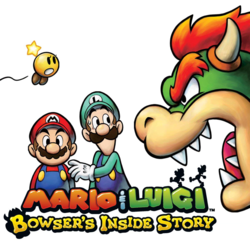
Mario and Luigi: Bowser's Inside Story
Developer: AlphaDream
Publisher: Nintendo
Released: September/October 2009
Platforms
Nintendo DS
Genres
Role-Playing Game
Action
Adventure
Platformer
Certification
CERO: A
ESRB: E
OFLC: G
PEGI: 3+
So, another Mario game has been released, and you're probably thinking, "That’s nothing new". Well throw that notion away, because Mario and Luigi: Bowser's Inside Story is the freshest, most original Mario title to ever hit a Nintendo system. The biggest inclusion is the new protagonist, Bowser. Yes, Bowser! The decades long arch nemesis of Mario finally gets centre stage. This is an exciting concept, considering only snippets of Bowser's personal life and ambitions have been revealed in past games. Now we get to search beneath that rough exterior and see what makes Bowser tick on the inside... literally.Basic information
Mario and Luigi: Bowser's Inside Story
Developer: AlphaDream
Publisher: Nintendo
Released: September/October 2009
Platforms
Nintendo DS
Genres
Role-Playing Game
Action
Adventure
Platformer
Certification
CERO: A
ESRB: E
OFLC: G
PEGI: 3+
The game opens to a scene inside the life of a Toad family preparing for dinner. Suddenly, the father Toad breaks through the wall of the house, afflicted with a horrifying ailment known as "The Blorbs", which causes those infected to balloon to enormous size, ceasing their ability to do... anything. An emergency meeting is called at Peach's castle, which includes herself, her Toad council, a Star Sprite named Starlow, and of course the Mario Brothers. During the meeting Bowser storms in, but is easily bested by Mario. After being ejected and feeling rejected, Bowser comes across a mysterious mushroom dealer who offers him a "lucky" mushroom which will make him strong enough to defeat Mario. Bowser scoffs down the mushroom and returns to the castle, where he proceeds to inhale everyone at the meeting (and some other Mushroom Kingdom objects), just before passing out. He awakens with a case of amnesia, not knowing what he just did, but discovers that his castle and the Mushroom Kingdom have been taken over by the evil Lord Fawful. The goal of both Bowser and the Bros. is now to defeat Lord Fawful, although both have completely different motives.
As Bowser (and eventually Mario and Luigi), you travel throughout the different venues of the Mushroom Kingdom. The 3/4 overhead view is very simple to navigate - sometimes too simple. As you progress you will explore caves, beaches, forests, towns, and castles. However, they are only half of the areas to discover. As the title suggests, Mario and Luigi must navigate their way through Bowser's internal organs, into areas such as the Funny Bone, Nerve Cluster, Flab Zone, and Rump Command. Bowser's insides are viewed as a traditional 2-D platforming style, which adds a nice variance to the overworld camera angle. Both venues are loaded with obstacles, many of which can only be accessed by gaining different powers throughout the game. While some may sneer at the idea of revisiting cleared areas, the rewards are definitely worth the trip, and since all of the enemies are specific to their location, sometimes it's fun to return and lay the smackdown on those baddies who caused you grief earlier in the game.
At the start, Bowser is limited to only using his punch, and the Mario Bros. can only jump. As the plumbers make their way through Bowser they often come to an impasse, where - after putting their heads together – they discover new abilities within them which allow them to move on. Some moves include standing on each other's head to spin across large gaps; Luigi whacking Mario on the head with a hammer to make him fit into tight places; and together drilling underground in order to access even tighter places (and uncover treasure). Bowser's new powers are unlocked by the Mario Bros. after successfully clearing areas of his insides. Bowser will eventually be able to unleash his flame breath, do a ground pound, and roll around with his spiky turtle shell, among other things.
Many of the powers are unlocked through minigames, and believe me, there are a tonne. Thankfully, most of them tie in beautifully with the wacky story, and all of them are incredibly fun, and challenging, to play. Mario and Luigi can enter a Challenge Node within Bowser to test their skills with battle powers, or take on insanely hard bosses; while the Bowser minigames require him to use his battle powers to massage a big block's back. All of the minigames require expert timing to obtain a high rank and reap the rare rewards.
As with previous Mario and Luigi titles, this one has a strong RPG element and is presented beautifully. Killing an enemy grants you experience points to gain levels, and coins to purchase equipment. As you level up, your stats increase (such as HP, Power, and Defence), and you even get to play a slot machine minigame which adds even more points to a specific stat. Also, as you reach specific level milestones your rank increases, allowing you to equip more gear and shop at more upscale stores. The equipment is also well tailored and varied to allow a great deal of customization. Besides the shells and overalls that Bowser and the Bros. can equip, respectively, to increase their defence, many different items will increase the stats, battle powers, and even the amount of loot you receive. It's quite a treat when you have multiple treasure boosting gear equipped and watch the bonuses rack up after clearing a battle. Some such pieces are powerful enough that they create a handicap, making the bad guys tougher to take down in order for you to claim the gold and experience.
A new element to Bowser's Inside Story is the use of badges. As Mario and Luigi progress they will obtain, and can purchase, badges, which unleash benefits in battle when enough well timed attacks are accomplished. These too can be customised, and each brother has their own badge set which can be combined with one another for different results.
The battles themselves follow a standard turn-based RPG format. The Bros. can attack with their jump, hammer, or other special attacks which are unlocked by collecting puzzle pieces throughout the world and inside Bowser. Bowser can use his punch, fire breath, and other special attacks as well, which he unlocks by rescuing his trapped minions. Bowser can also inhale certain enemies, who fall into his stomach and must battle the Mario Bros., adding even more nuances to the encounters. As with the minigames, the battles require finesse with your buttons. By timing your attacks perfectly you can deal a greater amount of damage. This is also the case with your defences. Every monster has a different attack, and many times more than one type. You can avoid taking damage, or even inflict counter damage, by anticipating the attack and pressing the button at the precise moment. This certainly adds complexity to the game, considering the plethora of different attacks that you must memorize. Also, each brother is assigned their own button to perform... well, everything; and Bowser has a button specifically for punching and one for ducking. So figuring out what attack is coming, who is being targeted, and pushing the right button at the right time will have even veteran gamers thinking on their toes. But consistently timing your attacks perfectly will yield an enormous sense of gratification.
The biggest flaw in the game would have to be the graphics. While the world is beautifully coloured (as is with all Mario games), the backgrounds are far too integrated; meaning the character sprites feel very detached from the rest of the world. Aside from that though, the animation of all the moves are smooth and lag free.
The music score and sound effects are slightly above par. It is a refreshing change to not hear the classic Mario songs remixed, and most of the tunes are catchy and fit the different locations. Only one gives me ire; a sombre melody that befits Boo's haunted mansion, but is oddly played in numerous areas both within Bowser and around the overworld. The tune is simply out of place. As expected, the script is all subtitled, with only some choice words spoken by the Bros. and the Koopa King. Personally, every time Bowser says, "Showtime!" before a battle, I can't help but think of Aknot from "The Fifth Element"... Okay, that may be an obscure reference, but fans of the movie will know what I'm talking about. Back to the script; it is whimsical, well written, and full of humour. Almost all the characters have a distinct personality, with the exception of the Mario Bros. They are actually the most linear characters in the game... but then again... this is Bowser's story, right?
Small technical errors aside, Mario and Luigi: Bowser's Inside Story ranks near the top of my list of the most well-rounded Action/RPGs, and that is high praise in my very critical RPG eye. Whether or not you're a diehard fan of the Mario series, this game has a rich and off-the-wall plot (think Earthbound), very customisable characters, and a challenging battle system designed to hone your timing skills, or knock you unconscious trying.
9/10
Sean
Labels: DS, Mario, Nintendo, Review, Sean, Sean Engemann
- Sean Engemann

And now… the lull.
The start of a new year is often flaccid when it comes to marquis titles. But never fear, as I have found a few noteworthy games to look forward to in the coming months, and even some possible hidden gems.


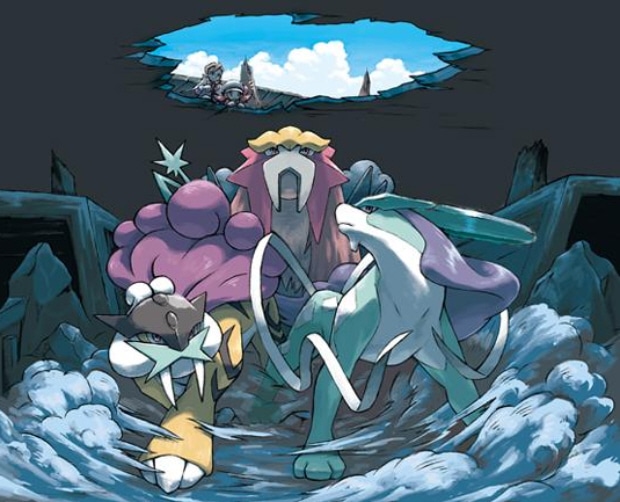
A couple of potential sleeper hits you may want to keep your eyes on, now. Sky Crawlers: Innocent Aces - coming out January 14th in North America, and sometime in February for Europe - joins the rare genre of flight combat games for the Wii. While confusing motion controls may be scrapped by most gamers for a more traditional analogue control, the smooth gameplay and fast action dog fights are sure to attract some gamers, especially fans of the Ace Combat series. For those fighting game enthusiasts out there, Capcom is releasing (not surprisingly) another game in the ‘Versus’ series, this one titled Tatsunoko vs. Capcom: Ultimate All-Stars. The game sports a cast of over 25 playable characters, including Capcom icons such as Ryu, Chun-Li, Mega Man and Viewtiful Joe, as well as members of the Tatsunoko cartoon series including Ken the Eagle, Karas and Gold Lightan. What separates this version from previous ‘Versus’ iterations is the blend of 2D and 3D graphic styles, giving both a classic feel with a modern flavour. Look for Tatsunoko vs. Capcom: Ultimate All-Stars in stores on January 26th and January 29th in North America and Europe, respectively.

Unfortunately, that’s pretty much it for the DS.
My recommendations, if you’re looking to cut a swath of destruction with your Wii Remote, the aforementioned Wii games should fulfil that desire. As for the DS, I would suggest picking up Mario & Luigi: Bowser’s Inside Story or The Legend of Zelda: Spirit Tracks if you didn’t already get them for Christmas, and take a nice slow time completing them, since nothing looks respectable on the horizon for the DS.
Sean
Labels: DS, Feature, Releases, Sean, Sean Engemann, Wii
- Sean Engemann

Ever since it was shown at E3 2009, 5th Cell's creative Nintendo DS puzzle game Scribblenauts has had an overwhelming amount of hype and anticipation for its release. For those of you who don't know, Scribblenauts gives the promise of letting the player solve action puzzles using literally thousands of nouns. All one has to do is think of something they would like to conjure and simply type it on the bottom screen and it instantaneously appears on the screen to be used however seen fit. Now that the game is on shelves, could it possibly live up to the amount of coverage and buildup it has received in the past few months?
It's sort of telling that before Scribblenauts even gives the player a menu, it drops them right into a playground title screen to mess around with the item generator. I say this because this is easily the most impressive part of the game, and rightfully so. Being able to summon anything that comes to mind is a power that no other game has given before and, for the most part, 5th Cell has kept their word. Scribblenauts has pretty much everything you would ever think of, jam packed into a tiny cartridge (copy written material and profanity omitted, of course). There is a shortcoming however, in the fact that a lot of words give the same result, for instance; "monster" and "boogeyman". Another issue that arises from having so many things in the game is glitches between objects interacting. This is pretty much an unavoidable problem however, as the game would have been in testing for years if they were to check how every object interacts with one another. Overall, the item creation is a blast and its problems are easily forgivable.

Scribblenauts is predominately a fun game but there is one major problem that takes away from full enjoyment: the controls. With the exception of moving the screen around the level, all of the games controls are done with the touch screen. The annoyance occurs in this because moving your character and moving objects is the same action. This creates huge amounts of frustration by creating such situations as trying to pick up an object and incidentally making Maxwell jump into a pit of lava and attempting to make him walk across a bridge only to pull the bridge out from beneath his feet. By making the d-pad control the character, this issue could have been easily avoided and, although it doesn't take away a great deal from the game, it certainly diminishes a lot of fun from some of the levels.

Scribblenauts is a charming game and a technological accomplishment. Its item creation makes up in quantity what it lacks in quality. This also applies for the games levels, as they are somewhat repetitive. The experience is clouded by its poor controls, but people who are interested in the game will most likely be able to ignore this problem. With plenty of unlockables and a level editor to fool around with, Scribblenauts will last a long time to players who enjoy the game. In a world full of copy-cat game design, its great to see developers trying something different and thinking outside the box and Scribblenauts is a game that should not be passed up by gamers looking for a break from the typical experience.

Labels: DS, Nintendo, Review, Scribblenauts, Tyson, Tyson Breen
- Anonymous
Subscribe to our content
and never miss a single thing

 subscribe to our monthly newsletter:
Our most recent writing

Our most recent reviews
Recent comments
All comments are subject to our commenting policy
Latest videos

Subscribe on YouTube

GGTL Classics
Some of the very best articles dug out from deep in the GGTL archives, written by some of our past and present wordsmiths alike.
Your continued use of this website and/or any others owned by Gamer's Guide to Life.com represents your acceptance and indicates your full understanding of all of our legal policies and terms. Our legal policies and terms are legally binding. If you in any way disagree with or refuse to be bound by any part of said legal policies and terms, you are advised to leave this website immediately.