 Follow us on Twitter: @ggtl
 Join our friendly community!


Latest news

 2.4.10

*Cough*.
Alright, so that’s probably not what happened, but nevertheless, in a recent press release Nintendo did confirm that the successor to the DS - codenamed 3DS - is in production. Better yet, they have given us a planned launch date: within the next fiscal year, which would put it anytime up till the end of March 2011. So let’s get my event and launch predictions out now.
I wager that we will not have any playable demos available at E3, but instead must suffer with a few video clips showcasing “some” of the features. This year’s Tokyo Game Show will have working models for the lucky attendees to test out, and more of the system’s features revealed. Depending on the growing success of game apps on the iPhone and other smartphones, we could possibly see a worldwide launch for the holidays (despite my arguments on these points in the previous article). If not available by the end of the year, we will definitely see a launch early spring, 2011.
So I mentioned that 'some' of the features will probably be showcased at E3. The press release stated that the 3DS will allow users to play 3D games without the need for special glasses. Japanese reports have confirmed that the technology is Sharp’s parallax barrier technique (a material placed in front of the LCD which contains a series of slits, allowing different sets of pixels to be seen, creating depth. This technology, while interesting, does require the user to view the screen from a specific angle. Considering that another (not confirmed) feature will include a “tilt” function, I am curious to see how Nintendo will overcome the obstacle of moving the 3DS while still projecting a 3D image. Since the “tilt” feature is already out there in Rumourville, we can probably expect an official announcement about that at E3, if not before.
Thankfully the 3DS will be backwards compatible, allowing you to play the countless DS games you have accumulated and grown to love over the years. Hopefully Nintendo will have figured out a way to transfer any downloaded DSiWare games over to the new platform. And I’m still pushing for a Virtual Console, giving us access to all the portable classics from the Game Boy and Game Boy Advance.
So, 'yay' that the system has been confirmed, and 'yay' that we have a release window. Hopefully new bits of rumours or official information make its way to us, which I will hastily bring forth to you, loyal GGTL readers.
Sean
Labels: 3D gaming, 3DS, DS2, DSiWare, Nintendo, Sean, Sean Engemann
- Sean Engemann

Nintendo is notoriously good at keeping information close to their chest, giving all of the media the old "Nintendo does not comment on rumours or speculation" comment. Hard as they may try however, they can’t completely control those who seem to have their hands on development kits, and therein lies the rub. Apparently “trial” kits having been given to The Pokémon Company, along with a select few other Japanese developers, who have let slip a couple secrets about the inevitably upcoming handheld.
The most predominant rumour is the apparent “tilt” function (a la iPhone), but more advanced than a simple accelerator. Though I doubt Nintendo would ever try to call it an “iPhone killer”, since the iPhone is more a communication and application device, while Nintendo’s primary focus has always been on the games. This type of upgrade could encompass all sorts of features, from shock detection to dual accelerators and multiple axes. We will have to wait for official word from Nintendo (which will probably come in teaser snip-its much like they did before the Wii was launched), or from insider leaks before we can confirm anything. A developer at The Pokémon Company has stated that the Nintendo DS2 is, “Genuinely the best thing I think I’ve ever worked with,” which only makes us salivate for more rumours, or better yet, hard evidence.
I think the system would do well to follow in the Wii’s footsteps by being completely backwards compatible, allowing a slot for DS cartridges (if the media is different), and also a Virtual Console where consumers could download Game Boy and Game Boy Advance games. Frankly I am surprised that this feature is not already available for the DSi, considering the thus far success of the DSiWare. Another feature I would like to see reintroduced by Nintendo is communication between the DS2 and the Wii, much like the promising but failed attempt between the Game Boy Advance and the GameCube.
Looking back at how Nintendo reveals their big news, here is my timeline “guesstimation”. With the announcement of the Nintendo DSi XL just released, don’t expect anything at this year’s GDC. I believe June’s E3 will yield the first announcement by Satoru Iwata, holding up a “shell” of the system, mimicking what he did with the Wii at E3 2005. Then we will get some, but not all, of the system’s features revealed in September at the Tokyo Game Show. Sadly, I doubt we will see anything hit retail shelves this holiday season, and should expect a worldwide release sometime in 2011, sooner rather than later. However, if the only thing we have to look forward to come Christmas time is a new Zelda game, then Big N may have to push the DS2 early to keep a strong financial bottom line.
Sean
Labels: DS, DS2, News, Nintendo, Rumours, Sean, Sean Engemann
- Sean Engemann

Game Information

Basic information
The Legend of Zelda: Spirit Tracks
Developer: Nintendo EAD
Publisher: Nintendo
Released: December 2009
Platforms
Nintendo DS
Genres
Action-adventure
Certification
CERO: A
ESRB: E10+
OFLC: PG
PEGI: 7
While there are some game series that seem to fade into the bleak world of monotony after countless sequels are released, the Zelda chronicles have always presented a polished product which leaves us quite satisfied. The Legend of Zelda: Spirit Tracks for the Nintendo DS lives up to its pedigree, and will keep you engaged and enticed from start to finish.Basic information
The Legend of Zelda: Spirit Tracks
Developer: Nintendo EAD
Publisher: Nintendo
Released: December 2009
Platforms
Nintendo DS
Genres
Action-adventure
Certification
CERO: A
ESRB: E10+
OFLC: PG
PEGI: 7
The story opens simply enough in a small coastal village, where we find Link (or any name of your choosing) preparing for his final engineering test and ensuing graduation ceremony at Hyrule castle. At the ceremony, Princess Zelda bestows Link with the title of Royal Engineer, but also slips him a note requesting a secret meeting in her chambers. She proceeds to explain that her Chancellor, named Cole, has been acting suspicious, and wants Link to escort her to the Tower of Spirits to investigate the gradual disappearance of the Spirit Tracks. Zelda gives Link his standard green garb, which sadly in the this game is reduced to a mere recruit’s uniform, in order to pose as a guard and escape the castle that Zelda has been confined to for her protection. After a successful escape, Link, Zelda, and Link’s tutor Alfonzo, make their way to the Tower of Spirits via train, only to run off-course halfway due to a sudden disappearance of the tracks. The party is confronted by Cole, who reveals his true form and intent, and his second-in-command, Byrne. The diabolic duo defeats the party and, for all intents and purposes, kills Zelda and takes her body to be used as a vessel for the resurrection of the Demon Lord, Malladus. Zelda’s spirit remains and accompanies Link throughout his journey as he tries to restore the Spirit Tracks and find the powers needed to defeat Malladus so Zelda may reclaim her body.
While many may sneer at the notion of a train corrupting the classic fantasy world of Hyrule, the concept and gameplay actually work quite well with the story. The tracks themselves are actually chains, which have bound the Demon Lord to the Tower of Spirits, but as his powers have strengthened, the chains have disappeared. Movement on the track feels surprisingly more free than the open waterworld from Phantom Hourglass, and as more of the track is revealed, more options and obstacles present themselves. Since this game does not take place in an endless sea of blue, the world is much more vibrant and appealing to the eye. There are essentially four quadrants which make up the land of Hyrule: the Forest Realm, Snow Realm, Ocean Realm, and Fire Realm, each with at least one temple (dungeon) to explore, and all filled with interesting locales to visit. Since the train is bound to the speed of its engine, the time to travel between destinations can become tedious. However, portals become available on the tracks as you progress through the story, allowing you to quickly travel to distant locations with a blow of the train’s whistle. Of course, the train rides are never stagnant, as enemies and obstacles frequently appear, many of which can be handled with a well placed cannon shot. Though your cannon will only slow the possessed demon trains; and if your route is not planned properly, or you are not quick at timing your turns to avoid a collision, your game ends in flames and cries from Zelda.
The train also becomes a transport vehicle for both passengers and cargo, as some of the sidequests have you hauling such things as fish, cuccos, lumber, and ice to an alternative destination in a timely fashion; and residents who are eager to visit other parts of the world. Each successful transport will result in a new section of track being revealed, with new mysteries to be uncovered. Even with an empty train, you could lose plenty of hours tracking down all the rabbits hidden behind boulders, which you must catch in a netting minigame and bring them to the refuge called Rabbitland Rescue in order to claim rupees and other prizes. Along with other minigames such as stamp collecting, a target course, and a fighting challenge which pits you against progressively more difficult rounds of monsters and bosses, there are many ways to collect upgrades and artifacts. Yet, as clever and fun as these sidequests and minigames are, they are inconsequential to the main plot, and their rewards are merely for the “completist” gamer.
The game’s biggest flaw is the ease of difficulty. This fault translates to both the enemies and the dungeons, and while some may find it a refreshing change from the taxing and frustrating Ocean Temple in Phantom Hourglass, I believe it takes away an element that has always separated the Zelda franchise from other adventure games. The bulk of enemies are slow and easy to avoid, and while some carry their own defenses, most can be easily dazed with your boomerang, and quickly dispatched. Other obtainable weapons include the standard bombs and bow, a sand wand, a snake-like whip replacing the hookshot, and the whirlwind, which requires you to blow into the microphone to create the vortex. Another clever use of the microphone occurs when you obtain the pan flute. With it you must again blow into the microphone, but this time you create music depending on where you move the flute with the touch screen. It is an interesting addition with a realistic feel, as you must play in harmony with the spirit guardians in order to open paths to the temples. You will also learn tunes used to locate hidden objects, heal yourself, or call birds to help you reach inaccessible locations; yet most of these are only used sporadically and more could have been done to give the flute a better role. Despite needing many of these weapons and items to solve the temple riddles, in battles they are - for the most part - superfluous, as many will fall back to the boomerang’s “daze and destroy” tactic. The bosses, although well presented and intimidating, are easily predictable and defeated quite readily with the weapon obtained in that particular temple. So although you may feel compelled to dish out your rupees beforehand for a healing potion, it will probably go flat and get mouldy before you need to drink it. The temple puzzles themselves get progressively harder, yet with the exception of the final few floors of the Tower of Spirits, they remain easily solvable. Despite the lack of difficulty, the puzzles are still interesting, and while some seem to be recycled from previous Zelda games, there are definitely fresh ones to be had. One of the more interesting concepts is having Zelda use her spirit to control the Phantom Guardians in the Tower of Spirits. This allows a very unique cooperative experience between you and Zelda, as her Phantom embodiment can access areas Link cannot, forcing you to handle two characters alternatively to solve puzzles and defeat enemies. Apart from the standard Phantom, there are also some that brandish a fiery blade, some that teleport, and some that transform into a havoc-wreaking boulder, all which can be possessed to reach the next floor.
The cast of characters in Spirit Tracks is broad and colourful, with the reappearance of familiar faces (supposed grandchildren of those in Phantom Hourglass, since this story takes place a century later) and races, but also some fresh ones as well. Zelda plays very well as Link’s partner, and it is nice to see her donning the princess garb, rather than her oddly drawn, androgynous alter ego, Tetra. Even Byrne, a suspected enemy, evolves throughout the story and eventually must grapple with an internal conflict. You can spot a relative of Jolene (the female pirate from Phantom Hourglass) running the Take ‘Em All On challenge in Hyrule Castle, and of course the Anouki and Goron tribes fit nicely in their respective realms. Thankfully, the very annoying character Linebeck from Phantom Hourglass has been reduced to an artifacts trader. Linebeck III now runs the shop and will pay rupees for any items Link comes across, and also sells upgraded sections of your train in all different styles. This however needed further development, since apart from a one or two heart boost to your train, the changes are merely superficial. And since a lot of effort is required to obtain some of the rarer artifacts, it would be more satisfying to have the train upgraded in different ways, possibly with cranes to pull up treasure from the ground or ocean, or luxury or bar cars that provide a steady income of rupees when carrying guests.
The graphics are the same cel-shaded style seen in Phantom Hourglass and its forebearer Wind Waker, and while not as popular as the more realistic designs seen in Twilight Princess, they work very well with the DS platform. The gameplay is smooth, and the only lag comes when multiple enemies appear in the same screen, which happens infrequently. The colours are gorgeous, and each quadrant of the world begs to be discovered and admired. The music and sound are also solid, as expected. Many of the classic Zelda tunes are present, slightly modified to fit the colonial/western theme that seems to accompany the use of a train. Of course all the dialogue is silent and subtitled, but this is one of the few series that doesn’t require voice acting for the story and characters to be engaging.
The multiplayer aspect comes in the form of a battle mode, which will look familiar to those who have played the Four Swords game. You and up to three other players duke it out on a dungeon-like level trying to obtain as many force gems as possible. There are six different levels to chose from, all with different obstacles, and although you are left without a weapon, there are many ways to dispatch your friends and capture their gems before the timer expires. It is an interesting, fast paced experience, but more of a diversion than a full-fledged multiplayer inclusion.
The Legend of Zelda: Spirit Tracks brings some fresh ideas to the series, adding an exciting mode of transportation and new ways to solve the clever, yet tame, puzzles. While the graphics have not changed much from those of Phantom Hourglass, they are definitely smoother and more vibrant. The story is gripping, and all the sidequests and minigames provide a nice diversion from the task of saving Zelda and Hyrule. Whether you’re a fan of the series, or just looking for a good action-adventure game, this one will definitely provide many hours of enticing gameplay.
9/10
Sean
Labels: DS, Nintendo, Review, Sean, Sean Engemann, Zelda
- Sean Engemann

Game Information
Basic information
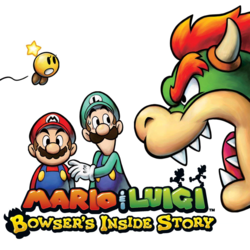
Mario and Luigi: Bowser's Inside Story
Developer: AlphaDream
Publisher: Nintendo
Released: September/October 2009
Platforms
Nintendo DS
Genres
Role-Playing Game
Action
Adventure
Platformer
Certification
CERO: A
ESRB: E
OFLC: G
PEGI: 3+
So, another Mario game has been released, and you're probably thinking, "That’s nothing new". Well throw that notion away, because Mario and Luigi: Bowser's Inside Story is the freshest, most original Mario title to ever hit a Nintendo system. The biggest inclusion is the new protagonist, Bowser. Yes, Bowser! The decades long arch nemesis of Mario finally gets centre stage. This is an exciting concept, considering only snippets of Bowser's personal life and ambitions have been revealed in past games. Now we get to search beneath that rough exterior and see what makes Bowser tick on the inside... literally.Basic information
Mario and Luigi: Bowser's Inside Story
Developer: AlphaDream
Publisher: Nintendo
Released: September/October 2009
Platforms
Nintendo DS
Genres
Role-Playing Game
Action
Adventure
Platformer
Certification
CERO: A
ESRB: E
OFLC: G
PEGI: 3+
The game opens to a scene inside the life of a Toad family preparing for dinner. Suddenly, the father Toad breaks through the wall of the house, afflicted with a horrifying ailment known as "The Blorbs", which causes those infected to balloon to enormous size, ceasing their ability to do... anything. An emergency meeting is called at Peach's castle, which includes herself, her Toad council, a Star Sprite named Starlow, and of course the Mario Brothers. During the meeting Bowser storms in, but is easily bested by Mario. After being ejected and feeling rejected, Bowser comes across a mysterious mushroom dealer who offers him a "lucky" mushroom which will make him strong enough to defeat Mario. Bowser scoffs down the mushroom and returns to the castle, where he proceeds to inhale everyone at the meeting (and some other Mushroom Kingdom objects), just before passing out. He awakens with a case of amnesia, not knowing what he just did, but discovers that his castle and the Mushroom Kingdom have been taken over by the evil Lord Fawful. The goal of both Bowser and the Bros. is now to defeat Lord Fawful, although both have completely different motives.
As Bowser (and eventually Mario and Luigi), you travel throughout the different venues of the Mushroom Kingdom. The 3/4 overhead view is very simple to navigate - sometimes too simple. As you progress you will explore caves, beaches, forests, towns, and castles. However, they are only half of the areas to discover. As the title suggests, Mario and Luigi must navigate their way through Bowser's internal organs, into areas such as the Funny Bone, Nerve Cluster, Flab Zone, and Rump Command. Bowser's insides are viewed as a traditional 2-D platforming style, which adds a nice variance to the overworld camera angle. Both venues are loaded with obstacles, many of which can only be accessed by gaining different powers throughout the game. While some may sneer at the idea of revisiting cleared areas, the rewards are definitely worth the trip, and since all of the enemies are specific to their location, sometimes it's fun to return and lay the smackdown on those baddies who caused you grief earlier in the game.
At the start, Bowser is limited to only using his punch, and the Mario Bros. can only jump. As the plumbers make their way through Bowser they often come to an impasse, where - after putting their heads together – they discover new abilities within them which allow them to move on. Some moves include standing on each other's head to spin across large gaps; Luigi whacking Mario on the head with a hammer to make him fit into tight places; and together drilling underground in order to access even tighter places (and uncover treasure). Bowser's new powers are unlocked by the Mario Bros. after successfully clearing areas of his insides. Bowser will eventually be able to unleash his flame breath, do a ground pound, and roll around with his spiky turtle shell, among other things.
Many of the powers are unlocked through minigames, and believe me, there are a tonne. Thankfully, most of them tie in beautifully with the wacky story, and all of them are incredibly fun, and challenging, to play. Mario and Luigi can enter a Challenge Node within Bowser to test their skills with battle powers, or take on insanely hard bosses; while the Bowser minigames require him to use his battle powers to massage a big block's back. All of the minigames require expert timing to obtain a high rank and reap the rare rewards.
As with previous Mario and Luigi titles, this one has a strong RPG element and is presented beautifully. Killing an enemy grants you experience points to gain levels, and coins to purchase equipment. As you level up, your stats increase (such as HP, Power, and Defence), and you even get to play a slot machine minigame which adds even more points to a specific stat. Also, as you reach specific level milestones your rank increases, allowing you to equip more gear and shop at more upscale stores. The equipment is also well tailored and varied to allow a great deal of customization. Besides the shells and overalls that Bowser and the Bros. can equip, respectively, to increase their defence, many different items will increase the stats, battle powers, and even the amount of loot you receive. It's quite a treat when you have multiple treasure boosting gear equipped and watch the bonuses rack up after clearing a battle. Some such pieces are powerful enough that they create a handicap, making the bad guys tougher to take down in order for you to claim the gold and experience.
A new element to Bowser's Inside Story is the use of badges. As Mario and Luigi progress they will obtain, and can purchase, badges, which unleash benefits in battle when enough well timed attacks are accomplished. These too can be customised, and each brother has their own badge set which can be combined with one another for different results.
The battles themselves follow a standard turn-based RPG format. The Bros. can attack with their jump, hammer, or other special attacks which are unlocked by collecting puzzle pieces throughout the world and inside Bowser. Bowser can use his punch, fire breath, and other special attacks as well, which he unlocks by rescuing his trapped minions. Bowser can also inhale certain enemies, who fall into his stomach and must battle the Mario Bros., adding even more nuances to the encounters. As with the minigames, the battles require finesse with your buttons. By timing your attacks perfectly you can deal a greater amount of damage. This is also the case with your defences. Every monster has a different attack, and many times more than one type. You can avoid taking damage, or even inflict counter damage, by anticipating the attack and pressing the button at the precise moment. This certainly adds complexity to the game, considering the plethora of different attacks that you must memorize. Also, each brother is assigned their own button to perform... well, everything; and Bowser has a button specifically for punching and one for ducking. So figuring out what attack is coming, who is being targeted, and pushing the right button at the right time will have even veteran gamers thinking on their toes. But consistently timing your attacks perfectly will yield an enormous sense of gratification.
The biggest flaw in the game would have to be the graphics. While the world is beautifully coloured (as is with all Mario games), the backgrounds are far too integrated; meaning the character sprites feel very detached from the rest of the world. Aside from that though, the animation of all the moves are smooth and lag free.
The music score and sound effects are slightly above par. It is a refreshing change to not hear the classic Mario songs remixed, and most of the tunes are catchy and fit the different locations. Only one gives me ire; a sombre melody that befits Boo's haunted mansion, but is oddly played in numerous areas both within Bowser and around the overworld. The tune is simply out of place. As expected, the script is all subtitled, with only some choice words spoken by the Bros. and the Koopa King. Personally, every time Bowser says, "Showtime!" before a battle, I can't help but think of Aknot from "The Fifth Element"... Okay, that may be an obscure reference, but fans of the movie will know what I'm talking about. Back to the script; it is whimsical, well written, and full of humour. Almost all the characters have a distinct personality, with the exception of the Mario Bros. They are actually the most linear characters in the game... but then again... this is Bowser's story, right?
Small technical errors aside, Mario and Luigi: Bowser's Inside Story ranks near the top of my list of the most well-rounded Action/RPGs, and that is high praise in my very critical RPG eye. Whether or not you're a diehard fan of the Mario series, this game has a rich and off-the-wall plot (think Earthbound), very customisable characters, and a challenging battle system designed to hone your timing skills, or knock you unconscious trying.
9/10
Sean
Labels: DS, Mario, Nintendo, Review, Sean, Sean Engemann
- Sean Engemann

Game Information

Basic information
Final Fantasy Crystal Chronicles: The Crystal Bearers
Developer: Square Enix PPD 2
Publisher: Square Enix
Expected: February 2010
Where to find more
Official Homepage
Wikipedia article
After first being announced way back at E3 2005, followed by years of virtual silence, Final Fantasy Crystal Chronicles: the Crystal Bearers has been off the radar for some time. However, it is finally hitting U.S. store shelves on December 26th, with the European release set for early February 2010. The apparent lack of focus on the game’s development has taken much criticism, but hopefully the extended creation time has allowed it to be polished and prepared for anticipated gamers.Basic information
Final Fantasy Crystal Chronicles: The Crystal Bearers
Developer: Square Enix PPD 2
Publisher: Square Enix
Expected: February 2010
Where to find more
Official Homepage
Wikipedia article
The story takes place a thousand years after the Great War, the premise of the first game in the series released on the GameCube. While other games bear the name Crystal Chronicles, Crystal Bearers would likely be classified as the sequel to the first game, tying in many story elements that follow the natural progression of its predecessor. While the game is chalk full of colourful and interesting characters, as is common in nearly every Final Fantasy, Crystal Bearers lacks the capacity to control an entire party. You take the reins of a single character named Layle, a Crystal Bearer from the Clavat tribe, one of the four clans which make up the world.
The progressive Lilty tribe defeated the dissident Yuke tribe during the Great War, shattering the Yuke Crystal and supposedly annihilating the Yukes. A theory in the game is that after its destruction, fragments from the Yuke Crystal attached themselves to individuals all across the globe, granting them special magical powers and thus labelling them as Crystal Bearers. This game’s timeline is more industrial, with machinery in the forefront, and magic seen as a taboo ability all but lost except by the few Crystal Bearers, who are feared and scorned by the public. Although young, Layle is a world renowned mercenary who has been hired by the Lilties to escort their newest airship called Alexis, a technological marvel and symbol of Lilty superiority. However, during its maiden voyage the airship comes under attack by monsters and Layle confronts a nemesis who was thought to have vanished.
Crystal Bearers combines gameplay elements of both the first Crystal Chronicles game and of traditional Final Fantasies, and yet is an original game in its own right. While you might think this to be a standard turn-based RPG, it is actually better classified as an action game with some platforming and even on-rails shooter facets. As Layle, you take control of his telekinetic powers, harnessing the ability to manipulate objects, enemies, and even townsfolk, often against their will. As you progress, you will learn new combinations and methods of using your powers, and obtain accessories to even further enhance them. In addition to defeating foes, you can use your abilities to shake chests, grab onto ledges, and seal enemy producing vortexes, among other things.
As expected, the controls for this game are unique, utilising the capabilities of the Wii remote to interact with the environment. The Nunchuck attachment is used to control Layle’s movement, while the Wii Remote is used to target and manipulate much of the world and its inhabitants. As the story unfolds and new obstacles emerge, players will discover new ways to use the gravity based magic. Since the Wii lends itself to more action based gameplay, Square Enix wanted to give as much freedom to the player as possible, allowing innumerable ways to dispatch enemies. So use your creativity, and enjoy the expansive and interactive world.
As mentioned before, Layle can purchase different accessories to increase his gravitational powers, but also to improve his defenses, and other upgrades such as expanding his reticule to influence a greater number of targets. Along with shops to purchase items, you can also collect materials from defeated enemies and other sources, and take them to the workshop to create your own rings, amulets and earrings. This allows a nice level of customization for Layle, to tailor his abilities to the player’s liking.
Although the graphics will never be as awe-inspiring as in Final Fantasy XIII for the PS3 and Xbox 360, this game definitely looks gorgeous, and is quite possibly the most beautiful-looking game for the Wii thus far. The characters are full of detail and expressions, and the world is colourful and inviting. It will be interesting to see after playing the game how the camera will react to Layle’s movements, and how well the frame rate is when combating multiple enemies.
The musical score sounds great, and it is refreshing to finally have the script voiced on a Nintendo console, rather than the typical “subtitles with grunts”. However, from the trailers and videos viewed, the script and voice acting seem to be of moderate quality, but I will reserve that judgment for the full review.
Final Fantasy Crystal Chronicles: The Crystal Bearers looks to give a fresh take on the venerable series; much like the Wii did for the video game industry. With a gamut of interesting characters, a huge world to explore, and a (so far) engaging storyline, Crystal Bearers is on track to revitalise Square Enix’s audience of Wii owners. Be sure to check back in the coming weeks for the full review.
Sean
Labels: Final Fantasy, Hype Train, Preview, Sean, Sean Engemann, Square Enix, Wii
- Sean Engemann

And now… the lull.
The start of a new year is often flaccid when it comes to marquis titles. But never fear, as I have found a few noteworthy games to look forward to in the coming months, and even some possible hidden gems.


A couple of potential sleeper hits you may want to keep your eyes on, now. Sky Crawlers: Innocent Aces - coming out January 14th in North America, and sometime in February for Europe - joins the rare genre of flight combat games for the Wii. While confusing motion controls may be scrapped by most gamers for a more traditional analogue control, the smooth gameplay and fast action dog fights are sure to attract some gamers, especially fans of the Ace Combat series. For those fighting game enthusiasts out there, Capcom is releasing (not surprisingly) another game in the ‘Versus’ series, this one titled Tatsunoko vs. Capcom: Ultimate All-Stars. The game sports a cast of over 25 playable characters, including Capcom icons such as Ryu, Chun-Li, Mega Man and Viewtiful Joe, as well as members of the Tatsunoko cartoon series including Ken the Eagle, Karas and Gold Lightan. What separates this version from previous ‘Versus’ iterations is the blend of 2D and 3D graphic styles, giving both a classic feel with a modern flavour. Look for Tatsunoko vs. Capcom: Ultimate All-Stars in stores on January 26th and January 29th in North America and Europe, respectively.

Unfortunately, that’s pretty much it for the DS.
My recommendations, if you’re looking to cut a swath of destruction with your Wii Remote, the aforementioned Wii games should fulfil that desire. As for the DS, I would suggest picking up Mario & Luigi: Bowser’s Inside Story or The Legend of Zelda: Spirit Tracks if you didn’t already get them for Christmas, and take a nice slow time completing them, since nothing looks respectable on the horizon for the DS.
Sean
Labels: DS, Feature, Releases, Sean, Sean Engemann, Wii
- Sean Engemann
Subscribe to our content
and never miss a single thing

 subscribe to our monthly newsletter:
Our most recent writing

Our most recent reviews
Recent comments
All comments are subject to our commenting policy
Latest videos

Subscribe on YouTube

GGTL Classics
Some of the very best articles dug out from deep in the GGTL archives, written by some of our past and present wordsmiths alike.
Your continued use of this website and/or any others owned by Gamer's Guide to Life.com represents your acceptance and indicates your full understanding of all of our legal policies and terms. Our legal policies and terms are legally binding. If you in any way disagree with or refuse to be bound by any part of said legal policies and terms, you are advised to leave this website immediately.