 Follow us on Twitter: @ggtl
 Join our friendly community!


Latest news

 2.5.12

Back in January, Square Enix released Final Fantasy XIII-2, a follow-up to Square’s most recent (and, in some circles, controversial) entry in the long-running JRPG series.
Reviews of the game have ranged from lukewarm to rather positive, but many of the critiques boil down to the same thing: the combat and gameplay are fun, but the story is awful.
For the unaware, the story is a direct continuation of XIII’s narrative. XIII-2 follows Serah, sister of the first game’s protagonist, and Noel, a time-travelling soldier who was sent back to avert a global apocalypse sometime in the future. Ignoring the prominent Terminator parallels, XIII-2’s story entails Serah and Noel travelling to different points in time, defeating dimension-shifting 'paradox' monsters and engaging in stilted, 'stylised' dialogue that wouldn't fly in a remedial script-writing class. XIII-2’s jargon-heavy world doesn’t try especially hard to welcome new players into the fold (though, to be fair, it is a direct sequel), and the melodramatic character interaction only further obfuscate the tale.
How far JRPGs have fallen in the past decade or so. Once the fore of storytelling in gaming, JRPGs are now bringing up the rear, with even the most highly-praised stories carrying an almost apologetic level of explanations and qualifications. Meanwhile, gamers are finding compelling plots and engaging characters in even the most action-packed genres.
It didn’t always used to be this way. Back in earlier days of gaming (by my watch, right up through the SNES), players more or less had to choose whether they wanted action or story. Platformers like Super Mario World or Donkey Kong Country were exciting and fun to traverse through, but they weren’t exactly go-to games for players looking for an emotional, involving experience. Conversely, RPGs didn’t offer thrill-a-minute gameplay like their platforming and shooting console-mates, but instead gave gamers characters, story arcs and more cerebral thrills than seeing how many coins they could collect before the end stage.
Now, in 2012, the wall between visceral action and involving story has been completely broken down (though not entirely removed). Games like BioShock and Assassin’s Creed are giving gamers compelling plots and engaging characters while still providing twitchy, fast-paced action. Meanwhile, games like Final Fantasy or Star Ocean, representing a genre once synonymous with storytelling, offer players staid, clichéd narratives and cardboard-cut-out characters. It’s all a bit backwards, really.
There are many potential discussions about what RPGs still have to offer the gaming world now (or, for that matter, what even qualifies as an RPG anymore, what with every game nowadays having some sort of XP system), but today we’re limiting it to JRPGs and their stories. Why do JRPG stories fail to hit, and what can be done to get the genre back on track?
I’ve held a pet theory about JRPG storytelling for a while now, and Final Fantasy XIII-2 helped to solidify it (funnily enough, it was Final Fantasy XIII that helped me form it in the first place). Back in the NES and SNES days, developers didn’t have the technological prowess to tell the stories they had in mind, one-to-one; instead, they needed to make concessions based on the technology available, both in terms of what could be displayed onscreen, and what their characters could say.
This creativity through limitation led to some of gaming’s most beloved titles: Final Fantasy VI; Secret of Mana; Chrono Trigger. Each of those games had a weighty, complex story, and the technological ceilings of the Super NES made it necessary that each story be told as cleanly as possible. Rather than tell it in the manner of a movie or television series, game directors and producers adopted a new kind of storytelling specifically for video games, one whose episodic, overarching structure most closely resembled a novel. This style helped present mature themes like suicide, addiction and death in an understated way that was simple enough to avoid melodrama, but focussed enough to avoid dulling their impact.
All this changed with the release of Final Fantasy VII. With the added hardware of the PlayStation, many restrictions imposed by the NES and SNES were lifted, letting directors and producers create games that adhered even closer to their creative visions. Players could explore even more expansive worlds, and characters could express themselves on even greater levels, with better animations and dialogue than ever before. Directors could tell exactly the story they wanted to tell, exactly the way they wanted to tell it.
It’s unfortunate, then, that the results have been so alienating. With the aforementioned hardware restrictions, game designers were forced to leave the Japanese-only sensibilities of their storytelling at the door, and instead created stories with broader, more universal themes.
Nowadays, traditional JRPGs are completely and totally steeped in Japanese storytelling conventions; the kind that are nigh-inscrutable to everyone but the most ardent Japan apologists and actual native-Japanese folk. In their desire to replicate their precise storytelling vision, game creators are able to emulate their favourite torrid Korean soap opera down to the most exact detail, leaving the non-Korean-soap-opera fans in the dark about the game’s appeal at all.
It’s not that JRPGs need to ape Western themes, or conform to a traditionally-Western idea of a game story. Chrono Trigger, my favourite game of all time, had an extremely strange story, involving a sentient robot, a talking frog and a cave woman fighting to save the world from a space parasite. Yet, the game’s story was — and still is — highly praised, not for its particulars but for its execution. Chrono Trigger painted its characters and story decisions in articulate, simple strokes, letting players meet the game halfway and invest themselves in its tale. For such ridiculous material, it had a pronounced level of subtlety and reservation (again, no doubt brought on by the SNES's limitations). It was broad, but sincere, and didn’t become caught up in trying to oversell itself.
Of course, it isn't as though top-tier JRPGs are in danger of becoming extinct. Quality JRPGs are still being made today, like Atlus’ Radiant Historia, a JRPG that, by all accounts, displays the exact same control and maturity that its 16-bit predecessors did. Perhaps it’s just a coincidence, then, that the most highly-praised traditional JRPG in years was released for the DS, a system with only slightly less hardware restraints than the SNES. Perhaps DS developers know something that console devs don’t?
Ultimately, if JRPGs are to dig themselves out of their current hole, they need to concentrate on what made them popular in the first place: storytelling. Not just Japanese storytelling, but storytelling that even JRPG neophytes can get wrapped up in. I’m not saying that publishers like Atlus should ditch such delightful J-games like Disgaea or the Atelier series, but I do think there should be room for both. Strong characters and compelling storytelling transcend cultures. JRPGs have since gained ground in terms of play mechanics, with games like Tales of Vesperia and Final Fantasy XIII-2 offering gameplay thrills on the level of the industry’s best. All they need to do is remember what they did better than any genre in gaming.
Watching JRPGs lose their prominence in game storytelling has been painful, but I firmly believe that great games can still be made using their template; look at 2008’s Lost Odyssey, a game that used old-school RPG gameplay while creating memorable locations and characters in a new, distinct way. Game storytelling is a broad field, with no one method standing 'superior' to any of the others, and there’s no reason why gamers shouldn’t have the option to enjoy a quality JRPG story along with the Portals, Uncharteds and Call of Dutys of the industry.
Note: for an excellent read on why JRPGs don’t necessarily need a good story to succeed, check out writer Kat Bailey’s new JRPG column on Joystiq.
Labels: Andrew Testerman, Chrono Trigger, Final Fantasy XIII-2, JRPG, Opinion, Radiant Historia
- Andrew Testerman
 The 'greatest game of all-time' contention is something that cannot be taken lightly, and a debate that we have often here at Gamer's Guide to Life.com.
Whilst the subject matter can spawn discussion on almost any game ever made, Final Fantasy VI and Chrono Trigger always seem to come up toward the top; right where they should be. Now, I'm not here to tell you which is better than which, but I'm fairly certain that Final Fantasy didn't stop at its second game, right?
That's what I thought.
Back in the nineties - or, as it is better known, the golden age of the RPG - the sheer might that Squaresoft held could not be denied. They were the company which could turn an emaciated goat into a stalwart knight, a rotten pineapple into a succulent steak, a worse-for-wear trainer into a hand-cannon. They were the people who lived in a shining fortress of awesome, surrounded by their unfathomable numbers of die-hard fans. You probably get it, but Square could do no wrong and, thus, Final Fantasy VI and Chrono Trigger were born.
Undoubtedly, both titles are known far and wide for their incredible gameplay and unrivaled soundtracks. The art, stories; everything about these games illuminates the darkest of corners, but I'm not here to tell you about how both of these games deserve the spotlight. Actually, I'm here to make a case against my fellow writer, Andrew Testerman, who claims that Chrono Trigger is Final Fantasy VI's superior in every way.
This view cannot pass.
Final Fantasy VI was a landmark for the critically-acclaimed series, as it's responsible for paving the way for the rest of the games - most notably Final Fantasy VII. While that game garners the majority of popular praise, rest assured that it would never have been the same without the cool-and-collected Final Fantasy VI at its heels. Final Fantasy VI also came out before Chrono Trigger, and still manages to contain depth that the games of today - including Chrono Trigger - struggle to implement.
Here's exactly ten reasons why the sixth installment of the Final Fantasy name is miles better than Chrono-whatever.
1: Espers

When there aren't any more Espers to find, Setzer and I have the same expression.
The Espers are the magical entities that make exploring the world of Final Fantasy VI such a blast. These creatures are living and breathing just like any character, but they boast unique magical powers that they bestow upon you by turning into an enchanted stone, called 'Magicite'. Some stones will simply be given to you, but there are plenty of others that must be found and/or earned before you can reap their benefits. It might all sound complicated, but once you get these little stones you can equip one to each character, which will teach you specific magical abilities, alongside providing special bonuses for levelling. With that said, you can also summon said Esper into battle. Depending on which you summon, the creature will perform either a devastating attack or a beneficial power upon your party.
What can you summon in Chrono Trigger? Not a goddamned thing.
2: The cast
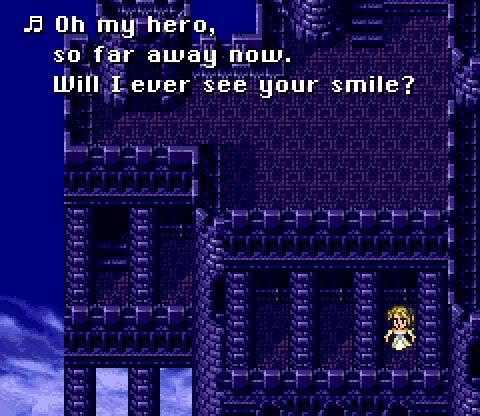
Which other character is going to sing in an opera and then slay a God? Yeah, you tell them Celes!
Final Fantasy VI has a sprawling cast and is composed of exactly fourteen characters. These characters are all permanent, meaning you have many options at any juncture of the game. More importantly, though, these characters aren't faceless goons with the personality of a piece of sandpaper; every single person on the roster has a history, personality and emotional dialogue that will affect you throughout the course of the game. To this day, there has never been a cast this large in an RPG whilst simultaneously introducing characters you actually care and want to know more about (with perhaps the exception of Mass Effect 2).
What would you rather have; the measly seven characters that Chrono Trigger puts up? Sure, Frog is an interesting guy, with his heal requiring him to lick his friends and all. That's friggin' gross. Why not trade him for someone like Edgar Figaro, who uses some kind of steam chainsaw that has the ability to insta-kill enemies? Oh, and did I mention that when this chance comes up, he also throws on a Jason Vorhees mask? Final Fantasy VI is the clear winner here.
3: The music
Alright, alright: the music that both games boast is out of this world, but there's only one guy who can make a half-an-hour end theme sound this good. That man is Nobuo Uematsu, and he's responsible for these harmonious noises, and perhaps the best theme song of all-time. No kidding here. I mean, the man has his own rock band - The Black Mages - that recreates the music from the entire series. If you haven't had a chance to check out all three of their albums, I suggest doing so right after you're done reading this here article.
4: The world
Like most RPGs of its time, Final Fantasy VI has a sprawling world available for you to explore, with loads of hidden environments, characters and some unreal super-secret items. The game's steampunk style also adds some flavour that really captivates the essence of that fictional time-period. One should also note that the game opens up even more once you reach the halfway point. I really don't want to spoil what happens, but let's just say that the face of the world changes forever. Regardless, the best part is that there's always something for you to do, and when it's all over or nearing the end, you can go exploring and find hours upon hours of extra content that you never knew existed.
5: Limit Breaks - Desperation Attacks
One of the staples of Final Fantasy is the over-the-top and extremely flashy Limit Break manoeuvres made popular by Final Fantasy VII. Final Fantasy VI pioneered these Limit Breaks, by way of the Desperation Attack. Yeah, it isn't nearly as great as the stuff found in the other titles, but they are certainly satisfying to watch. Unlike the Limit Break systems you might know - getting hit to build a meter - Final Fantasy VI characters only perform these devastating attacks at very low health. There's no prompt or warning, a character will just jump up, perform his insane move, your jaw hits the floor, then you continue playing, wondering what the hell just happened.
So while you're putting ice on someone's sword or combining some weird shadow magic with rocks, just remember one thing; Final Fantasy VI created these lunatic attacks.
6: Evil enemies

The main antagonist of Final Fantasy VI is the psychotic, magic-addict clown called Kefka. Compared to the Magus and Lavos threat in Chrono Trigger, Kefka quite simply makes them look all sorts of stupid. Much like the Joker in the Batman series, this guy is evil simply because he wants to be; there's no other reason. Poisoning a stream to kill off an entire castle of people because you felt like it? He totally did. Consuming the essence of the Espers, killing them in the process for your own benefit? He's totally there. Once you play the game and see what this 'man' is capable of, you'll have no choice but to agree with me.
7: The opening scene
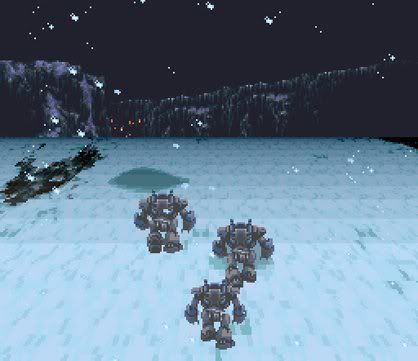
Watching mech-suit dudes walking toward a town has never been this enticing.
Words cannot describe the (unfortunately, I have to use this terribly trite word) epic nature of this cinematic. One must bear witness to such treasures so that the mind can understand it.
8: Choices
When you're making a difficult decision whilst playing your latest game on your new console, bear in mind that the sort of choices you're making actually came from a game like Final Fantasy VI in the beginning. With such a robust cast of characters, there are times in this game where you embark upon tactical gameplay which consists entirely of you forming up parties and fighting. Who you choose to bring with you, where you go and what you do can - and will - affect the outcome of the scenario and the game itself. If you're not careful, there are characters you'll never meet and people who you've grown close to who might just up and die. 1994 was certainly a good time for video games.
9: Battle Scenarios
Chrono Trigger has the advantage of real-time monster fighting goodness, but there's something about Final Fantasy VI's style that cannot be denied. The way the game sets itself up makes the random combat not quite as frustrating as it definitely could be. Sure, you could find it annoying at times, but the combat itself more than makes up for it. With the host of Relics, magical abilities and powerful weapons available, you can create battle scenarios that your friends might never have even tried. Yes, the monsters are static images, unlike Chrono Trigger's fully-animated monster things. But damn, those images sure do look good.
10: Ultros
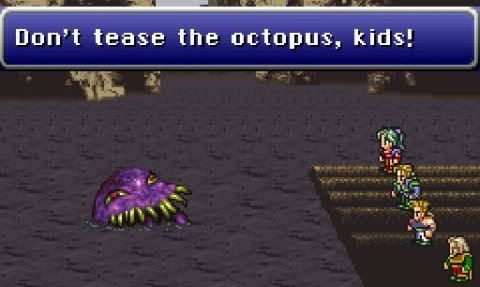
One of the most unique 'villains' of all-time.
You know him, you love him, and he's totally an octopus. This guy follows you around for most of the game, causing headaches as well as humour when you least expect it. Man, I love this guy. Who does Chrono Trigger have? Maybe Robo? But I'm not dealing with that Rick Astley theme-song copying mess. Trust me on this one.
So, there you have it; ten perfectly legitimate reasons why Final Fantasy VI is the superior game. And, whilst I'm an avid defender of the greatness that is Final Fantasy VI, please don't miss out on Chrono Trigger either. The game is damn good.
Just not as good as Final Fantasy VI.
Labels: 2011, Andrew Whipple III, Chrono Trigger, Final Fantasy VI, PS1, SNES
- Andrew Whipple III

Squaresoft, one of Square Enix’s pre-merger companies, has made some of the most celebrated games of all time.
Arguably their best work was produced in the mid- to late-90s, on the SNES and PlayStation. Of their many classics, few are in as high regard by gamers as Final Fantasy VI and Chrono Trigger for the SNES. Released a year apart from one other, in 1994 and 1995 respectively, both FFVI and Chrono Trigger have had a resounding impact on the RPG genre. Both titles are fondly remembered even today, and remain mainstays on many gaming publications’ 'Greatest Games of All Time' lists.
Of the two, though, Final Fantasy VI is often remembered as the better, placing higher on the same Greatest Games lists, and enjoying greater notoriety than Chrono Trigger’s relative level of obscurity. This cannot do. As someone who has played and loved both titles, I can say without reservation that Chrono Trigger is the crown jewel of Square’s SNES catalogue, and better than Final Fantasy VI in many respects.
You ask for a reason? Here are ten of them.
1: Combat is much more fun

Whilst the story in Final Fantasy VI is rightly adored, at the end of the day, games are meant to be played, and this is where Final Fantasy VI starts to lose some steam to Chrono Trigger. Compared to the stiff, lifeless battles in Final Fantasy VI, Chrono Trigger boasts an exciting, dynamic take on the Active Time Battle system. Characters actually seem to occupy the same physical space as enemies, and the small idle animations give each monster and ally a feeling of life, rather than an ornate, but ultimately static, picture of opponents. Also, whilst FFVI bestows each character with different abilities for use in battle - Locke can steal, Cyan can use Sword Tech, etc. - none of them are as fun to use as the Inventive Tech system, a variation on magic that allows different characters to combine their powers into an über-attack.
2: Better-looking characters and backgrounds

Perhaps it isn't fair to call out an older game for looking worse than a newer one, but Chrono Trigger’s sprite work is easily superior to Final Fantasy VI’s. Whilst series stalwart Yoshitaka Amano’s lovely art direction isn’t necessarily worse than Akira Toriyama’s work on Chrono Trigger, the world and characters in Chrono Trigger look much better-realised, with brighter colours, more environmental detail and far more expressive character sprites for each of the cast. Modern consoles will become more and more powerful as time goes by, but there will never be a day when Chrono Trigger is not a beautiful game.
3: Leaner, more-focussed experience

Final Fantasy VI is an epic, grand tale of many characters, locations and plot points, taking anywhere between 35 and 60 hours to complete, depending on your level of thoroughness. Chrono Trigger, whilst telling a story spanning across time, has fewer characters and locations, making its play time something more like 15 to 20 hours (again, dependent on thoroughness).
Why is this a plus? Chrono Trigger has much better pacing throughout, and its comparable brevity makes it easier to revisit (more on this later). Final Fantasy VI is replete with well-written characters, each of which are fleshed out (yes, even Gau...), but it’s easy for members of the cast to get lost in the sauce. Chrono Trigger - whilst not necessarily featuring characters as complex - features fewer characters painted in broader, but no less loving, strokes, resulting in a more memorable cast of digital thespians. Perhaps it’s personal preference, but I would rather have a slightly shorter, more-focussed game I could replay often (see also Super Mario RPG), than a sprawling, overly-long game that I would never want to sit through again (see also Final Fantasy VII).
4: Greater sense of imagination and place

The steampunk vibe of Final Fantasy VI is undoubtedly pretty damn cool. Steam-powered armour, subterranean castles and an Orwellian research facility for magic contribute to FFVI’s sense of aesthetic. That said, there are just as many bland, generic towns dotting the map face are there are memorable locations. Chrono Trigger’s world is smaller than FFVI’s, but it presents six variations of each location, depending on when you visit it. These range from prehistoric mud huts, to lively modern fair grounds, to post-apocalyptic domes. FFVI’s appeal lies in the subtleties of the locales, whilst Chrono Trigger’s settings are distinct from the moment the player steps foot in them.
5: Visible enemies

Let’s face it; one of the most tedious parts of JRPGs is the random encounter. No one likes being lost in a dungeon and exploring the place, only to be interrupted by a new battle every four or five steps. Like many JRPGs at the time, Final Fantasy VI suffers from this problem. Unlike many JRPGs at the time, Chrono Trigger - thank goodness - doesn’t. Every monster roams about the dungeon, allowing players to choose when they want to fight - if they want to fight at all. Granted, some areas are impossible to get through without first defeating some enemies, and foes will occasionally spring an ambush, but for the most part, there is no fighting in Chrono Trigger that is out of the will of the player.
6: Player impact on the world

Final Fantasy VI lets players follow along with its well-told and entertaining narrative, but they’re never given a chance to really impact the world with their decisions. Near the end of Chrono Trigger, players are offered a host of optional sidequests throughout different points in time. These quests, whilst not essential in order to finish the game, create visible changes within the game world, letting players alter history, and sometimes the result is not always what the player was expecting. There are also a few other moments of player choice-impact scattered throughout the main quest, but far be it for me to spoil them here.
7: 'New Game +'

Perhaps the single greatest gift to RPGs, and one of the greatest to gaming as a whole, is 'New Game +'. For the uninitiated, 'New Game +' is the option to start a new game, but retaining all previous experience, equipment, money and items collected on your first playthrough. Not only does this offer a great opportunity to absolutely destroy challenging sections of the game, but, in Chrono Trigger, it also gives way to...
8: Multiple Endings

Why bother to go through Chrono Trigger at all once it’s been beaten? The promise of new endings, of course! Chrono Trigger features thirteen different endings, which vary depending on when players decide to challenge the final boss, a challenge which can be undertaken at almost any time from the outset. Endings vary based on who is in the party and during which events the boss is fought. The endings range from good, to bad, to out-and-out strange, with the weirdest breaking the fourth wall entirely. An excellent incentive to relive the title’s finest points, multiple endings give Chrono Trigger an added sense of personality, as well as a stratospheric ceiling of replay value.
9: Many, many small presentation- and gameplay-related reasons

Again, perhaps it’s not fair to condemn a game for not having the small fixes made by its successor, but it’s these small fixes that make Chrono Trigger a much better-playing game. Characters in Chrono Trigger can move in eight directions, feeling much less stiff than the north-south-east-west mobility of Final Fantasy VI. Rather than having to equip an item to run, players can simply hold down a button to move faster. Characters that go unused in battle still level up (though they don’t gain new Tech abilities). When going from exploring to a battle, the game stays on the same screen, instead of breaking the flow and transitioning to another one. Chrono Trigger possesses numerous small fixes that ultimately add up to a better gaming experience, and one that has aged much more gracefully than its more highly-praised brethren.
10: Magus

C’mon.
That isn't to say that Final Fantasy is somehow a bad or inferior game. Far from it. Final Fantasy VI’s grand, epic story and deeply memorable score are just two of many reasons to love it unreservedly. That said, I hold Chrono Trigger closer to my heart, and it will always be my favourite over Final Fantasy VI. Fortunately, both are available on the Wii’s Virtual Console for a measly 800 Wii Points (around $8, or £5.60), giving gamers a better opportunity than ever to experience two of the greatest games of all time. Want to really decide which is better? Snap them both up, and decide for yourself.
Do you think Chrono Trigger is the better of the two, or does your heart lie with Final Fantasy VI? Let us know in the comments, or Tweet us your opinions via the Gamer's Guide to Life.com Twitter account.
Labels: 2011, Andrew Testerman, Chrono Trigger, DS, Final Fantasy VI, Game Boy Advance, PlayStation, Super Nintendo
- Andrew Testerman

Maybe it was all part of my hormone-induced post-puberty hysteria, but I remember a time when Japanese role playing games, or JRPGs, were the games to beat. If you owned a PS1 or PS2 back in the day – which seemingly every gamer did – each year you were bombarded by one JRPG after another. Fans of the genre, such as myself, poured hour after hour into these games, completing every sidequest, finding every weapon; inching ever closer to the elusive 100% completion. Back then, it seemed like JRPGs would always be the king of the gaming hill. Life was good.
So what the heck happened?
With the exception of Final Fantasy XIII, it has been years since I've been offered a decent JRPG for my PS3. The industry has undoubtedly changed, and so have the gamers who fuel it, but have we really reached the point where the classic JRPG has lost its magic? I refuse to consider Fallout and Mass Effect 'RPGs', regardless of their much-publicised role-playing elements. Where are my turn-based battles? Where are my goofy characters? Where is my melodrama?! Call me old-fashioned if you must, but if you’ve rubbed the soreness out of your eyes at 3:00 a.m. whilst trying to strategise just which party members to use and what battle tactic to implement, in order to get through that one final boss, then you know what I’m talking about.
With the barren JRPG landscape in which we currently find ourselves, it dawned on me that thousands of gamers out there might not have even had a chance to experience a decent JRPG. Really, the only viable solution for those out there wondering what is it about these 'Final Fantasy-type games' that makes old-school gamers go mental is to mine the classics. Well, consider me your guide.
If you’re a JRPG buff, you’ll find below a short but tasty list of some of my favourite games, that you might - but shouldn't have - missed out on back in the day. If you're a JRPG noob that can’t tell apart a potion from an elixir, do yourself a favour and check out one of these games ASAP.
Dragon Quest VIII: Journey of the Cursed King
A silent, yet heroic, protagonist. A princess in peril. A buxom girl with the power of magic. A talking frog. If ever there were a JRPG that defines the genre, Dragon Quest VIII is it. Dragon Quest VIII was released in Japan in 2004, before making its way to North America in 2005, and finally to Europe and Australia in 2006, during which time the PlayStation 3 was looming overhead and the PS2 was slinking into the shadows. When all was said and done, Dragon Quest arguably ended up being one of the last hurrahs of the ageing PS2, a fitting swan-song for the JRPG on a console defined by the genre.
With DQVIII, Square Enix managed to take every classic element of the JRPG - random enemy encounters, a turn-based battle system, an open world map, item and equipment collection and the need to level grind – that reviewers had been criticising for years as tired and outdated, and make it all seem fresh again. For JRPG enthusiasts, DQVIII was like coming back home after a long holiday; nothing beats sleeping in your own bed, right?
Even now, more than six years after its original release, this game is easy to recommend, with a massive campaign - which can take you anywhere from 50 to 100 hours – and endearing cel-shaded visuals. If you want to find out whether or not JRPGs are for you, this is the game to try.
Shadow Hearts: Covenant
Shadow Hearts: Covenant is set during the First World War, and features a dark and tortured hero who has no need for wussy magic spells. Oh no, because he can turn into a demon. All types of demons, actually. If you’re wondering; yeah, he is badass. The cast of playable characters is certainly one of the most memorable and eclectic ever to be featured in a JRPG, including Gepetto, the doll maker, who makes use of his puppets to battle; Blanca, a white wolf; Joachim, a French vampire wrestler; and the one and only Princess Anastasia Romanov.
Oh, did I mention that Rasputin is actually one of the enemies in the game? And he’s not even the big baddie.
With two discs worth of engaging story, the most memorable aspect of the game is its battle system, featuring the Judgement Ring. Every action you take in battle is governed by the Judgement ring, a kind of dial. Whether or not your planned action succeeds depends on your ability to press the right button, just as the marker on the ring is crossing over the corresponding section of the ring. Each character's judgement can be customised and modified, making markers move faster or slower, and expanding the action areas. When you factor in combos and special moves, you end up with some pretty frantic battles, which require precise timing. Sound complicated? Well, it should, because it kind of is; just do yourself a favour and watch the video embedded above.
If what you see seems at all interesting, give this game a shot. You won’t be disappointed.
Breath of Fire: Dragon Quarter
The first JRPG I ever played was Final Fantasy VII on my PS1, and so began my obsession. The second JRPG I got my hands on was Breath of Fire III, and so was my obsession cemented. Breath of Fire has held a special place in my heart ever since.
Like the Final Fantasy series, the games in the Breath of Fire series have many elements in common, that carry over from one game to the next; primarily, the blue haired protagonist, Ryu, who had a bad habit of turning into a dragon. With Breath of Fire V, or Dragon Quarter, the fine folks at Capcom turned the series on its head. Forget the sprawling open worlds that the previous games were known for, filled with floating castles and magical forests; Dragon Quarter sticks you in a post-apocalyptic world in which humanity has been forced to retreat underground. Depressing and dreary scenery is the norm. The battle system was completely reworked, with no more random encounters; rather, enemies are fought directly in the dungeon environments, with a grid based battle system slightly reminiscent of Final Fantasy Tactics.
The greatest change, however, is the difficulty. It is insane. Why’s that? Well, when you die, you actually die. That 'Game Over' screen is not just there for kicks; the game is very much over and you must start again from scratch. Why the hell would you even play this sick, sadistic game, churned from the minds of Japanese madmen? Well, each time you die and start over, your keep your abilities, items, equipment and level; not only that, but as you die and restart the game, your D-Ratio increases.
What does this mean? A higher D-Ratio will give you access to areas, cutscenes, and plot points which were previously inaccessible. Long story short, in order to experience the whole game, you need to die and play through it more than once, with the bright side being that each time you play, things will be different. This makes up for the relatively short 10 hour campaign.
This is as about as hardcore as hardcore gets. Man up and get on it.
Chrono Trigger
What happens when you take the game developers behind Final Fantasy, pair them up with the character designer from Dragon Ball, and throw in an epic story featuring time-travel and the fate of the world?
Epic awesomeness, beyond compare.
Forget Final Fantasy VI; if I had to pick one JRPG out of the Super Nintendo catalogue, Chrono Trigger would be it. Extremely innovative for its time, nowadays Chrono Trigger’s mechanics are classic. The battles are typical JRPG turn-based affairs, but the Active Time Battle system - in which each character gets a turn to strike once a specific timer bar fills up – has rarely been so well implemented. First of all, enemies are fought right on the environment map where you encounter them, with no separate battle screen required. As for your combat options, things get quite tactical, with area-affecting spells and the possibility to combine two characters' moves for combo specials, with devastating effects.
What truly makes this game timeless, though, is its story. Heroic feats, magic spells, and time-travel are the things childhood fantasies are made of. Many JRPGs create worlds with rich histories and fantasy-filled futures, but Chrono Trigger lets you experience the history and future of its world, and it’s quite a ride. Couple that with some incredibly endearing and memorable characters, and gorgeous animation, and you have a truly timeless game. Chrono Trigger is already available on the Wii Virtual Console, and should be hitting Xbox Live soon, so there is really no excuse. If you haven’t played this game yet, get it as soon as you can, and stop bringing shame to yourself and your ancestors.
If one of the games listed above doesn’t tickle your fancy, then JRPGs really aren’t for you. Which, sadly, makes you not quite as awesome as I had hoped.
...I should get over it with time.
There are plenty of other classic JRPGs that could stand tall next to the games featured here. Don’t be shy; sound off with your favourites in the comments below.
Labels: 2011, Breath of Fire: Dragon Quarter, Chrono Trigger, Columns, Dragon Quest VIII, Joey Núñez, PlayStation, PlayStation 2, RePlay, Shadow Hearts: Covenent, Super Nintendo
- Joey Núñez
Subscribe to our content
and never miss a single thing

 subscribe to our monthly newsletter:
Our most recent writing

Our most recent reviews
Recent comments
All comments are subject to our commenting policy
Latest videos

Subscribe on YouTube

GGTL Classics
Some of the very best articles dug out from deep in the GGTL archives, written by some of our past and present wordsmiths alike.
Your continued use of this website and/or any others owned by Gamer's Guide to Life.com represents your acceptance and indicates your full understanding of all of our legal policies and terms. Our legal policies and terms are legally binding. If you in any way disagree with or refuse to be bound by any part of said legal policies and terms, you are advised to leave this website immediately.