 Follow us on Twitter: @ggtl
 Join our friendly community!


Latest news

 7.5.11
We also reviewed Civilization V as a standalone game.
Heilir, brothers and sisters of the shield. Fill your mead horns and slaughter the livestock taken during our last raid; we have cause for celebration. Odin smiles upon us, for he has blessed our warriors with a new method of practicing for their bloody and glorious entrance through the Val-hall Gate, conscripting Firaxis Games on Midgard to heed his raven's call. Weight your hammers and sharpen your axes, fierce vikings, for battle against exotic and formidable foes can now be met in the international colosseum of Civilization V.
Warn the world - the fury of Old Denmark approaches.
Lesser nations? Wall your cities and hide your women - your Ragnarok comes.
In their latest DLC for Civilization V, Firaxis Games gives players the ability to lead an old Norse power, Denmark, into the international fray. Like the Polynesia civilisation offered as DLC before it, this new Danish civ represents not only the geographic nation of Denmark, but also the cultures of its Scandinavian neighbors, forming a true 'Viking civilisation' made up of Scandinavian culture as a whole.
Does this blanketing union of Denmark, Norway, Finland, and Iceland do justice to all five of those unique historical powers? Has Firaxis done justice to Scandinavian history with this DLC? Let's take a look.

Harald Bluetooth, king of all the Danes. He once killed a man for a sandwich... and he wasn't even hungry.
To create their Danish civilisation, Firaxis had to look primarily at the Viking Age, during which period Scandinavian raiders sailed by longboat to to nearly every corner of medieval Europe. For a few hundred years, early kings had practically no defence against these Northmen, who would sail quickly (by either sea or river) to a coastal town and sack it before a larger, slower royal army could arrive to provide protection. To implement this uniquely Norse capacity to strike amphibiously from bodies of water like lightning, the Danes enjoy the 'Viking Fury' special ability, which gives land units extra movement while embarked, a milder movement cost when moving from sea to land, and no movement penalty for pillaging a tile.
Viking Fury alone makes Denmark one of the most formidable military powers in Civilization V. When coupled with their special units, the blitzkrieg potential of the Danish civilisation becomes downright frightening. Both Berserkers, skilled amphibious viking warriors who replace the Longswordsman, and Norwegian Ski Infantry, excellent snow and tundra soldiers of Winter War fame, enjoy extra turns over the units they replace that allow them to cover substantial distances in a short period of time. With a navy to protect them as they embark, both can lead quick, effective invasions that will easily wipe unprepared players off of the map.
There are two ways to catalyse Denmark's unique abilities: conquering and exploring. Conquering is fairly simple; no matter how you start your game, choose scientific research so that you get Optics (and therefore embarkation), Steel (which unlocks the Berserker), and Rifling (prerequisite for the Norwegian Ski Infantry) as soon as possible. Whichever social policies you choose are really just a matter of taste, as long as you create an empire that can buy, train, or upgrade Berserkers and Norwegian Ski Infantry in high quantities once they become available. Once you have your army of special units, allow them to travel over water (you may want to train a naval escort) to whichever leader you'd like to wipe the smirk off the face of, cook up some microwaveable popcorn, and watch the nations crumble like sandcastles. Sandcastles being attacked by viking raiders. Your viking raiders. It's a good feeling.

Every Danish land unit embarks in classic viking longboats. This includes modern units like Giant Death Robots, which I imagine weigh at least 60-70 tonnes. It takes a special kind of heroic, foolhardy badass to storm a beach with waves of mechanised infantry, backed only by the naval equivalent of glorified wooden yachts.
Surprisingly, I've also found that Denmark's embarkation bonuses make it a great choice as a peaceful nation of merchant explorers allied with all the world's city-states. It works like this: build a navy of discovery, and send it out to discover all the city-states, natural wonders, ancient ruins, and potential trading partners (opposing players) your map has to offer. The downside of this tactic for any other civilisation is that it takes real time and effort to explore all of the ancient ruins discovered, as a land unit is required to dig around the remnants of old Troy and pillage its cultural, populatory, or monetary benefits, unless your Danish land units receive embarking units that allow them to island-hop from ruin to ruin relatively early on in the game. The benefits of exploration for Denmark can give it the cost-effective leg-up it needs during, say, the classical or mediaeval age, to help pay for either a reign of easily purchased buildings and peace, or an army of Berserkers with their minds set on war.
Like in its Polynesian DLC, Firaxis released a historical scenario along with the playable Danish civilisation. 1066: The Year of Viking Destiny puts you in the shoes of Harald Hardrada of Norway, Sweyn II of Denmark, William the Conqueror of Normandy, and the besieged Harold Godwinson of England, as they strive to either protect (Anglo-Saxons) or conquer (Vikings and Normans) the fields, hamlets, and cities of early mediaeval England.
From a strictly gameplay-centric point-of-view, this scenario is terrific. Each playable leader receives his own powerful special unit and ability, to cultivate a strategy around. Both Sweyn and Hardrara receive the amphibious, quick-moving Berserkers used by Harald Bluetooth in regular games, as well as the general embarkation bonuses of Viking Fury. William the Conqueror can both dig in with the Motte and Bailey improvement (a castle built by Swordsmen which provides +100% defence to any units on it and damages all enemy units adjacent to it by 3 health per turn) and unleash offensive hell on enemies with his Norman Knights, which receive the Blitz promotion (allowing them to attack twice per turn), to carve his place in history. Harold Godwinson protects his throne against all three threats eclipsing him, by enlisting the help of city-states (influence with them degrades at half the normal rate) and employing Huscarls, which receive a free Cover I promotion (+25% against ranged attacks) and boast a +50% combo bonus when facing mounted units.

How different would European history have been if he didn't win at Hastings? This scenario can make that happen.
The entire scenario is geared towards reckless war - allied city-states turn over direct control of their units to you; happiness, culture, and diplomacy are turned completely off; and the only way to beat the game is to complete the Domesday Book wonder in London (which can only be constructed after building six Domesday Shire Courts in English cities). With so many special units and abilities to choose from, there are numerous tactics that can be employed in order to take London and complete the Domesday Book before time runs out.
Never before have I seen a country as demolished as the England in this scenario. It's downright gratuitous. If you play as any of the invaders, you'll get a scripted note every so often saying, "Hey, you know that rapine and murder you keep writing home about? Well, Steve back here in the motherland wants in. I know, I know, Steve didn't want to come before... he said the whole idea of invading a foreign country was a waste of time. But he's changed his mind! And he convinced some friends to come along. Come on, check them out." Just like that, you'll receive six free, mincing, bloodthirsty units to unleash on whatever quivering English women, children, and sheep are left in its burning towns and fields, for absolutely no cost. The wanton destruction I caused playing this scenario three times left me quiet, philosophical, and in dire need of a shower, some community service, and a good pray to any dear and fuzzy god other than Thor, whose bidding I'd followed quite enough for one afterlife, thank-you-very-much.
Anyone who read our Polynesia DLC review knows that I have a huge problem with the lack of effort Firaxis has put into adding unique, scripted flavour to new Civilization scenarios. Paradise Found, the scenario released alongside Kamehameha and friends last March, was a huge let-down in that it tried so very little to recreate the legendary creativity and scripted fun of scenarios found in Civilization II. Everything was bare-bones, and that made the whole scenario feel dry and unfinished, like a deserted beta Firaxis chucked out at the world, in a failed attempt to justify its unreasonably high DLC prices. '1066' does a much better job of spicing up the scenario, even though it still falls nowhere in the standards of the scenarios of yore.

Ah, Stonehenge. After the seventh world war, when humans have long since been replaced by Robotnikoidian overlords, it'll still be hanging around, standing up straight like nothing's happened.
Seeing Stonehenge, or discovering a decrepit Hadrian's Wall north of York. Becoming allies of Welsh city-states and receiving Longbowmen before they were popularly implemented into the general British culture was fun, as was seeking out and conquering Ireland as the Normans instead of London, potentially making Dublin the high seat of an Irish Empire with the power of historical England. Though there are no creative, slightly-theatrical scriptings to go along with the conquering of Dublin or the addition of Welsh peasant longbowmen to your army, they still go a long way towards making the scenario especially deep and fun for history buffs hungry for a richer scenario, in which they receive dynamic, interesting, fun answers to all their 'what-ifs'. We want historical Easter eggs. 1066 is a quantum leap in the right direction.
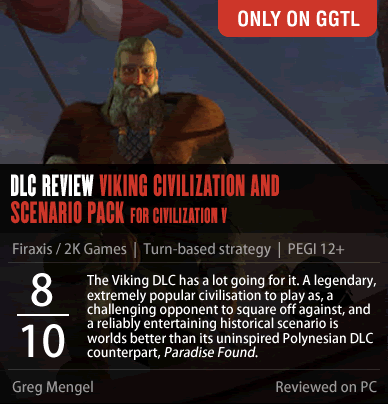
The Viking Civilization and Scenario Pack has a lot going for it. A legendary, extremely popular civilisation to play as, a challenging opponent to square off against, and a reliably entertaining historical scenario that - whilst not amazing by any stretch of the imagination - is worlds better than its uninspired Polynesian DLC counterpart, Paradise Found.
I tip my mead horn to you, Firaxis. It may be a little expensive, but this DLC will definitely grace my computer screen for months, maybe years, to come. Odin would be proud.
8/10 [?]
Labels: 2011, 2K Games, Civilization, Civilization 5, Civilization V, DLC, DLC Review, Firaxis Games, Greg Mengel, History, PC, Review, Sid Meier
- Greg Mengel

Sid Meier's Civilization series is about a lot of things. Planting personality tumors on the pristine images of celebrated world leaders. Winning a pious cultural victory as a peaceful Mongol empire filled with flowers and hippie children. Destroying the primitive United States of America and annexing its archipelago'd island territories during the Renaissance. Sending Babylon to the moon. If you were forced by a crazed video game journalist to describe the Civilization series in one word at gunpoint, you might squeak out words like "history", "possibility" or "alternative reality", past trembling lips.
Civilization is, at its core, a lump of moist clay that the player moulds with artistic skill, as they sculpt a geography and human culture any way they wish.
It's a game wherein changing history is all the fun.
To effectively alter the course of history, one must have tools to work with. In Civ, these tools are civilisations themselves. The more you have available, the more you can change the course of human experience, tweaking its story into something utterly historical and wonderfully unique. Here are, in two parts, 25 civilisations that should be welcomed with open arms into the melting pot of Civilization V, complete with possible Special Units, Special Buildings, Special Abilities, and explanations from my history major brain as to why I selected each.
The greatest article-background theme music in the history of YouTube.
Let's begin.
1: Carthage

Leader: Hannibal Barca
Capital: Carthage
Special Unit: Numidian Cavalry. The most important cog in Hannibal's trans-alpine army had to be his Numidian Cavalry, light horsemen who he constantly used to flank, surround, and generally irritate Roman Legions, with constant raids in nearly all of his campaigns. An affordable replacement for the Horseman, costing fifty hammers and boasting a whopping five moves per turn, with the same negative penalties as its forerunner for crossing rough territory. Perfect for the frugal ancient warlord on the go.
Special Building: Cothon. A protected inner harbour that secured Carthaginian naval and trade interests when besieged by a superior naval force. Acts as a dual harbour and market.
Special Ability: Sons of Tyre. As descendants of the Phoenicians who founded Tyre, Carthage knew how to build and maintain a gigantic trade network that spanned north-to-western France, and south to the eastern coast of Africa. Not too shabby for a navy of quinqueremes and galleys. + 1 movement for naval vessels, and x2 gold received for meeting new city-states.
Overview: The Lex Luthor of Ancient Rome has already made appearances in Civilization II and IV. If Carthage isn't offered as Civilization V DLC in the near future (alongside an Ancient Mediterranean scenario), I'll eat my hat.
2: Plains Indians

Leader: Sitting Bull
Capital: Black Hills
Special Unit: Dog Soldier. A military society of the Cheyenne who fought fiercely against American expansionism. Not the biggest fans of Washington's 'Manifest Destiny' ability in the game... Replaces Lancer, receiving +1 movement and +50% combat bonus when fighting in friendly territory.
Special Building: Hunting Party. Worker improvement which causes Horse and Deer tiles to provide production points, and Deer to produce twice as much food as usual. Even better, add Buffalo to the game. Appears as Tipi on the map (like the Polynesian Moai).
Special Ability: Ghost Dance. The prophet Wovoka's vision of a world of peace and prosperity with all nations plants the seed for a Plains Indian utopia, which the entire world can look upon with awe and harmony. Golden ages last 60% longer when Sitting Bull is not at war.
Overview: The idea of a broad Native American civilisation led by Sitting Bull in Civ IV cheapened the unique cultural history of many a Native American tribe lumped into it. Whittling the civilisation down into Plains Indians and Iroqouis (who are already in Civ V) makes much more sense.
3: Israel

Leader: David
Capital: Jerusalem
Special Unit: Mossad. Yep, it's time for Sid Meier to bring back the spy. How the Mossad functions will rely heavily on what abilities normal spy units are given (if Firaxis ever implements them). That said, this secretive espionage network has penetrated just about every international trade network on the planet. It even emerged from the shadows in 2001 to warn the Pentagon of "a major [terrorist] assault" that turned out to be 9/11. They're all cloaks, daggers, and ninja stars of Jerusalem.
Special Unit 2: Caterpillar D9. Part bulldozer, part tank, this mechanised, armoured engineer is suitable for duty in both peace and war. Replaces worker in modern era, defends itself with 20 strength.
Special Ability: I have two ideas that might be kosher... The first is Promised Land. As the high seat of the land given to your people through divine covenant, your first city automatically receives a Temple at no cost. Additionally, happiness and gold obtained from Incense and Wine is doubled for the course of the game. A second special ability could be Diaspora, which gives your civilisation a free settler at your capital every time an enemy captures one of your cities, or two settlers if they take your capital. Founding new cities with those settlers costs no penalty to culture.
Overview: Israel has straddled the fence between moderately important nation and world power since the Middle East worshiped djinn and sent tribute to Babylon. It deserves its first invitation to the big civilisation dance since Call to Power.
4: Byzantine Empire

Leader: Justinian I
Capital: Constantinople
Special Unit: Cataphractos. Mail-clad katafraktos, heavy melee horsemen, had existed in Greece and the Middle East since ancient times, but were revived and perfected by the Byzantines as they set out to reconquer the territory of ancient Rome. This heavy cavalry hammered relentlessly against Persian and Arabian lands, reclaiming huge chunks of lost Roman territory in the Middle East. Cheaper and more mobile than their western-European counterparts, Cataphractos boast +1 extra movement and half the production cost of Knights.
Special Building: Hippodrome. Who says sports and politics don't mix? There was a long period when Byzantine politics were split up according to who cheered for which faction in Constantinople's famous Hippodrome, a giant, circular horse-racing arena. The Hippodrome replaces the Circus, and provides +3 happiness and +3 culture per turn.
Special Ability: Roma Orientae. Founded as a second capital to protect the Eastern territory of the Roman Empire, the Byzantine Empire has always considered itself the last bastion of Roman might, order, and civilisation, and seeks to restore their territory through military means. As far as your citizens are concerned, sending generals to force out barbarians squatting in Italy, Spain, and Numidia is all part of the family business. Annexing cities or installing puppet states causes half as much unhappiness.
Overview: Civilization IV gave players their first shot at playing Rome's younger, smaller brother, the Byzantine Empire. Somehow, they weren't as fun to play as I had anticipated... Civ V should give them another shot.
5: Ethiopia

Leader: Haile Selassie I
Capital: Addis Ababa
Special Unit: Kush Footman. Mentioned repeatedly in ancient texts, like the Bible, the Kingdom of Kush stood as one of the most powerful countries in the ancient Mediterranean. It repeatedly pushed back invasions from larger powers like the Seleucid Dynasty, Egypt, and Rome. A quick Spearman replacement which receives a two extra strength (9 instead of 7) and twice as many moves per turn (4 instead of 2) than its counterpart.
Special Unit 2: Oromo Militia. While it had a cavalry, early modern Ethiopia probably didn't need one. Due to their cultural predisposition towards foot travel, the Oromo people living in Ethiopia have repeatedly demonstrated their quick ability to pick up their guns and defend their homeland. A fast replacement for the musketman, that receives +3 movement in friendly territory.
Special Ability: Abyssinian Tenacity. Egypt. Italy. Arabia. Rome. A rogue's gallery of civilisations have tried and failed to crush the Kingdom of Ethiopia under their heel and come back battered, beaten, and a little less belligerent towards the soft-spoken African of ranchers and intellectuals. Military units facing superior forces (units with higher strength) receive a 50% combat bonus. Take that Mussolini.
Overview: The Kingdom of Ethiopia has been too important for too many centuries not to be considered as viable DLC content for Civ V. While we're at it, Firaxis should add Bob Marley as a Great Artist, just so the game has a dash of Selassie-inspired Rastafarianism to calm its torrents of international war. One love, brother. One heart... The last time we saw Ethiopia was Civ IV.
6: Brazil

Leader: Pedro II
Capital: Brasilia
Special Unit: Jungle Brigade. When your backyard is the Amazon rainforest, you'd better know a little bit about wilderness survival. Every one of these guys could've killed the Predator. A replacement for the Rifleman, the Jungle Brigade receives no moving penalty for trekking through rugged environment tiles, and enjoys a +50% bonus when fighting in forests or rainforests.
Special Building: Engenho. Want bananas? Spices? Rubber (which, by the way, should be added to Civ V immediately)? Then find your way to Brazil: they've got luxury resources aplenty and a specialised system of cultivating them. Cities with access to any resource that requires a plantation can build an Engenho, which doubles the happiness obtained from all such plantations within city limits and provide a small (one hammer) boost towards production.
Special Ability: Jewel of the Amazon. Since its earliest colonisation by Amerindian tribes, the geographic location of Brazil has enjoyed an exotic cornucopia of natural resources to cultivate, export, and enjoy. In a way, the wide range of goods found in Brazil's fields and plantations is representational of its extremely varied cultural and biological diversity, which itself is a wonder to the known world. Happiness output of luxury items is doubled for the course of the game. That, or they could treat all jungle tiles as roads, à la Hiawatha's Great Warpath. It's up to you, Firaxis.
Overview: Analysts around the globe are predicting that the next twenty-or-so years will be Brazil's time to step up to the plate as a major hitter in the international "Big Power Club." Its GDP is currently ranked eighth, making its economy larger than those of Russia, India, South Korea, and Australia. That's impressive to say the least. This would be Brazil's first trip to the big civilisation dance.
7: Inuit

Leader: Kiviuq. Finding a famous Inuit chieftain has proven to be a difficult task, for two reasons: (a) the scattered nature of Inuit tribes provides no framework for a united leader, and (b) Europeans seem to have taken only generalised, unspecific records of their dealings with Inuit tribes since the Age of Exploration. Choosing Kiviuq as the leader of the Inuit is the equivalent of choosing King Arthur as the leader of the English.
Capital: Nunatukavut
Special Unit: Qajaq Hunter. As inventors of the qajaq (anglicised as "kayak"), Inuit hunters often traveled in search of better whaling territory. Oftentimes, the best spots had to be wrestled from the hands of rival tribes through violent raids, which meant that Inuit tribesmen had to be ready to both attack and defend themselves from threats on land and at sea at a moment's notice. Replaces the warrior, can instantly embark and receives no penalty for making amphibious assaults.
Special Building: Odoodem Monument. To honour both the lives and deeds of their ancestors and the grand mythology of their tribes, indigenous peoples in the North American Pacific Northwest created great cedar monuments, physical reminders of the deeds of their clan. These unique Odoodems (totem poles) stand tall as constant reminders of the history and culture of the Inuit civilisation, and can be built by workers directly on a game map. +4 Culture, limit one per city.
Special Ability: Sacred Orca Hunt. Plains Indians are to Buffalo Hunts as Inuit are to Whaling. Nearly every aspect of Inuit life, from the fabric used to make their clothes to the bones needed to create their sleds and weapons, relies on the ability to obtain resources from the sea. All naval and embarked units work as fishing boats, and sea resources (Fish, Whales) produce double food and money. As a luxury resource, Whales also produce double happiness.
Overview: I believe the Civilization series is about not only pitting great powers that never would have contacted each other in actual history against one another, but also about giving civilisations that never developed into great powers a chance to do so. Imagine what a vast, advanced Inuit civilisation would look like, towering over smaller, less technologically advanced cultures like the indigenous Russians. To me, that's a core aspect of the historical free-for-all that is Civ.
Photo by Rolf Hicker.
8: Mexico

Leader: Benito Juárez
Capital: Mexico City
Special Unit: Zapatistas. Nobody does rebellion like the Mexicans. Is el presidente ignoring your hungry, poor territory? Rebellion. Are you feeling a little communist-y this morning? Rebellion. Did bad salsa from the official government Cinco de Mayo picnic incite a revolution of heartburn in your gastronomic heartland? Rebellion. When you're taking down governments with nothing but your poncho and a dream, your greatest ally is mobility. And tequila. But mostly mobility. Replace normal Cavalry with a boost to movement (from 3 to 4) and no terrain cost.
Special Building: Hacienda. Though owned by often opulently wealthy patróns, haciendas have been centres of peone and campesino (peasant) society since the first Spanish landowners built their mansions in the New World. One unique group to grow out of hacienda culture is the vaquero, a Mexican cowboy whose impact on cultural history gives all livestock tiles, within the limits of any city possessing a Hacienda, +2 food per turn. Becomes available upon the discovery of Civil Service.
Special Ability: Batallón de San Patricio. During the Mexican-American War several thousand Irish, German, Canadian, English, Italian, Spanish, Polish, Scottish, and Swiss Americans were so struck by Mexico's almost mystical devotion to Catholicism that they expatriated, forming a now-legendary battalion of treasonous heroes who stood toe-to-toe with the onslaught of an adolescent but bloodily effective American military. Let's assume that the Mexico you play as is as closely tied to a similarly widespread religion, giving you a 10% chance to convert an opposing civilisation's units to your side after defeating them in friendly territory.
Overview: Say what you like about Mexico having never grown into a power worth representing in Civ V; its unique and lasting effect on world culture is more than substantial enough to merit a chance to wave the red muleta of competition at the bullish kingdoms of England, Persia, or Siam in the high-stakes international dance found only at el grande plaza del Civ.
9. Zulu

Leader: Shaka
Capital: Ulundi
Special Unit: Impi. Though they later adopted rifled weapons, these legendary warriors originally used shields and heavy throwing spears so effectively that they proved a challenging foe first for Boer Commandos, and then for the technologically-far-superior British Empire at the height of its power. Sporting only slightly higher attack power than Spearman, which it replaces, the beauty of the Impi is its ability to also launch ranged attacks (Melee Power: 8, Ranged power: 8, Range: 2). One unit type, all the ancient invasions you can eat.
Special Building: Ikhanda. Same as the Barracks, except that it requires no maintenance and cuts the cost of military units bought in that city by 33%. Experienced warriors lead to pillaging, which leads to cash back home, which when taxed purchases more warriors, which in turn leads to more pillaging! It's basic economics.
Special Ability: Stealing Their Rifles. Just as the Impi eventually adopted rifles after waging war against the Royal Army and Boer colonists, so does Shaka adopt the technology of all his opponents. Gain science from every enemy unit killed. Go on, wipe out that peaceful city-state full of monks, orphanages, and unicorn giggles. For science.
Overview: The Zulu have been in Civilization since its humble beginnings. As a perennial alumnus, its warm welcome into the Civ V fold is just a matter of time.
10. Cahokia

Leader: High Mississippian Chief. We know so very little about Cahokia in the academic community that a generic name will have to do. That said, scholars have excavated a large building at the top of Monk's Mound that could have likely been a paramount chief's palace, and large, ornamented burial grounds protecting the remains of an important individual surrounded by weapons and icons of a falcon-man.
Capital: Monk's Mound
Special Unit: Falcon Warrior. To create its impressively vast trade network, Cahokia must have sent warriors far and wide to 'coerce' smaller Native American tribes to trade with them. The Falcon Warrior acts as a Scout-Warrior hybrid, enjoying the attack power of a Warrior (6), the free movement over terrain of a Scout, and the promotion trees of each.
Special Building: Ceremonial Workshop. Cahokian excavations have unveiled a copper workshop surrounded by religious items such as large earrings and long-nosed god maskettes. Has the same cost and bonuses as the Workshop, which it replaces, with an additional +1 culture for every cultural building created after it.
Special Ability: The Long Arm Barters. At its height, Cahokia likely oversaw a vast north American trade network reaching as far as California, Canada, and the Aztec capital, Tenochtitlan. Around 1250 AD, its population is estimated to have included as many as 40,000 people, making it larger than the London of the time. Maritime and Cultural City-States offer gifts of resources at Friendly (instead of Allied) status.
Overview: Cahokia, like the Inuits, are another 'civ that could have been'. If it hadn't mysteriously disappeared during the 15th century, for reasons that I can only assume are somehow tied to the Philosopher's Stone, Cahokia might have blocked European colonists from decimating North American civilisation with the awesome power of blankets.
11. Bulgaria

Leader: Krum
Capital: Tarnovo
Special Unit: Bolyar Knight. Representing both minor and major Bulgarian nobility, Bolyar knights were responsible for leading Bulgarian troops into battle against their many enemies lurking both along and just beyond the East European frontier. With threats against the kingdom encroaching from all sides, Bolyar Knights boast the same high movement rate and attack power as basic knights, but enjoy the Medic promotion free upon spawning.
Special Building: Literary School. During the early medieval ages, Bulgarian Emperors mandated that literary schools promote scholastic study of the Glagolitic and Cyrillic alphabets (the most famous alphabets ever). Replaces the Library, providing +1.5 science for every 2 citizens instead of the normal +1.
Special Ability: Bolyar Justice. Life is hard in Bulgaria (pretend I just said that with a Bulgarian accent). As the border between Christian Europe and the forces of the East, drastic measures must repeatedly be taken in order to stop those belligerent neighbours and rampaging barbarians from running amock, with a mailed grasp to the throat. Bulgarian tradition must be protected by any means necessary. The Bulgarian people know that, accept it, and even celebrate it from time to time. +1 happiness per 5 enemy units defeated, which resets every age.
Overview: Bulgarian history is... scary. The dark, cruel nature of the First and Second Bulgarian Empires are hallmarked by rigid religious piety and fear of invasion from strange religions and bloodthirsty hordes. By creating and sustaining two empires in such a volatile hotbed of political, religious and ethnic hostility, the Bulgarian people overcame a challenge that few other nations could have worn. They have every reason to be in Civ V (and a Medieval-to-Renaissance East European scenario wouldn't be find any problems getting played, either).
12. Tibet

Leader: Songtsän Gampo
Capital: Lhasa
Special Unit: Himalayan Infantry. When people think of Tibet, their first thoughts usually don't produce the image of an imposing, tyrannical empire crushing the hopes and dreams of neighbouring kingdoms under the heels of their spiked, plate-mailed feet. Before it adopted Buddhism and became the international paragon of peace and harmony, Tibet was a formidable nation of warriors who became a thorn in the side of Chinese, Indian, and Arabian monarchs (amongst others). While Tibetan cavalry was widely considered slow and cumbersome, its heavy infantry - protected by layers mail and furs - were widely feared in combat. Replaces the Swordsman, does not require Iron to build, receives no penalty for crossing hilled terrain, and can cross mountain tiles.
Special Building: Gompa. Fuse a monastery, a nunnery, a university, and a citadel together, add a mountain, toss in several generations of dedicated monk caretakers, and you've got a Tibetan Gompa: a center of prayer, meditation, exercise, and learning. Gives all the benefits of a Monastery, with the exception that it additionally receives +1 happiness and culture for every mountain tile and +.5 happiness and culture for every three hill tiles within city limits.
Special Ability: Home of the Golden Urn. Though it was originally renowned for the tenacity of its mountain-manly warriors, Tibetan fame reached its height when it became home to the Dalai Lama and his descendants. This font of spiritual wisdom gushes into the minds and souls of your people, giving you access to the Piety Social Policy tree from the start of the game. Another possibility is Roof of the World, which would offer some kind of benefit involving mountain tiles, such as a production bonus, or the ability for all units to cross mountains, instead of just the Himalayan Infantry.
Overview: Despite living in an ecosystem that generally frowns upon the survival of anything living, the Tibetan people have thrived both as a militaristic empire and as a quiet nation of enlightenment. Its success in both manifestations is more than enough reason to let it hang out at the cool kids' table of Civ V.
13. Celts

Leader: Boudica. I would suggest Vercingetorix instead, as he actually won some victories to place on his trophy shelf when fighting Rome, but after how popular Boudica (and her bodice) were in Civ IV, I think players would revolt.
Capital: Bibracte
Special Unit: Wild Beasts. Greek and Roman contemporaries describe their enemies in Celtic Gaul as erratic, unpredictable, and incredibly forceful warriors who fought naked, or covered in animal furs. Though genius generals like Julius Caesar capitalised on the chaotic strategy of Celtic warriors, the vast majority of armies sent to subdue Gaul met swift defeat. That's what made Julius Caesar so popular to Romans; he subjugated the only culture able to sack the Roman Republic. Wild Beasts replace the Swordsman, offering a 14 strength upgrade over the former's 11. Rawr.
Special Building: Dun. Nobody played sofa fort like Celtic children. These ancient, round, moated walls of wood and stone that held back advancing Roman and Germanic armies may have been the father of the medieval castle. Offers 8 city strength, 3 more than is provided by Walls, which it replaces.
Special Ability: Druidism. The spiritual and practical leaders of all Celtic civilisation, regardless of tribe, were the druids. Secretive and cryptic hermits, these magnificently-bearded sages dwelled in caves and forests, studying secret oral traditions and communing with the Celtic gods. Upon re-entering society, druids often instigated great cultural or political change, stopping battles from being fought, unifying rival tribes, or offering tips for a full harvest. When entering a new age, you may select a Great Person of your choice to appear next to your capital twice per game (when entering a new age, an option will appear to select one of your two free Great People, or save them for a subsequent age).
Overview: Ever seen the movie Druids? Yech.
Well, that's it for Part One of my '25 civilisations I believe deserve a chance at world domination by way of Civilization V'. Can you guess what the next twelve will be? Throw your guesses in the comments section below. I'll bet the souls of my unborn pets and children that nobody will divine number 25.
Check back on Saturday (around 5pm BST) to see Part Two of this list, or embrace the short-term memory loss caused by spending the majority of your life staring at a screen and follow The Official, Formal, Incredibly-Intense GGTL Twitter Account of Serious Business and Undeniable Gravitas to get a reminder.
Editor's Update - the second half of this list has been published, and can now be found here. Thanks for reading, and feel free to bookmark Gamer's Guide to Life!
Labels: 2011, 25 civilisations, Civilization, Civilization 5, Civilization V, Feature, Firaxis Games, Greg Mengel, History, List, Sid Meier
- Greg Mengel

We also reviewed Civilization V as a standalone game.
E komo mai, travelers. E noho mai, e 'ai a e, wala'au.
Lay down a towel, mix up a fruity drink in a coconut shell, and take in the crashing waves, orange and blue sunset, and warm ocean breeze with all your senses, friend. Now that your soul is a rainbow of peace, let's talk about the new Polynesia DLC for Civilization V, from Firaxis Games.
Ancient Hawaii may have been paradise. Bananas, pork, coconuts, sweet potatoes, white beaches, crystal seas, clear weather, tropical rainforests, exotic animals, and living room aplenty. Colonised by Polynesian settlers as early as 300 AD, it eventually became one of the largest, most unified bastions of Polynesian culture in the Pacific.
In their latest DLC pack for Civilization V, Firaxis give players the chance to step into the shoes of Hawaii's most famous leader, King Kamehameha the Great, as they cultivate a Polynesian empire that ends not with colonisation by larger powers (as actually occurred), but with a cultural, diplomatic, military, or scientific victory that heralds Polynesia as the greatest and most dominant culture ever to populate the known world.
But has Firaxis done Polynesian culture justice? Let's examine.
King Kamehameha the Great. You could crush a coconut on those abs.

To create a playable civilisation from what was historically a vast, scattered collection of Polynesian tribes dotting the Pacific, Firaxis had to get a little creative. Whilst its leader (Kamehameha the Great) and capital city (Honolulu) represent the Kingdom of Hawaii, the new Polynesian civilisation's unique unit (Maori Warrior, from New Zealand), and unique building (Moai, from Easter Island), originate in locations thousands of miles away from Hawaii. These guys got everywhere; I would only be half-surprised if we found Moai statues on Mars.
The glue that binds the playable Polynesian civilisation together is its unique ability, Wayfinding, an amazing and mysterious form of navigation by which Polynesian explorers supposedly used not compass, but epic song, to chart their progress during long journeys at sea.
As a playable civilisation, Polynesia offers some substantial perks in Civilization V, the most valuable being that Wayfinding allows their land units to embark over water from the start of a game. In an archipelago map set at a marathon pace, a player using Kamehameha can obtain a huge advantage over his or her rivals by using Maori Warriors (which are also available at the beginning of a game) to clear out barbarians and colonise a gigantic ancient seafaring empire. While opponents are stuck on their lonely islands of origin until they discover sailing, Kamehameha can carve out an impressive foothold, beating opponents to key strategic and luxury resources that can turn the tide of a game.
Another helpful trait Polynesia boasts is its ability to order workers to build Moai, which boost the cultural output of what might otherwise be a useless desert square. For players aiming at a cultural victory, a "great wall of Moai" can prove extremely invaluable. The Polynesians are excellent cultural explorers, and may be the game's best option for players hoping to follow the Liberty or Commerce social policy tracks.

Those who download Civilization V's Polynesia map pack will receive not only the playable Polynesia civilisation, but also a scenario, Paradise Found, in which you play as one of four Polynesian leaders as they strive to become the dominate culture of early Polynesia. If you play the scenario on a map of the South Pacific (it is also available on random archipelago map types), you can gain achievements for discovering and colonising famous locations like New Zealand, Australia, Hawaii, and Easter Island.
I found two problems with Paradise Found. The first is that the scenario is far too easy; all a player has to do is focus completely on culture in order to win. Build temples and Moai, churn out scouts and settlers, stir for a few hundred turns, rinse and repeat. My second issue ties into a general problem I have with scenarios made after Civilization II. Paradise Found is nowhere near as exciting or interactive as it could have been with more events, bonuses for exploration, or historical quirks made available by creative scripting. Offering achievements for discovering recognisable geographic locations is a good start... but I want more.
Instead of a lonely text bubble noting that Captain Cook has suddenly shown up and left your territory, changing the fundamental way your culture lives, eats and thinks without so much as a wave hello, for example, I'd like to actually see his ship, and be able to attack it for more treasure and technology [1]. By the same token, I'd love to start the game earlier in history and have some interaction with the supposed Chinese junk fleet discussed in Gavin Menzies' 1421.
New Zealand. Where Maori Polynesians first met their hated, ancient enemy: the sheep.

When I invade New Zealand, I'd like some scripting telling me how the Maori culture of its inhabitants mingling themselves into my empire gives my civilisation (or at least the cities I found in Kiwi territory) a culture or trade bonus. The same goes for Hawaii, Easter Island, and Australia. Perhaps the first culture to discover these areas could receive a scripted message that their exploits have led to the writing of a great epic song that is worked into the empire's Wayfinding tradition, giving a bonus to water travel for all naval units for the remainder of the game.
Once your Polynesian tribe enters the nineteenth century, add a side-quest to find and wipe out Bully Hayes, the famous South Pacific pirate, in exchange for technology, or maybe a powerful exploratory naval unit in the form of the Leonora, his legendary ship. Or just add some basic civilisation contact with the French, the Americans, the Japanese, the Germans, and the Dutch, all of whom were extremely active in the area by the early-to-mid 1800s, in part due to their growing needs for one of its most valuable natural resources: oil. Without even some basic scripting along these lines, Paradise Found ends up feeling bland and uninspired.
For its addition of the Polynesian civilisation in regular games, I give Firaxis all the positive attention it deserves. For the mediocre nature of the Paradise Found scenario, I have little praise to offer.
If you ever read this, Firaxis, I offer one final word of advice. The next time you make a scenario, go to a used game shop, find Civilization II: Multiplayer Gold Edition, load up the scenarios, and immerse yourselves in the scripting of Midgard, X-COM, Atlantis, and The World of Jules Verne. If you can combine the unique flavour of those scenarios with the terrific graphics and gameplay of Civilization V, then you'll have the makings of amazing, must-buy DLC.
Kipi hou mai, travellers. Mahalo.
6/10 [?]
[1] The man was killed in Polynesian Hawaii, for gods' sake. And we know that the Polynesians had lots of strange, spiritual perceptions of Cook that could be tapped into with some creative, theatrical scripting or voice. [^]
Labels: 2011, Civilization 5, Civilization V, DLC, Greg Mengel, History, PC, Review, Sid Meier
- Greg Mengel

“These concubines are less than satisfactory! Beat them, sell their families into slavery, and fast them for a week.” Emperor Washington barked brusquely in his chamber room, naked except for an array of jewelry decorating a pale, pouchy frame. All in the room glanced at each other nervously as the irate leader dressed, belting his longsword and donning his crown as servants draped his shoulders with a sleek bear-skin robe. Sneering, the now somewhat-clothed despot turned on three women wailing desperately on the ornamentally carpeted floor behind him, bodies bruised as tears cut rivers through their painted, sore faces. “Knowing their children and grandmothers labour at the salt mines of Hanoi will teach the ungrateful harlots to please without weeping. Ruined the whole evening...”
“Certainly, great Washington, Child of Zeus, Prince of Moon and Sun.” Grand Vizier Hamilton trod cautiously, bowing slightly in place. “Your vassal, Napoleon, has sent an envoy. A young knight named Richelieu, I believe. He awaits you in the palace hall.”
“Vassal...” Washington scoffed, shutting his eyes. Two slaves rushed from opposite walls to rub his temples. “I cannot tell a lie; the fairy French are more damned trouble than they’re worth. Were they not between me and that warmongering bitch Catherine...” Washington punched left palm with right fist.
“...they would fall before your knights like leaves in autumn.” Hamilton offered poetically.
Washington glared at Hamilton for a moment, as if deciding whether the man was being sarcastic, then chuckled.
“That’s why I don’t kill you and sell your loved ones into labour, my friend.” The leader closed on his aide briskly, slapping him hard on the shoulder. “You entertain me. Come! Napoleon’s lap boy awaits.”
The two advanced towards the White House throne room to meet their esteemed guest. Minutes later, when the coast was truly clear, Washington’s slaves and servants relaxed at the departure of their dictator, their tsunami of fear ebbing temporarily with a collected sigh of relief.
This is the world of Civilization, which has long addicted the masses of gamingkind. Part strategy game, part historical epic, all pure, unadulterated digital heroin; Sid Meier’s classic videogame series will always have a special place in the hearts of hundreds of thousands of gamers.
Its fifth installment does not disappoint. Still, it has issues, like the fact that it turns some of history’s most peaceful cultures and historical figures into genocidal egomaniacs bent on world supremacy. Only in the world of Civilization can Gandhi become an authoritarian fascist bent on the complete and utter destruction of a friendly, defenseless, culture-centric Germany led by Otto Von Bismark, the gentle lamb of leaders of state.
Summed up, here are the pros and cons of Civilization V.
Pros:
Combat. Units not stacking is amazing, wonderful, and terrific. It leads to less units needed overall, which in turn forces players to think strategically about how they fight.Range of victories. Cultural, diplomatic, space, time (score), conquest.
AI. It’s more intelligent than in previous installments... when it’s not acting like the bully from second grade, slapping you up and down the playground (see cons).
Unique civilization units, buildings, and abilities. Unique civilization attributes are much more diverse and useful than in the last game, and will drastically effect the way you play.
Policy Tree. Allows for custom play-style unique to each civilization/policy combo when combined with unique civilization strengths.
Downloadable content. Extra civilizations and official custom maps aren’t here yet, but when they do arrive, they’ll be swell.
Modding. It’s gonna be big. With a nice in-game mod browser and oodles of Firaxis support, the custom game and scenario possibilities have mountains more potential than in any previous installment.
Aesthetics. With smoother graphics, an intelligent soundtrack, and vibrant art, it’s the sleekest Civ yet.
Achievements. Beat the game before the Classical Era? With a single city? Using no hands? You’ll get props for that.
Cons:
AI. At high difficulties, every non-playing civilization secretly - then openly - wants to kill you. Sweet-hammering-Thor, it gets annoying.Steam is mandatory. If you don’t like Steam, tough luck: it’s the only way to play.
Addictive. It's as though heroin and World of Warcraft had a lovechild. When you stay up until four on a work night for the Xth day in a row, it becomes a problem.
Summed up, Civilization is a huge improvement over its many predecessors, but like those ancestors, is riddled with incredibly annoying flaws. The fact that no computer civilization will ever, ever choose to chase a diplomatic, cultural, or technological victory, for example, is just damn ridiculous. Even at high difficulties (and perhaps especially then), warmongering foreign leaders will choose to attack you, even if it means putting their brave but untested archers on a path against your nigh-invincible giant death robot (yup, you get those).
Still, those annoyances haven’t been enough to keep my household from logging a mind-boggling 190 hours of game time since Civ V’s release. One hundred and ninety. With that time you could learn Gaelic, or memorize War and Peace. It’s both disgusting and beautiful, and was achieved by a household which includes not only two Civilization veterans, but also a couple of neophytes who equally enjoyed letting the world of Civ veer them away from their personal and professional responsibilities (medical school, employment, writing this article, et cetera).
What I love most about Civ V is its huge amount of potential. Allow me to explain. For me, the best part of Civ has never been the actual game. Since the first time I installed Civilization II’s Fantastic Worlds expansion pack onto my IBM Aptiva’s archaic and asthmatic hard drive, the jewel of Civ in my eyes has been its customized scenarios and mods. Taking the Civilization template and morphing it into the world of Jules Verne, Arcanum, World War II, Midgard, or Atlantis, allows for countless hours of fun. Civilization V’s in-game mod support paves the way for an era of fantastic and addicting mods like these.
Unfortunately, mods take time, so until a wave of them gestate into beautiful gaming butterflies of awesomeness, the regular game will have to do.
If you are now, or ever have been a fan of history, strategy games, giant death robots, or laughing maniacally before a glowing computer screen in your lair as you crush your many enemies, grossly contorting the historical continuum, then stop reading, jog to the store, and buy this game immediately.
9/10 [?]
Labels: Civilization, Civilization 5, Greg Mengel, Review, Sid Meier
- Greg Mengel
Subscribe to our content
and never miss a single thing

 subscribe to our monthly newsletter:


Our most recent writing

Our most recent reviews
Recent comments
All comments are subject to our commenting policy
Latest videos

Subscribe on YouTube

GGTL Classics
Some of the very best articles dug out from deep in the GGTL archives, written by some of our past and present wordsmiths alike.
Your continued use of this website and/or any others owned by Gamer's Guide to Life.com represents your acceptance and indicates your full understanding of all of our legal policies and terms. Our legal policies and terms are legally binding. If you in any way disagree with or refuse to be bound by any part of said legal policies and terms, you are advised to leave this website immediately.