 Follow us on Twitter: @ggtl
 Join our friendly community!


Latest news

 15.6.12

Being one of the most prestigious franchises in contemporary gaming, you probably don't need me to tell you to get excited for Assassin's Creed III.
While Ubisoft has been cranking these puppies out, ACIII will prove to be their greatest undertaking yet by exploring unfamiliar areas, even to the developers. New open world environments, a brand new combat system, naval battles, improved stealth elements, a half British half Native American protagonist, it's clear Ubisoft isn't trying to make this game good - they're making it unforgettable.
Assassin's Creed III interview
ACIII will explore the often untouched American Revolution time period. Made distinct by the unexplored lands, expansive environments and deep woods of that time, it's an area unfamiliar to Assassin's Creed in general. Playing as Connor, the new protagonist, you'll find yourself running through these wild environments scaling trees and jagged cliffs while combating the fierce weather and feral animals. Don't worry, great as the new scenery will be, dense cityscapes will still make an appearance with Ubisoft's trademark accuracy. Boston and New York will be the focus in ACIII based on a one to three replication ratio. Expect to see timeless buildings like the Old Boston State House as well as the historical Long Wharf. We were also told to be ready to experience events such as the Great Fire of 1776, which we're sure no good will come of.

Revolutionary War venison tastes so good, the Animus shuts down because its jealous it can't have any.
It's important to note that these outdoor environments will feel as you'd expect them to; huge. According to Ubisoft Associate Producer Julien Laferrière, the forested areas are 2,000 x 2,000 which is roughly 1.5 times bigger than Rome in Assassin's Creed: Brotherhood. Being that massive, you can climb every single tree and rock, setup ambushes from the safety of the wood and explore brand new gameplay options that have never existed before in the Assassin's Creed universe.
One of my favourite new mechanics I saw in the showcase was the new weapon called the rope dart. Hailing from a Chinese descent, the rope dart acts as a multipurpose weapon used to take out one opponent. During the demo, Connor was positioned in the trees and used the rope dart to hook a soldier by the throat. Immediately jumping down, the rope slung the helpless soldier into the trees, dangling for his comrades to discover moments later. Whether you use this to take out a target quickly or for more of a distraction is up to you.

Is the apple I took really worth THAT much to you?
The combat has been completely reworked and rewritten for ACIII. Connor is especially handy with an axe and dual-wields, which required a system with more finesse and skill. I can tell you the system is extremely responsive and satisfying, especially when groups of enemies come into the fight. What's neat about this rework is that is also effects the AI. No longer will your enemies be relatively dumb in the fight nor will they allow you to exploit them into doing stupid things. Wait, an Assassin's Creed game where the AI is actually going to present a legitimate challenge? You better believe it.
The most talked about feature of the game would have to be the naval combat and with good reason. Once again, Ubisoft is trying to stroll out of their comfort zone and make something that's worth playing. While we don't know how much of the game will require naval warfare, you'll definitely be able to control your own ship from a third-person perspective. You can leave the helm at any time, interact with your crew, customise your belongings, etc. You can even tweak your cannons by feeding them specialised ammunition, you know, for all that deep sea pirating you're going to do.

Have you seen a hooded man that looks kinda shady? No? Move along.
ACIII looks mighty impressive and even if you're sick of the typical Assassin's Creed formula, there's enough different stuff here to warrant giving it a go. Whether playing the game purely for multiplayer, the new environments and naval battles or for the sake of the narrative, ACIII has something for absolutely everyone. October 30th can't come soon enough.
Labels: Andrew Whipple III, Assassin's Creed III, E3 2012, Interview, PC, PS3, Ubisoft, Xbox 360
- Andrew Whipple III

Originally announced four years ago, right the way back in 2008, I Am Alive has had a rough time in development.
It looked like vapourware until it was recently re-announced as an XBLA/PSN release. Whilst the final product isn't everything it could have been, it still provides a fresh, compelling experience. One year after a disaster referred to only as 'the event', our protagonist Adam returns to his ruined hometown of Haventon, searching for his wife and daughter, who were never evacuated. He carries a bit of food and water, a climbing harness and one unloaded pistol. Though his character isn't given much of a chance to develop, it is refreshing to have a hero whose goal is to simply survive and find his family, not kill all the bad guys.
Continue reading this article »
Labels: I Am Alive, Peter Kratz, PSN, Review, Ubisoft, Xbox Live Arcade
- Anonymous

Rayman Origins
Developer
Ubisoft MontpellierPublisher
UbisoftPlatforms
PlayStation 3, Wii, Xbox 360, Vita (Feb '12), 3DS (Mar '12), Windows PC (Mar '12)Reviewed on
Xbox 360Genre
PlatformerCertificate
PEGI 7, ESRB E10+Over the last few years, though, running from left to right has found its way back into modern gaming lexicon, with no less than five major platformers released for home consoles since 2009. Joining this new 2D renaissance comes Rayman Origins, a quirky throwback to the limbless wonder’s first release on the original PlayStation. Whilst not my favorite platforming game since the genre came back into vogue, Rayman Origins has more than enough item-collecting, wall-jumping appeal for gamers craving more from the second dimension.
Like many of the best platforming games, Rayman Origins features barely any story at all. A brief cutscene at the beginning weaves a tale of undead grannies, brutish creatures and missing fairies, but the plot never becomes heavy-handed; in fact, it barely even registers, unless you’re really paying attention (like the talented wordsmiths who managed to eke five paragraphs out of the game’s story on its Wikipedia page). Rayman Origins foregoes plot in lieu of gameplay, and the results feel as light, breezy and carefree as can be.
Rayman’s journeys take him across sixty different levels and five different worlds, each boasting numerous gameplay hooks to tinker with, like Gourmand Land's ice patches, or the Desert of Didgeridoos' gusts of wind. In each level, players strive to collect small golden lums, which free kidnapped Electoons, who unlock new stages and help advance Rayman’s progress. Rayman also meets and frees several Nymphs along the way, granting him additional powers, such as running on walls or floating through the air.

I’ve you’ve spent more than ten minutes with a 2D platforming game since the SNES, there’s a good chance you'll be able to pick up Rayman Origins with little difficulty. The mechanics of running, jumping and using Rayman's special abilities are smooth and responsive, and Origins plays similarly to other strong platforming games recently released. In fact, I thought it played a bit too similarly; though Origins is mechanically solid, and quite fun in its own right, its gameplay never quite clicked for me, and left me feeling as though I had done similar things before in other games, and had a better time doing it then.
Perhaps it's Origins' over-emphasis on lum-collection, which I found unexciting and overly-simplistic in design. I also grew frustrated with the game grading my level performance and progression based on how many lums I had collected, which makes about as much sense to me as grading how many coins I collected in a Mario game, or how many bananas I scoffed down in Donkey Kong Country. I'm sure many platforming fans will enjoy perfecting their timing to snag that last lum before it disappears, but for me, Rayman Origins' single-minded focus on collecting them felt tedious. With little to offer besides combing every level for every last lum, I kept wondering, like Peggy Lee, "is that all there is?"
Where Origins really comes into its own, though, is during its treasure chest levels. Hidden in every zone, and unlocked only by collecting enough Electoons, the treasure chest levels are ten stages of the most sadistically-difficult, re-try-heavy gameplay this side of Dark Souls. During each stage, Rayman must chase a sentient treasure chest through a series of obstacle course-like areas, staying close to the fleeing chest as platforms collapse, doorways close and the entire zone becomes hellbent on stopping Rayman from getting his disembodied mitts on the escaping trunk. Treasure chest levels require route memorisation to simply progress, as well as a heaped helping of patience in order to finally succeed. These sections stand much taller than any other part of the game, and are easily Rayman Origins' high point; tricky though they are to complete, mastering the timing of each one becomes addictive, and the gratification brought by success is incredible.

Despite its stratospheric level of difficulty, Rayman Origins expertly treads the fine line between 'manageable challenge' and 'totally unfair.' Origins’ levels are rife with mid-level checkpoints, often saving after each new room or major bout of platforming. Rayman is also given infinite lives to progress through the game, the game tipping its hat to experimentation whilst still remaining a steadfast challenge.
Rayman Origins positively drips with personality, best expressed through its vibrant, eccentric art style. Every asset in the game (or darn near close to it) is hand-drawn, as well as stylised to an extreme bent, giving each area and stage a unique, untethered vibe. The art direction is particularly gonzo, leaning heavily on grotesque (though often charming) caricatures; broadly speaking, Origins' look is about as French as French can be, and it’s hard not to appreciate the care and love put into the game's appearance. Its music is pleasing, with jaunty tunes and various bouncy melodies, though none of the tunes stuck with me for longer than the time I spent playing it.

Similarly to other platforming games released since the genre’s new wave, Rayman Origins supports up to four-player drop-in/drop-out co-op. Gameplay as precise as Rayman Origins isn’t necessarily conducive to having multiple people, and Origins gets, if anything, even harder when played with a group. Still, co-op is a blast to play, mostly because Rayman Origins offers one of the most comprehensive player-griefing systems in all of gaming, practically encouraging gamers to take advantage of Origins’ infinite lives by slapping one another around or throwing other characters headlong into obstacles. It isn't the best option for making progress in the game, but co-op in Rayman Origins is still a whole lot of fun.
Really, apart from a few small gameplay design decisions, I have almost nothing negative to say about Rayman Origins, except that I found it fun, but ultimately unexciting. I feel almost perturbed; many in the industry have been crowing from the rooftops about Origins since as early as last September, with several listing it as one of their favourites of 2011. I wonder if I’m missing something, if the game mechanics possess an appeal I can’t understand, or if I’m simply expecting too much. As it stands, Rayman Origins is a great game, and one I would encourage folks to experience, but also one I simply can’t get into it as much as other, similar titles.
8/10 [?]
Labels: Andrew Testerman, Michel Ancel, PlayStation 3, Rayman Origins, Review, Ubisoft, Wii, Xbox 360
- Andrew Testerman

Late to the party, you say? 2011 may be dead and buried old news, but forgive me; I've only just built up the courage to say what I'm going to say.
You see, I'm not a man with splitting opinions, a vicious tongue or a mind for devil's advocacy. I like what I like, and generally that tends to be what everyone else likes. You'll find no 'Homefront was the bestest game evar!' antics from me. But in a year that granted me the gift of Batman: Arkham Asylum, the cherished delight of Portal 2 and the unforgettable, unconquerable, unbelievable Skyrim, amongst a glittering sea of celebrated gems, it was a coma-fuelled carmageddon that gave me the greatest joy.
Driver: San Francisco is a throwback in pretty much every way possible. The story itself harks back to the vibrant, garish and funky, beat-heavy 1970s, where everyone was either pushing coke or doing dope or being a dirty cop or doing something illegal and slightly hilarious. There's also the gameplay, which doesn't burden the player with muddy motion control, sloppy shooting mechanics or faulty free-roam. You drive, and occasionally you'll press a button, move the camera over another car, and press a button. Then you drive again. It's pure, clean and fresh. Whilst most modern titles cram the back of their game boxes with trademarked UltraCrap™ features ("now with 50% more green-brown textures!"), Driver had you, a car and a beautiful city. To top it all off, this is Ubisoft Reflections' last attempt at reviving the lifeless and much spat-on corpse of the Driver series; from the golden age of the ultimate PS1 cop-chase emulator, Driver has fallen hard, shooting itself in the foot with the awkwardly-titled Driv3r and then proceeding to maul its own limbs off in desperation with Parallel Lines and 76. When it was announced that the latest Driver would be a retro throwback to San Fran's heyday, all coddled up in the mind of coma patient John Tanner, eyebrows raised. When the game released, jaws dropped.
Well, mine did at least. See, 2011 was a wonderful year. Not if you were a dictator, or a Middle Eastern rebel, or near an earthquake hotspot, or Amy Winehouse, or pretty much anyone else in this sickening world slowly trudging to your inevitable anti-climactic demise. But, for videogames at least, it was damn exciting. Needles plunged into eyes in Dead Space 2, robots plunged into fiery pits in Portal 2, elbow-daggers plunged into cyborg motherboards in Deus Ex, and Skyrim plunged the world into a fury of 'Fus Ro Dah'-ing and wishing their cats could dual-wield. There was fierce competition, no doubt about it. But Driver: San Fransisco stole my heart and drifted across the Golden Gate bridge with it. And I'll tell you why.
You knew what Dead Space 2 was all about. If you had hands, or even eyes, well before your clammy palms had caressed your controller of choice you knew Dead Space 2 was about kicking alien ass and taking alien names. Maybe you'd completed Dead Space (2008), or just played the demo, or even caught a fleeting glance of a trailer, but any semblance of surprise had been squandered long before you ever played it. You knew how it would feel to decapitate an otherworldly head, and fly about in zero-gravity, and what Issac would say, do, think, whisper, murmur, smell like; the corpse of Dead Space 2 was examined and pored over long before its release into the big wide world. All the grand games of 2011 had the same issue: hyped beyond excess, with endless trailers, walkthroughs and interviews to feast upon, your appetite was spoiled before the main meal. I'm a huge Skyrim fan, and the game itself is unconquerable colossus of scale, and yet killing my first dragon didn't feel all that special. Because only a few months ago, I'd watched Todd Howard do the very same.

Driver: San Fransisco didn't have that problem. I'll choose my words carefully so I don't offend any hardworking Ubisoft employees, but... how do I put this? The game was shoved into a grimy corner to die a lonely death. Advertising was basic; no grand statements spilled from Martin Edmondson's - creative director - mouth; there wasn't a new trailer every thirty seconds. I knew a bit about the game, but I certainly hadn't followed it with the same wide-eyed vigour as I had with the better-endowed releases that came before it. It was brilliant.
When I got the game, seamlessly swinging sideways around San Francisco's sunbathed streets was an absolute thrill. Leaping from car to car in comatic fury was a real joy, whilst the good-cop/bad-cop (or in this case, white-coma-cop/black-sassy-cop) relationship - filled with sharp one-liners and just enough homoerotic tension to emulate all those 70s buddy movies - was riotous fun. With no expectation or preconceived notions, Driver: San Fransisco had an empty stage on which to wow the player, and it did so with all the tricks it could stuff up its sleeve.
The crux of the game had to be the side-missions. The main plot was tongue-in-cheek, bizarre, over-the-top brilliance, with interweaving threads of stolen ammonia and hospital beds. But to keep you interested, there had to be stuff to do, and I'll happily hold my hands in the air and claim that Driver: San Fransisco had the best side missions of any game I've played for a long, long time. Whilst Skyrim had you traversing endless load screens as you fast travel, enter a building, talk for a bit, leave a building, fast travel, find some treasure, fast travel, speak to a guy, and so on and so forth, Driver makes every side mission an attention-grabbing, emotionally-involving rollercoster. Who could forget Jun and Ayumu, clumsy Korean kids who accidentally get themselves embroiled in vicious street-races? An ageing truck driver nearing retirement who is caught up in a Speed-style bomb threat? An unfortunate husband unwittingly driving an adulterous wife to a lesion with her lover?
They each had spirit. They each had flair. They each had soul. Every single one of them felt crafted, sculpted and born out of love, and you find yourself becoming more and more involved in these characters with every lightning-fast second. I shouldn't care about these people! Whole games devote themselves to creating sympathy with a block of pixels, yet fail with a fizzle; Driver: San Fransisco, with a sharp script and colourful characters, grabs you and doesn't let go.
That's without retracing the fleet-footed main plotline, that's so brilliantly tongue-in-cheek yet straight-faced that you can't help but admire Ubisoft's gumption. Going from the meandering countryside roads of automobile shifting fun, through narrow back-alleys of genuinely disturbing plot twists ("Christ - he's everywhere!"), hurtling down the open highway of one of the most thrilling climaxes of the year - Driver was an utter joy to behold.
There are hundreds of honestly superb games out there. Games with blockbuster budgets, Spartan-sized teams and the community's eyes focussed dead on their every move; these types of games are wonderful to play and technically proficient. But when was the last time a game rocketed out of the blue and knocked your socks off? When was the last time you were properly, genuinely excited by the game you were playing, full of wonder and possibility and brimming with the unknown? Nowadays, those games are harder to come by. And all the more incredible for it.
Labels: Chris Hawke, Driver, Driver: San Francisco, Feature, Opinion, Ubisoft
- Chris Hawke

As gamers, we can all get a bit passionate about our favorite games. It is true that at times we can get a little bit too passionate, and often come off sounding like antisocial uber-nerds, but I’ve come to think there is no way around it. Obsessing about our favorite games is part of the gamer package; frankly, you learn to live with it. I, for one, have accepted the uber-nerd inside and am ready to share a little piece of him with you today, which is why I present my defense of 2008’s Prince of Persia. That’s right Sands of Time loyalists, I’m going there, so suit up and have your counterarguments at the ready.
I’m well aware that defending the merits of a game is not always a friendly affair. Truly, there are few things more rabid than a gamer on the defensive. Normally you can expect a tirade of one-liners and unintelligible outbursts of useless information, normally devolving into an exchange of lovely and unimaginative insults, including fan favorites such as 'noob', 'fanboy', and other more colorful words not suitable for a PG audience. You’ve been there, as have I. It can be sad. I will steer clear of these traditions, and try to be as objective as possible. Hopefully I can convince those of you who wrote this game off to give it a second chance.
Or you can side with the noobish Sands of Time fanboys. Your loss.
Prince of Persia was a re-imagining of the already re-imagined classic series. Ubisoft ended the Sands of Time trilogy back on the PS2, wrapping up the story quite nicely. When the next generation of consoles hit, fans were curious as to how Ubisoft would pull off a revisitation to the franchise with a fresh approach that wouldn't make a mess out of an already convoluted plot. It was quite the gaming conundrum, so the guys and gals at Ubisoft took some time off, made a little game called Assassins Creed, and came back to the drawing board. Once the developers got their creative juices flowing they decided that the best way to inject a breath of fresh air into the series was to completely re-imagine it (again). Long story short, they would keep the core gameplay style of the original Prince of Persia and basically throw out everything else, including the old Prince. Oy.
Hesitant as I was to accept this new Prince, who was kind of a jackass and sounded an awful lot like Nathan Drake, of Uncharted fame, I ended up loving the game. And even though a lot of hardcore Prince of Persia fans will dismiss this game based on its “extremely low difficulty” and “lack of challenge”, I’m here to tell you differently. Prince of Persia rocks, and here’s why.
Visual style and art direction
Slide Prince of Persia into your console of choice and the first thing you’ll notice is the game’s distinctive cell shaded art style. Look up any trailer for the game and you’ll see what I’m talking about (in the above trailer featuring the song “Breathe Me” by Sia, goose bump action is guaranteed). Although the game starts out with a very grayish pallet of colors, as you progress the world around you comes to life as colours jump out at you. These colours are complimented expertly by great animations for both the Prince and Elika (more on her in a bit) and lots of smooth texture work on the environments. The use of light and shadow, particularly when Elika uses her powers, is extremely well done, and little details such as the butterflies and petals which float over flowers and grass should not be missed.
All these graphical bells and whistles wouldn’t amount to much if the environments and characters were bland or unimaginative, but fear not, both characters have very distinctive designs imbued with tons of personality, and the world they inhabit is equally aesthetically pleasing. The world is split into four main areas, each of which has its own visual and architectural style ranging from a somewhat medieval European setting to an Arabian Nights-style aesthetic. Once you get knee deep in these environments they leave an impression on you which is not soon forgotten.
Level Design

I’ve had a game controller in my hand for roughly 20 years now, and in that time there have been very few moments during which my grip around that controller loosened as I stood in awe of a game and simply say 'Wow'. Running vertically up the surface of an air balloon and then magically bouncing to another, repeatedly, whilst every structure around me collapsed, was one of these moments. If you’ve played this game you know I’m talking about the aftermath of the Prince’s and Elika’s final battle with The Alchemist in the Vale. If you haven’t played this game, you really are missing out on some outstandingly creative and ingenious level design.
As is tradition in Prince of Persia games, the titular character is quite a nimble fellow, with wall-running being his preferred method of travel (hey, I’d run on walls to get from everywhere too, if I could). With this game Ubisoft kept the Prince’s trademark movement and maneuvers, but this time around they’ve given their protagonist a much more interesting playground to move around in. It’s quite obvious that Ubisoft primarily focused on the platforming aspect of this game, with combat taking a comfortable seat on the back burner; wall jumping, wall running, roof crawls and pole swinging are combined with some nifty magical assisted flights of fancy, all in such a perfect way that at times you just have to sit back and ask yourself 'did I just do all that?'. I can only imagine how painstaking designing a functional and attractive level in which all this craziness can happen fluidly was. The end result is pretty awesome, and watching the Prince move around this vibrant world is really a thing of beauty.
The Story

A beautiful and tragic Princess, with a destiny to fulfill. An unlikely hero who may be more than meets the eye. An epic battle between a God of Light and a God of Darkness. The Prince of Persia story is mostly a by-the-book affair, but I’m a sucker for these classic tales of good versus evil; there’s a reason we see so many of them in film and literature - they work! And even though the story is clichéd and formulaic, I still believe Ubisoft deserves praise for successfully cleverly creating a deep mythos in a single game. See, throughout the entire game you can make the Prince and Elika begin conversations with the press of a button, this normally results in charming and funny banter which is immensely helpful in fleshing out their characters, allowing you to care for and relate to them, but more importantly these conversations also normally include interesting tidbits of information on the enemies you will face and the world they inhabit. Trust me - there’s a lot of information. If you find yourself wondering what motivated the grotesque thing you are fighting to become the monster he is today, or why the larger than life environments around you seem so abandoned, I can assure you the details are there, if you’re willing to listen.
I enjoyed the story of Prince of Persian more than that of most games. Surely, it was somewhat simple compared to the complex plot which Ubisoft crafted in the Sands of Time trilogy, but who’s to say that’s a bad thing? The game’s characters made the tale of this Prince of Persia shine, and speaking of characters, I think it’s time we tackle Elika.
Elika

I loved Elika. I loved her character design and her characterization. I loved the way she interacted with the Prince. I loved her kickass magical powers. I loved... all of her.
Elika is a rare breed in the current videogame landscape; a useful AI partner. If you’ve played games with AI partners before you know they can oftentimes be lots more trouble than they are worth (Yes! I’m talking about you Sheva!). This is not the case with Elika, who is nothing but helpful and never gets in the way of your progress. Think of Elika as the magic abilities you would normally acquire in other action games of this nature, only instead of the Prince learning new spells (à la God of War) Elika will become stronger and gain access to new abilities which you can access with the press of a button. For example, despite all his talents, the Prince can’t perform a classic double jump, but if necessary Elika will assist him in the middle of a jump by giving him a boost that makes sure he goes the distance. The same rule applies for battles; if you need a little extra support of the magical kind you can integrate Elika into your combo with a single button press. The system works and does a great job of making you feel like you’re actually controlling two characters with none of the extra hassle normally involved.
What I love most about Elika are the small interactions which occur naturally between her and the Prince. If Elika falls on you after a landing, she’ll sometimes apologize; if the Prince and her walk into each other while sharing the small space on a beam, they will hold hands and switch positions with a nice little turn, at times eliciting an uncharacteristic giggle from the normally solemn Princess. It’s in these interactions that the figures on the screen become more than avatars, growing into actual characters which you learn to care for.
As you have probably deduced by now, Elika is a constant companion who always has your back; oddly enough most of the criticism surrounding the game is based on just this aspect of her character. Elika is so helpful that she will never let you die. That’s right, you can’t die. If you miss a critical jump, Elika will lunge after you and use her pretty, glowy powers to lift you to safety. If an enemy is about to land a killing blow our girl will put on a particularly painful light show and get him off your back. I know how this sounds, but in all reality it is not very different from the checkpoints which are currently employed by most games, and makes a lot more sense, too. I mean, get killed in God of War and all this means is you’ll have to look at that unattractive 'You Are Dead' screen, push a couple of buttons, and Kratos will be miraculously appear, wound-free, just a few steps back from where he 'died' just moments before. Way to take me out of the game experience. When you think of Elika as your automatic checkpoint, the whole 'no challenge' argument becomes a bit moot.
Now I know this game is not perfect, and it is clearly not what some fans of the series were expecting from a new entry into the franchise, but I still firmly believe the 2008 Prince of Persia survives on its own merits. Anyone who sees it in a bargain bin or the dusty shelf of a used bookstore should pounce on the chance to play it.

Well enough from me, I’ve already told you what I think. Now it’s your turn - have you played Prince of Persia? If so, what did you think of it? Sound off in the comments section below, fellow gamers.
Labels: 2011, Columns, Joey Núñez, Prince of Persia, RePlay, Ubisoft
- Joey Núñez

Why does the Assassin’s Creed series keep pulling me back? It is a question that I pick my brains attempting to answer. By rights, I should be disillusioned with the series by now, as after the second game in a series subsequent sequels don't usually interest me, instead passing me by. With Assassin’s Creed Brotherhood, the third title in Ubisoft's series, however, I’m still drawn back as though by an invisible hand. There’s something unexplainably enamouring about everything that Assassin’s Creed is.
Therefore, it was with both that question and a sort of reckless confidence that I tore the cellophane packaging from my copy of Ezio’s latest adventure. Brotherhood, a direct sequel to 2009’s Assassin’s Creed II, picks up the plot on the nail biting cliffhanger provided by the previous title. As the prequel's protagonist, Ezio Auditore da Firenze, you spend your time largely in Rome, where the Borgia - under the order of the Pope and his son, Cesare - oppress the city's people through their military presence.
The gameplay mechanic is essentially identical to Assassin's Creed II, and whilst those who have played the previous game will find this wonderfully familiar (it allows immediate access into this new iteration), players may find themselves questioning the £40-50 price tag for what, at first glance, seems like a large-scale expansion pack to its prequel. Whilst not enough is changed from Assassin's Creed II to win any innovation awards, after a few hours with the game players will realise that both the technical and interactive aspects of the title are polished and refined compared to the previous title, and those issues which were present in ACII have been (for the most part) solved. The similarity of the controls and mechanic to ACII means that combat can pose very little challenge to veterans of the series. Brotherhood is undoubtedly more than an expansion pack - it's everything ACII was and more, bundled into what definitely qualifies as a sequel.

Along with the return of Ezio as main protagonist, the entire cast of Assassin's Creed II make their second appearance in Brotherhood. Caterina Sforza, La Volpe, Machiavelli, Leonardo da Vinci, Mario Auditore (and the Auditore family, except Ezio's younger brother) and the 'enemy' family of the Borgia all return from the previous installment. Fans of Brotherhood's prequel will feel immediately at home with this familiar cast, meaning that Brotherhood forgoes the character development sequences at the opening of the story which Assassin's Creed and ACII both used, instead jumping straight into the action. Although excellent for series veterans, newcomers to the series may struggle to understand the characters, as the explanation afforded in previous games is ommited.
Ezio isn't the only leading man here either, as his modern-day counterpart, Subject #17 - or, as we know him, Desmond Miles - is more prominently featured than he was in the previous installments. Whilst periods out of the Animus (the machine used to tap into ancestral memories contained within human DNA) are still rare, they serve more of a purpose in this latest game and actually involve some level of compelling gameplay. Far from being limited to walking about a single room, Desmond gets to explore outdoor, indoor and even underground locations, including some explored by his ancestor, Ezio, in the main campaign. He also exhibits many of the athletic and combat-based abilities of Ezio - gained through the 'bleeding effect' - which allow him to scale structures and buildings much as Ezio can. The balance of the game is much less biased towards the historical aspect (instead there's more of an equality of distribution between the historical and modern-day sequences), and the more prominent sections in the modern world allow players to relate more to Desmond as a character whilst increasing realism, engrossing players further. The juxtapositioning of the modern-day technology and characters in the ancient Roman ruins creates a truly fantastic atmosphere, and gives a feeling of adventure distinctly similar to the ruin-exploration sequences in series such as Uncharted or Lara Croft.
The ability to enter and leave the Animus at will through the (newly redesigned and very slick) pause menu, however, is largely superfluous and serves very little purpose. Leaving the Animus will provide the player with very few options other than to get right back in; other than where forced to by the storyline, players should avoid leaving the Animus and stay within Renaissance Italy. Whilst the story-based modern sequences are effective, returning to the modern day through the pause menu without reason yields very little reward.

The campaign is immersive and exciting for the most part, and the addition of specific achievements in missions to gain 100% synchronisation adds replay incentive. Missions are fun but there are still ocassionally issues with repetition, and some missions can be too easy whilst some can be incredibly difficult (particularly missions in which you must not be detected). It can be much more tactically demanding than ACII at times too which, whilst not necessarily bad, may drive some away. Outside missions, the aim is to liberate areas of the city from Borgia influence by assassinating a Templar overseer before destroying that area's 'Borgia Tower'. This process varies in difficulty depending on the military prowess and capacity of the troops and their overseer, and the overseer's tactics vary too: some will stay and fight whilst some will flee, and the player must vary their approach to each overseer in order to compensate. Combat is slightly improved on that in ACII; it is as streamlined as ever, but with a larger, much more satisfyingly brutal range of moves which makes swordplay much less repetitive and much more exciting, and the addition of the 'kill streak' feature is very welcome. Weaponry can once again be purchased through the game's economy system (which is also improved on and is effective as ever) and the range of weaponry is great too, with the welcome addition of a better, faster-firing pistol and a crossbow. The new weaponry doesn't fit in with the canon of the game, though; in ACII, pistols, rifles and crossbows were almost non-existent, whilst in Brotherhood (a direct sequel, remember) they're about as common as the horses (more on that later).
Rome, centre of power for the Borgia and the Templar Order, has a major role in Brotherhood, being the major locale for the game's action. Whilst previous locations are playable, such as Monteriggioni and Florence, they're only featured very briefly. The single setting limits the game's variety somewhat, but it is a flaw which is made up for by the sheer size of the city - it is three times the size of the largest city in Assassin's Creed II, meaning that travel between objectives or landmarks on foot is largely replaced with a horseback commute. The city is also more vibrant and varied, with different areas having entirely opposite personalities and appearances. Some areas are ruined, some are run down and others - particularly those around Borgia strongholds - are more lah-di-dah. Whilst there's enough uniqueness to each area to make you feel that the map designers haven't just copied and pasted a small area a thousand times, the many unique cities of Assassin's Creed II were better at avoiding the overwhelming feeling of déja vu that pne can get when riding around Rome.
Rome looks wonderful, principally due to the marked graphical improvement on even last year's title. The characters no longer look like poor plastic recreations of human beings, but instead are far more believable and three-dimensional. Facial animation and rendering is far improved: the first facial closeups are enough to wow players who experienced ACII's dismal faces. Cities are much improved and the colour range seems to be wider, helping to make the game seem much more vibrant. Simply put, Brotherhood is nicer to look at than its younger sibling. Howbeit, in spite of the graphical improvements in some areas the draw distance for scenery is surprisingly short, and gamers should expect to experience a fair deal of 'popping' scenery whilst exploring Rome. Other technical areas are slightly lacking, too: I experienced sound issues during playing, lip-synch is quite obviously out at various points and loading times, where they occur, are lengthy.

The 'brotherhood' of the title refers to Ezio's campaign in the game to collect together a band of Assassin recruits to counter the army built by Rodrigo and Cesare Borgia. It's an interesting plot point and the Assassin recruits can come in useful in battles (due to the ability to call them in as extra reinforcements). However, the process of recruiting new Assassins is far too simple; kill a few relatively unskilled guards and the new recruit is yours. It poses very little challenge at all. Furthermore, the ability to send recruits off on missions across Europe through pigeon coops is an interesting concept but it isn't fantastically realised: there isn't any real incentive to send recruits on missions as it isn't tied into the main plot. Really, the brotherhood could be far better implemented to both be a part of the campaign's plot, and give some incentive to use the recruits via the pigeon coops rather than just as human killing machines in a fight.
Horseback riding hasn't just been further implemented in terms of commute, either. They're much more common, and horses can now be taken inside the city walls, which is both a much welcome improvement on Assassin's Creed II and a necessity considering the outright enormity of the game world. You'll often find yourself calling your horse to get to your next objective, as going on foot would take far too long. Horses are also classified now; citizens might ride common horses, Assassins ride white ones whilst guards and other Borgia members ride dark armoured horses. Whilst this is a nice addition in terms of the game's depth, and helps the game to be even more immersive, the different horse types are only for aesthetic and have no impact on the outcome of a horse chase or mounted battle. Horseback combat has also been greatly improved; targeting on a horse is now possible, meaning the player can use the pistol or crossbow for long-range kills, whilst horseback swordplay is much more enjoyable and much less hit-and-miss than it previously was in Assassin's Creed II. Additionally, guards will also mount horses to aid on-foot infantry troops, making fights more varied and unpredictable.
Online multiplayer brings a new component to the series which was previously missing from the Assassin's Creed series but has been long demanded by long-time fans. The concept of the online multiplayer is impressively creative: stealthily hunt down your target whilst avoiding being assassinated yourself. The amount of points gained from each kill varies according to how stealthy you've been. You also have to escape your own pursuers: if you spot the person assigned to kill you, you'll be told to flee and either hide from, or outrun, your pursuer. It's cleverly implemented and the stealth and parkour aspects of the main game are well carried over from the campaign mode. Due to the high level of stealth it takes real tactic to play well, and it's not uncommon to see the players with the highest points in a game playing very, very tactically, instead of running in, all blades... blading.

The amount of game modes, however, are very few, with only four available to play. Not only that, but at the beginning of your online campaign, only two game modes will be available to you, with the others becoming unlocked as you progress through the online campaign. That said, the ability to choose your character at the beginning of a game is a really nice touch, and the online maps are nicely done and feature some locations which aren't playable in the main game (Siena being a personal favourite). The same few levels seem to crop up alot, with some only being played very rarely, though (at least in my experience). Players aren't allocated to games in terms of skill either, which can cause matches to be extremely one-sided, particularly if a level eight player tries to take on a level fifty Assassin.
The multiplayer function is interesting and works better than some online systems. The servers are stable and, though it often takes a while to find players, you barely ever experience the 'host disconnection' problems which other onlines offer up in large quantities (ahem, Call of Duty). The online is enjoyable and is a departure from the unoriginal internet-based play of late, giving something which is likely to be an experience entirely dissimilar to those players are used to. The only issue is that the online function just doesn't give that same feeling of military badass which the main game offers - you have only one weapon and the online is very much killing one target after another, with nothing to split it up or offer any sort of context for your actions. Whilst I know that online modes rarely have a plot - and I'm not asking for Asassin's Creed Brotherhood's online to have a storyline - somehow the blend of narrative and combat which is so polished in the main game is Assassin's Creed's hallmark; without it, you have a fun renaissance combat experience, but it loses that feeling of being everything Assassin's Creed is.
On a side note, Assassin's Creed Brotherhood's soundtrack - composed by the excellent Jesper Kyd - is as wonderfully immersive and vibrant as his previous work on Assassin's Creed II, and really helps give the player a sense of atmosphere and immersion.

So, as I asked at the beginning: why does the Assassin's Creed series keep pulling me back? With Brotherhood, at least, I put it down to the fact that I just wanted more Ezio. The story just wasn't finished, and Brotherhood offered me a plot which is posed just on the line between a good, compelling mystery and hours of ridiculousness - it's the perfect balance between being immersive and fun. Brotherhood is exactly what a sequel should be: it improves on its predecessor whilst retaining the familiarity of the previous title. Whilst previous Assassin's Creed players will feel right at home with this iteration, and should be struck by the combat improvements and additions to the game, there's no doubting that for those new to the series there should be very little difficulty in enjoying this as a stand-alone experience.
I would say, though, that perhaps the Ezio experience is coming to a close now, and when Assassin's Creed returns I'll be looking for a new character, a new setting and a new timeframe blended with the same trademark Assassin's Creed feel. Whilst I'm all for a feeling of familiarity, for me another Ezio storyline would begin to make the series feel bland. Assassin's Creed Brotherhood has been a fantastic way to spend my time over the last couple of weeks, but if Ezio returns again I think that - as with other sequels - I'll allow it to pass me by. Bring back Assassin's Creed with a new innovation and compelling storyline, however, and I'll be right back like a dog with a stick.
8/10 [?]
Labels: 360, Assassin's Creed, Assassin's Creed Brotherhood, Assassin's Creed II, Brotherhood, Linford Butler, PC, PlayStation3, PS3, Review, Ubisoft, Xbox 360
- Linford Butler

Prince of Persia works on an interesting premise. Though at its core it firmly remains a hack-and-slash title, it is the concoction of the various elements of fantasy, athleticism and swordplay which set Prince of Persia apart from other generic slashers. The formula intrinsically worked in previous iterations of the series, particularly in Sands of Time, which was met with universal acclaim. Perhaps, therefore, it is just time which has made the ‘fantasy-slashing' idea seem worn: The Forgotten Sands isn’t a game worth shelling the best part of fifty pounds out for.
Allow me to elaborate. The Forgotten Sands, an interquel taking place in the seven-year gap between Sands of Time and The Two Thrones, doesn’t feel like the same breed of polished title which Ubisoft is famed for. Perhaps this is down to my lack of experience of the Prince games – The Forgotten Sands is my first venture into the series – but that doesn’t excuse the fact that this latest Prince adventure feels like a quickly-ousted companion to the recent movie release. It seems distinctly rushed; unfinished.

The Forgotten Sands takes place in the unnamed kingdom of Malik, the brother of our titular hero, the Prince. As the Prince arrives, he finds Malik’s kingdom under attack by an enemy seeking a treasure somewhere inside the palace. Malik and the Prince liberate ‘Solomon’s Army’, a terrifying military power created to overpower its enemy but locked away due to its huge and unconquerable power. Malik and the Prince are separated and, for a reason that is entirely unapparent to me, the Prince just happens to stumble across a portal into the realm of a Djinn – a mystical creature similar to a human – called Razia. She tells him that he needs to reunite his part of a seal, of which Malik has the other, in order to imprison Solomon’s Army once more, and thus the Prince sets out on a goose-chase adventure to do just that.
With The Forgotten Sands, there isn’t a great deal in terms of plot, and what the player is served is much less than tender. There’s very little in the way of character development, as we learn too little about our various protagonists to even begin to make any impression of them. What the plotline actually consists of is undeveloped and inexplicable – why, for instance, does the Prince mysteriously find a trans-locational transporter (magic door) in his brother’s palace? Why does Solomon’s Army have a grudge against everyone they can find? For what reason does Razia, the Djinn, give the Prince magical powers with which to manipulate the elements? Throughout play, multiple questions are raised, and you never feel that they’re answered. Moreover, you never feel as though the storyline is in any way immersive or arresting – as a piece of Prince of Persia canon, it’s disappointing.

Combat also lets the title down somewhat. Please don’t misunderstand; the combat system is solid enough and battles have some sense of tension and pace. However, it is simple with it, and too much so. What tactic there is in the swordplay is taken away and replaced by a modus operandi which takes the explicit form of button-bashing. It’s too basic and too easy, and whilst such a style may appeal to the less experienced gamers among our ranks, the combat is simply disappointing to those expecting fully-fledged swordfights.
That said, combat begins to feel more worthwhile toward the end of the title, when unlockable power-ups, made available through experience points gained from slaying sandy enemies, come into their own. These power-ups take the form of various upgrades, such as increasing damage dealt by each sword swipe to being able to burn or knock over enemies using special abilities. However, it is only toward the final scenes of the game that you begin to feel powerful and formidable. Whilst the power-ups make the combat somewhat easier – the simplicity of which I realise that I have criticised – it brings a vibrancy and excitement to the gameplay which wasn’t present at the beginning. They almost make the simplistic swordplay mechanic passable.

Not everything about The Forgotten Sands, I’m glad to say, is negative. Sound design is fantastic – the music is immersive and matches the situations and settings, whilst sound effects are both believable and rendered in beautiful quality. Voice acting is up-to-par too, for the most part – though the Prince seems to have a penchant for talking to himself, the characters are well-voiced and believable.
Graphically, The Forgotten Sands varies greatly: it is largely impressive, with both textures and animation fluid and detailed. However, there are points at which the graphics become generally uninspiring – sandstorms, instead of raging, sharp-edged and angry, become cloudy and dull; more a yellowy-orange mist than anything. There are occasional framerate issues too: during large battles, in which many enemy AI inhabit the screen, knocking a single one over can result in a chain-reaction of falling enemies, which often results in juddery graphics and general glitchiness.
 The game comes into its own when the platforming aspects are involved. One would be forgiven for comparing the platforming to the Assassin’s Tomb minigames in Assassin’s Creed II – they feel very similar, only The Forgotten Sands is entirely made up of that style. The Prince traverses the terrain, which is much and varied, with gracefulness and elegance. Indeed, his seemingly endless supply of athletic talent works well here, with the parkour aspect feeling open-ended and free - a refreshing contrast to the oversimplified combat aspects.
Level design is wonderful. On the whole, the game areas are challenging to master, entertaining to interact with and impressive to behold. They take some level of intuition and brainpower to conquer and, particularly toward the end of the game, make fantastic use of the various skills which the Prince acquires on his travels. Moving from A to B is exciting, fast-paced and dangerous – one wrong move can send you plummeting, as the player simply must be engaged in order to have even the faintest hope of success.
 It is an absolute shame that The Forgotten Sands only becomes what it should have been at the very start by right near to the very end. You play through six or so hours of below-par gameplay, kept sane solely thanks to the marvellous level design and platforming, to be rewarded with gameplay – and even combat – which feels fast, furious and satisfying. It doesn’t feel like a victory, though; you can’t help but be disappointed and a little irked to find that the end of the game feels like what Prince of Persia: The Forgotten Sands should have been in the first place. It does, however, go some way toward redeeming what had, up until that point, been a mediocre and only faintly entertaining title. You even begin to wonder if the game will suddenly surprise you and become the Ubi-standard title which you always expected it to be.
And then, as suddenly as you were given it, the newfound quality and enjoyment is snatched away as surely as sweeties from a small child. Not that we do that here.
Enter a dull, tedious, never-ending and ultimately pointless set piece, in which you climb up an endless spiral slope, whilst various sand-based enemies scrabble toward you with no apparent purpose in doing so. Enter framerate issues when you attempt to tackle said horde of sand-monsters. Enter increasing amounts of frustration because it just goes on. And on. And bloody on. It ruins any illusion you had about The Forgotten Sands getting better from that golden point just before. Things go from bad to worse with a relatively uninspired section of gameplay during which you merely have to press the cross and circle buttons (or their Xbox/PC counterparts) in order to jump across large pieces of debris, amidst a sandstorm which is as undefined as it is atmospheric.
And a hint: it isn’t at all atmospheric.

I won’t even begin to speak about the near-impossible final boss-battle, which should be fun, edge-of-your-seat and – dare I say it – climactic. It isn’t. It quickly becomes frustrating due to your inability to complete it on any difficulty other than the easiest without dying repeatedly, the hugely small play area and the plain dullness of the battle itself.
In terms of my first romance with the Prince of Persia series, things didn’t go well with The Forgotten Sands. We wanted different things. I said to her: “it’s not me. It’s definitely you.” Because it was – The Forgotten Sands was, ultimately, a disappointment. It pains me to say it: I truly wanted it to amaze me, to stun me into fanatical obsession with the dashing prince and his amazing freerunning abilities. And whilst the freerunning was very good, it was one of very few bright sparks amidst the darkness of mediocrity. The game just feels, as I said at the beginning, rushed and unfinished. It had such potential, but fundamentally was always destined for the bargain bin. Which – if you still insist on buying this – is where you should look for it. Save your money for the day Ubisoft really deliver with the Prince, because we know that they can.
6/10
Labels: 360, Linford Butler, PC, Prince of Persia, PS3, Review, The Forgotten Sands, Ubisoft
- Linford Butler

Ubisoft today released an image that teased a new game. As with all teasers, we went into a bit of a frenzy trying to decipher hidden meanings, unlock the codes of the artwork and try to find its secret. And, amazingly, it worked.
You see, there's more than meets the eye to this teaser. Linford Butler and Chris Hawke have delved deep into their detective skills - Linford even donned a Sherlock Holmes hat. It looked stupid. We told him to take it off - to bring you all we could find on this teaser image, which we're 99% sure is Assassin's Creed III. Read on to learn the truth - it's all after the jump.

The original teaser image.
So, what did we find on the image? Surprisingly enough, a huge amount.
The symbol at the top of the image

The symbol at the top of the image is the first interesting aspect. Other than having an eagle symbol and a triangle within it - both, in themselves, typical symbols used throughout the Assassin's Creed series - the discerning critic would be forgiven for arguing that the symbol might just have the letters 'AC' either side of our feathery symbolic friend. And I wonder what the letters 'AC' are the initials for?
Country outline

This is perhaps one of the more obscure of our findings, but this outline - found on the far right of the original image - certainly looks like a country outline. Though the outlines of the image are very abstract, we feel that this particular symbol is just a little too detailed to be anything too abstract. Upon inspection - though you may need to squint a little to see it - it looks a little like the outline of Africa, and the bit to the side would overlap exactly where Egypt is on the proper map of the world. Which brings us onto...
Triangles and Pyramids

Other than suggesting a desert setting, the symbolism of threes contained in the image is unmissable. Triangles, of which there are many in the image, have three sides; whilst the most dominating structures in the image - the pyramids - have three faces. Linking to the country outline, the pyramids could also suggest the Egyptian link, but the symbolism of the threes could suggest - dare I say it - Assassin's Creed '3'.
The Eagle

The symbol of the Eagle is possibly one of the strongest symbols of the Assassin's Creed series, and is quite blatantly placed in this image. The Eagle has been used throughout the series: both Altair's and Ezio's name (protagonists from both AC1 and 2) mean Eagle in their respective languages. Furthermore, the eagle in the symbol further enforces the flying bird's presence in the image, and strengthening the link to Ubisoft's series.
Hidden blade

The man in the picture on first glance appears to be holding a bloodied knife or dagger in his hand. However, on closed inspection, he doesn't seem to be gripping a handle - instead, he is holding his hand in the same manner with which Altair and Ezio held theirs when weilding the hidden blade, Assassin's Creed most prolific weapon. The link is getting stronger.
Common weaponry

The character's arsenal also seems to backup our idea that this could be Assassin's Creed III. Weilding weaponry common of the AC series - a sword on one side, and throwing knives on his belt, alongside the hidden blade - just continue to point toward an Assassin's Creed series link.
Holding a head in his hands

Our new friend also seems to have aquired a rather... ahem... interesting object. In the above image (which has been brightened so you can see it easily), he is holding a severed head in one hand, in a rather proud manner - he certainly isn't hiding the fact. This confidence, coupled with the bloodied blade, leaves us with little doubt that this man is an assassin of some sort.
An apple a day...

And lastly, our pièce de résistance. We were wondering what would happen if we put the image through an editing program, and tinkered a little with the colour and brightness levels. And, lo and behold, a hidden image emerged from the white space at the bottom of the image. To the left of the bottom of the image (clearly seen in the above picture, if a little pixelated) you can clearly see a spherical object. This can be strongly compared to the apple of eden seen in various Assassin's Creed minigames, and throughout the plot of Assassin's Creed II. We couldn't be more sure that this is yet another subtle hint to a new Assassin-themed adventure.
Update #1
Searching through my email inbox, I've just realised something. A month ago, Ubisoft PR reps forwarded a 'message' from the fictional 'Abstergo Industries', the company in the Assassin's Creed series. Doctor Vidic wrote:
An offering to you who welcome a new dawn of man.
Take this image and answer our call. A great battle looms to finish
the past and begin the future. Stand ready to serve.
We will send for you soon.
Two parts of that stood out to me following this analysis. First of all, Take this image and answer our call. Despite the fact that a small image was included with that email, I'm now convinced that, in fact, the image referred to might actually be this teaser image. Also, the We will send for you soon part would also suggest this was planned for a while.
Update #2
Just noticed that on the website for the image, if you right click the image and go to 'View Image', it brings up the image solely on its own in the browser. Not unusual, you may think, but wait. Once doing this, looking at the URL in the browser, it reads:
/1052/files/Assassin_by_Gabz.jpg?1275429059
Read that again. Assassin_by_Gabz. So he is, quite evidently, an assassin. I can't think of anything more than that which confirms that this is, in fact, a game in the Assassin's Creed series.
So, all of this leaves us with the pretty clear outcome - Assassin's Creed III is closer than you think. Surprising, given that Assassin's Creed: Brotherhood has yet to be fully revealed, but unless Ubisoft are creating yet another spin-off, this looks to be the real deal. Oh, and if you're wondering what to call the man in the picture, call him Akhom. It's Egyptian for 'Eagle'.
Linford Butler, Lead Editor and Chris Hawke, PC Section Editor
Labels: Analysis, Assassin's Creed, Assassin's Creed III, Chris Hawke, Linford Butler, Teaser, Ubisoft
- Linford Butler
via source

In RePlay, Joey Núñez gives GGTL readers a taste of gaming from his own perspective. With the start of his 'The Gaming Experience' series, he proves exactly why a jump into the world of Assassin's Creed is something every gamer should undertake.
What's that? The memories of my ancestors are stored in my DNA?
Excuse me? You have a machine that will access my DNA and take me to some virtual reality world which will let me live through my ancestors memories?
Sorry, my ancestors are bad-ass assassins, you say? Well strap me in and call me Altaïr, I say hell yes.
Yeah, I'll admit it: when I break down the basic plot points of the Assassin's Creed games like that - well, the story sounds like complete rubbish. However, I can guarantee that it definitely isn't; not for the most part anyway. The weird pseudo-historical sci-fi tale that Ubisoft has crafted in some strange way just works. What isn’t sci-fi nowadays anyway?. You, as the gamer, just buy it. And you know why you buy it? Because these games are cooler than Sonic the Hedgehog circa 1992. Trust me, that is pretty darn cool.
Now, I know that there are some non-believers out there who just refuse to buy into all this 'assassins' hype. Well, considering the fact that Assassins Creed: Brotherhood was just officially announced, and a deluge of information on that game is just bound to slap you in the face come E3, I figured it was my responsibility to let you know exactly what makes Assassin's Creed work.
If you’re willing to enter this world and believe what the story has to tell you, the Creed games will provide you with a finely-crafted gaming experience, which I consider to be a true work of art. No joke. Ubisoft’s ability to create (and pardon me as I use this cliché) a living, breathing gaming world is truly stunning. Not only are you allowed to venture into some of the most recognisable sites and cities of recent human history - spanning from the Holy Land during the crusades, to Renaissance Italy - exploring every single alleyway and climbing up every rooftop, but these cities will react to you in believable ways. You are in these cities. You are an Assassin. You are in for quite a ride.
"Alright Joey, it’s a free-roam sandbox game. It’s been done before. Heard of Grand Theft Auto? Get over it."
Yes, the hater voice in my head does have a point. When Assassin's Creed came along, other sandbox games had already come and gone, but none of these games in my opinion were able to create a world as deep and as involving as the Assassin's Creed games. Most sandbox games gave you a free pass to explore the nooks and crannies of a nice enough city, sure, but each Assassin's Creed game featured upwards of three cities, and not just some made up pastiche of New York City. I’m talking Jerusalem, Venice, Florence, Acre, and Damascus. Exotic, visceral real-world locations which would be interesting enough to explore in a present day setting, and become that much more interesting when set in the 11th and 15th centuries. Not to mention the care Ubisoft has taken in recreating real world sites with an astounding level of architectural detail and fidelity, and though you can buy yourself a plane ticket and visit the Dome of the Rock in Jerusalem, I can assure you that Assassin's Creed will hurt your wallet a lot less. I’m also pretty sure you wouldn't be able to climb up the side walls of the Dome and gaze down at the city sprawling out in every direction in real life. Assassin's Creed will let you do that, and more.
Probably my favorite aspect of these games is the way you move. Granted a parkour, Prince of Persia inspired set of moves, Altaïr and Ezio (protagonists of Assassins Creed and AC2, respectively) flow through the cities gracefully. They are a part of these cities, and you can feel it. There’s a real exhilaration to be felt when your realise you’ve been free-running from rooftop to rooftop for over five minutes, in what would appear to be a perfectly choreographed set of moves, with the bustling streets of Venice flying by beneath you. I can't count the times I poured hours and hours into the Assassin's Creed titles just running around cities, taking in the sites, feeling free as a bird. And freedom is the key word here: invisible walls are down to a minimum, and for the most part, if you can see a location, you can get to it.
These are real cities, with beggars on the streets, pickpockets lurking in the corners and crowds who move and flow through the city; all of which react to your presence in mostly realistic ways. I know the HD generation of gamers have become somewhat jaded in recent years, and this level of freedom and attention to detail is almost expected, if not demanded; but as a gamer who was around when Tomb Raider was the pièce de résistance of 3D gaming, I can appreciate the technical feat which Ubisoft have accomplished.
However, none of the above would even matter if there weren’t solid gameplay mechanics backing up the pretty package, and luckily the Assassin's Creed experience doesn’t let down here either. Both games work around a mission based structure, in which you dive into your ancestor’s memories, are assigned a few assassination targets and are let loose on the poor digital bastards who have been marked for your blade. In the first game, you would have to waddle through a few fact finding missions before actually being allowed to go after your target, mostly in the form of eavesdropping and pickpocket missions. In theory this was a smart game mechanic, as I would suppose a real 11th century assassin would also get the four-one-one on his target before running in all-guns-blazing. Well, more like swords blazing: if there were guns back then, information on the target wouldn’t be so important, huh?
This system worked well enough, but was plagued by a sense of repetition brought on by a lack of variety in the mission objectives. This by no means broke the game, as in the context of the game-world the missions worked to make you feel that you were living the life of an assassin, but the problem was that life started to become somewhat boring as the hours of gameplay piled on.
Ubisoft was quick to address these complaints in their follow-up to the original game. Anyone who has played both Assassin's Creed games will be sure to tell you that the second game far surpasses the original, mostly due to the innovations made in terms of mission variety and gameplay options. Examples? Don’t mind if I do. The simple inclusion of optional assassination missions make you feel that much more like an assassin; having a real full blown Italian villa as your base of operations, where the choices you make affect the look and economic growth of the place is a definite win; the availability of shops, thieves guilds and helpful “ladies of the night” who will distract your prey are pretty awesome; and, because two is always better than one, dual hidden assassin's blades to help you kill two targets for the price of one.
All of the above, combined with a story which is much more personal and centered on the growth of your protagonist as a person as he accepts his destiny, makes Assassin's Creed 2 the stronger of the two games, capping off a franchise which is bound to stick around for the next few years. And you won’t hear any complaints from me as those sequels keep on coming. I’ll jump into those assassins robes as many times as they’ll have me.
So, why aren’t you playing it yet? That is the best question I’ve heard today. Rent, buy or borrow, it doesn't matter: somehow, get your hands on one these games and live your own Assassin's Creed Experience. You won’t regret it. Or perhaps you will, but this is the internet folks, and it’s not like I can be held accountable for my recommendation.
Joey
Labels: Assassin's Creed, Assassin's Creed II, Columns, Joey Núñez, RePlay, The Gaming Experience, Ubisoft
- Joey Núñez
 It’s been a while since playing the first Red Steel game, and frankly none of us expected to see a sequel after our high expectations of the innovative motion controls were shot down with an inaccurate, frustrating gaming experience. But time has passed, and my anger has subsided. Now, after looking into every detail of Red Steel 2 before the launch, and finding myself in the same excited state as I was years ago for the first game, I can safely say... it’s okay. Certainly not spectacular by any stretch, but good enough that I don’t want to launch my Wiimote at the TV, which is a huge improvement.
Those of you who attempted to play the first game will instantly notice some major changes to the formula. The story is completely different, shedding the modern era and yakuza based kidnapping plot for a blend of the Old West with Asian influences and some post modern technology. An odd mix to say the least, but certainly believable for the player, since the graphics are done with gorgeous cel-shading, giving the game a certain comic book feel. The visuals are vibrant and lag-free, yet although this does allow certain breaks from realism, one adjustment in particular left me slightly disappointed. I’m speaking of the lack of blood in the game. While Ubisoft stated that the omission of blood was to allow a softer game rating and therefore cater to a broader audience, watching your enemy turn into a puff of dust after you’ve stabbed him in the chest just takes the edge away from the game. And that’s sad, because wielding your katana has never felt closer to the real thing in a Wii game to date.

Trying to parry bullets in real life should not be attempted under any circumstances. Except on Wii.
Mind you, the sword control scheme isn’t perfect, but it’s a far sight better than the horrendous blade wielding in the first game, and can be used throughout the whole game. Swinging the Wiimote translates to a swipe across the screen, in any direction. You can do soft wrist-flicks for light hits, or put your whole arm into it for heavier blows, which are required to knock the armour off of some enemies. The melee action is fast paced and satisfying, especially when you’ve dispatched half a dozen foes that have ganged up on you. But it’s still a simplified system, and therefore doesn’t present an enormous challenge. While you can swing any which way, your hits are only registered vertically or horizontally. And blocking is even more disappointing, requiring you press the A button... and that’s it. Enemy bullets cannot penetrate your block, even if you’re holding the Wiimote behind your back. Sometimes foes will launch a heavy attack in which you must either block up or to the sides, but I personally would liked to have seen a broader range of parries, requiring some quick timing with you movements to avoid the blow. Despite the imperfect controls, Red Steel 2 is thus far the best use of the WiiMotion Plus, and hopefully other third party developer will see the possibilities and more games using the peripheral will be forthcoming.The story and characters are the game's real egregious criminals. The plot has a strong base, with the city of Caldera being overrun by a group of thugs who have been brought together by a larger and more sinister power, seeking the secrets of the Kusagari, the town’s protectors. After being banished for unknown reasons, you return to the city to find your clansmen murdered, leaving you as the last surviving Kusagari. Now you must cleanse the city of the invaders, and destroy those who are after your ancestral knowledge. Sounds compelling, right? The problem is that it never fully moulded into an engaging story. There isn’t a strong plot progression as you move from location to location, and the final battle and ensuing epilogue are so anticlimactic, you’re left confused as to whether you’ve really cleared the game, until the credits role and you’re left speechless - and not in a good way, either. The weak characters only add to the story’s demise. None of them are given enough interaction and personal aspirations to make them believable, and the nameless hero is so disjointed from the rest that you never truly feel compelled to aid him in his mission.

This is what happens when you make a guy in a hat angry.
The gameplay is the redeeming quality of Red Steel 2, and the reason it gets a decent review score. The action is fast-paced and often explosive. The progression of your battle abilities is fleshed out very well. You start the game with nothing to fight with, but quickly acquire your revolver, with your first blade soon after. You gain new powers after completing missions and by purchasing them at the various “safe houses”. With new sword and gun attacks, and Kusagari powers - many of which can be linked together to create lethal combos and cool finishing moves - you’ll continually feel as if you’re growing as a warrior. You may find certain combinations work best and use them constantly, but they never feel redundant, and the fast animations and smooth motions make them that much more satisfying. You can also use the money collected to purchase upgrades to your weapons and armour, but the difficulty of the enemies match your upgrades closely enough that you never really feel as if these improvements give you an edge in battle. You collect cash by defeating foes (combos multiply your cash earned), and by destroying everything tangible around town (boxes, barrels, phone booths, booze bottles, and more). Completing your main mission and any side missions you choose to perform also yield a monetary reward. However, most of the side quests feel contrived and often redundant, making you want to skip them after the first few.The music and sound are fairly good; neither memorable nor unbearable. The mix of Asian instrumentation and Western ditties pair surprisingly well together and fit the setting perfectly. I personally enjoy the clichéd two note bass line whenever you defeat a group of enemies. This may sound odd, but some of the game's instrumental score makes me think I’m playing Diablo, and I swear if I closed my eyes I would think I was in Tristram. The sound effects are spot on, with every gunshot, slash, and piece of scenery destroyed giving a nice, crisp timbre.
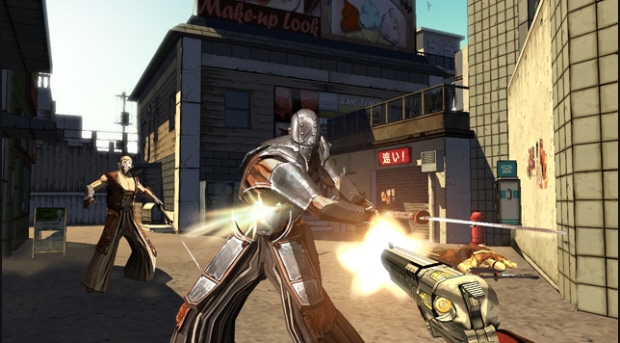
Why is it that the guy I'm pointing the gun at doesn't look scared, though the one behind him does?
Ultimately, Red Steel 2 is fun to play, certainly rife with action and visually stunning. Although far from perfect, the controls are among the best the Wii has seen, and you will definitely break a sweat if you want to cutting a swath of destruction through town (for the greater good, of course). The story will leave a sour taste in your mouth, and although the hero looks cool, you’ll be left wishing he had a tonne more personality. However, it looks as though Red Steel will become a trilogy, so hopefully the final iteration was will take all the criticism into consideration, and be a flawless finale.7/10
Sean
Labels: Nintendo, Red Steel 2, Review, Sean Engemann, Ubisoft, Wii
- Sean Engemann
 Times have changed. Sam has changed. Think back to everything Splinter Cell was and throw that out of the window. No longer are you spending hours working out how to sneak past guards, but instead you are tactically analysing how to burst in and take out as many heads as possible. More guns, more explosions, more action; Conviction is a total rebrand of Splinter Cell, and a rebrand that has done the series some real justice.
But did it need to really change? This is probably a weird question to pose in a climate where reviewers are constantly dismissing sequels for their lack of innovation. You see, Splinter Cell was notoriously hardcore, along with its audience. It was rewarding to those who put the effort in, and it was one of the few stealth games that did the job well. It’s now time for change; no longer can big publishers afford to sell to niche markets. Conviction’s team have been pushing the changes to every Jack Bauer wannabe out there, and that really sums up what the game is: a mix of 24 and Bourne.
 Splinter Cell: Conviction isn’t really heavy on the plot, but has enough backstory explained to keep new players right at home in the universe. It’s hard hitting, told through a variety of interrogations, flashbacks, narratives and projector displays. The team has innovated real time story telling in the most simplest of ways by cutting out the need for constant cut-scenes and keeping the pacing strong. Objectives and story advances are projected onto walls. They even offer in-game hints when you are struggling to progress. These are never obtrusive to what is going on around you and are stylish to boot.
The menus, HUD and the armoury screens are all sleek and polished. The game looks amazing, from booting up the title screen to the in-game action. While the lip-sync could do with some fine tuning, Conviction does look fantastic and is a great visual competitor with other 360 titles on the market. Each level is beautifully designed and the animations are sleek, with an atmosphere that sometimes ends up with you holding your breath, so as to not alert any guards on screen.
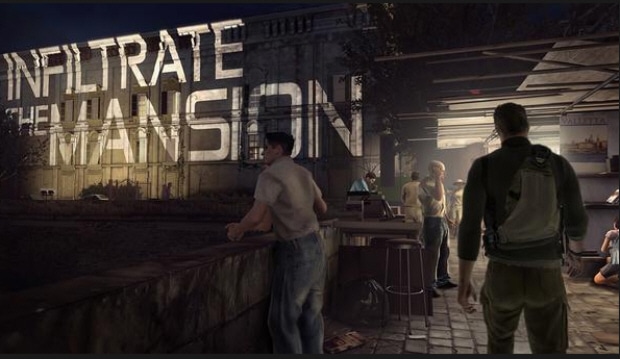 Busting faces open against sinks, walls, bars and even a piano, Sam is more bad-ass than ever before, his character taking a lot more control over the events that unfold. While his last starring role saw him switching teams, Conviction has him joining forces with Grim again. Long-time fans might roll their eyes as they hear the mention of Sarah, Sam’s daughter, is once again central for the developing plot, but it isn’t too long until things are mixed up to make not only Sam, but also the player, very confused about what is really going on.
Like 24 and Bourne, Conviction is a story of trust, which is what makes it intriguing. You find yourself wanting to find out what the hell is going on with Sarah once and for all, wanting to know who killed who, and who Sam can really trust after all. The single player lasts a slightly underwhelming 5-7 hours but then never felt overly repetitive. Each mission feels fresh and interesting, keeping you on your toes at each turn, something a lot more action shooters could learn from.
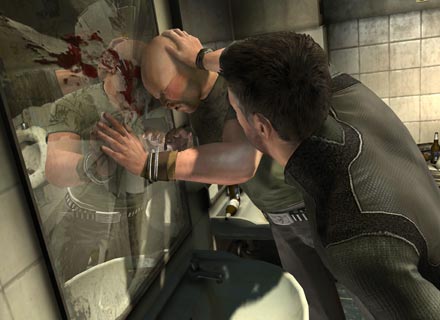 Conviction is a third-person shooter that plays around with the idea of being a stealth game. I think we can all openly admit that the game has radically changed the core gameplay to something that is more audience friendly, but don’t dismiss it quite yet. The shooting is smooth, confortable and if you are clever you can still play through the whole game without killing a single soul. Not that it would be any fun. There is a huge armoury of weapons and gadgets to play with too, but once you delve deeper into the game you will find the first pistol upgrades is the only real weapon you need if you line up your shots right. It isn’t until large scale, open shootouts where you’ll resort to the assault rifle.
The stealth is still there though, switching the screen from colour to black and white when you hide in the shadows. Sneaking up to guards and taking them out silently is a real thrill and there is plenty of variety to play around with your prey: pull them out of windows, drop down on them from above, call them over to car alarms or gadgets. You can even grab a guard and hold him as a human shield while you get some shots on other guards around.
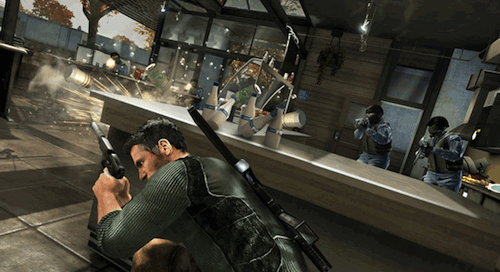 The real fun to be had is with the inclusion of the mark and execute (M&E) mechanic. Take a guard out with melee and you earn yourself the chance to stylishly execute 2-4 guards of your choice with a single press of a button. While it seems cheap, M&E is a real life-saver for the more crowded areas and makes infiltrating a room a real treat as the camera slows down to watch your last shot blow a guard's head up and blood trickle out.
The M&E is even more interesting when used in the games co-op campaign, letting each player mark guards together and then, when both are in position, perfect a synchronised execution which looks amazing. The campaign, which lasts a good 6 hours, can be played split-screen or on Xbox Live. You play as Archer or Kestrel, both agents working for Third Echelon and the Russian Government, who are put together on a mission. Offering a bit more back story to Conviction’s main plot line, Deniable Ops is a great alternative to the more action focused experience with Sam.
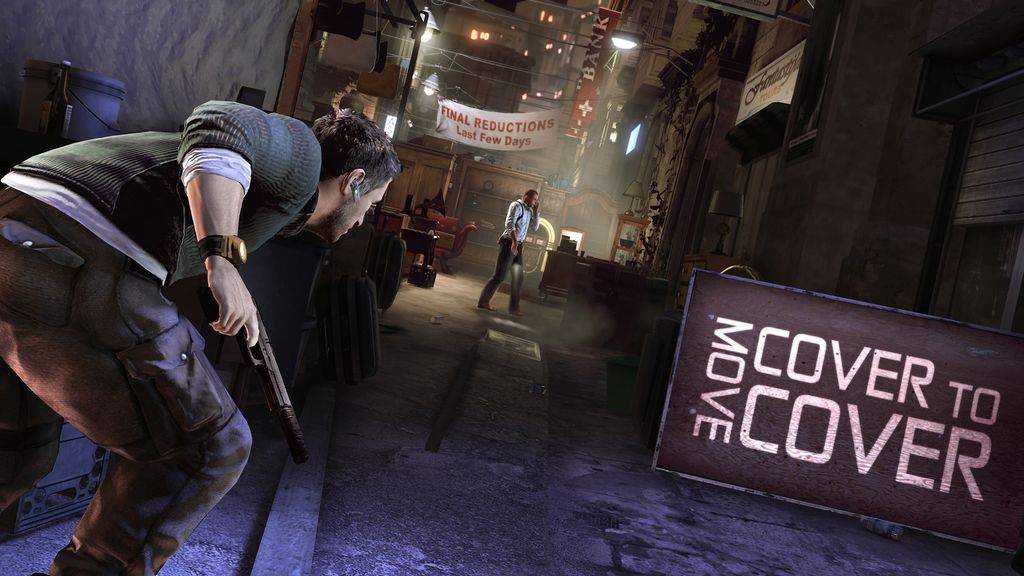 There are also a few modes where you can take out AI as well as your friend online, like deathmatch. There's a hunter mode, which is essentially 'horde', but you need to protect the EMP in the centre, and a ton of unlockable goodies to gain from doing a variety of P.E.C challenges in the game. There is so much in Splinter Cell: Conviction to return to alone or with a friend.
So yes, it was worth the changes. It was worth going against everything fans originally were worried about. Conviction is in no way like the original Splinter Cells, but Conviction is the innovation and revival the series needed.
9/10
Lauren
Labels: Conviction, Lauren Wainwright, Review, Splinter Cell, Tom Clancy, Ubisoft, Xbox 360
- Lauren Wainwright
Subscribe to our content
and never miss a single thing

 subscribe to our monthly newsletter:
Our most recent writing

Our most recent reviews
Recent comments
All comments are subject to our commenting policy
Latest videos

Subscribe on YouTube

GGTL Classics
Some of the very best articles dug out from deep in the GGTL archives, written by some of our past and present wordsmiths alike.
Your continued use of this website and/or any others owned by Gamer's Guide to Life.com represents your acceptance and indicates your full understanding of all of our legal policies and terms. Our legal policies and terms are legally binding. If you in any way disagree with or refuse to be bound by any part of said legal policies and terms, you are advised to leave this website immediately.