 Follow us on Twitter: @ggtl
 Join our friendly community!


Latest news

 30.4.11

Everyone has their religion. For some, it's found in a church. For others, it's located on a board, down the pipe of a twenty-foot wave. Performing Shakespeare might provide serenity for John, while Sarah finds her peace reading Tolkien. Everyone has at least one thing - one activity, setting, or scenario - that allows them to step off of the rails of life for a moment and take stock of the world. Human beings need these moments, these vacations of calm understanding in an otherwise confusing existence, to survive.
Closing my eyes and remembering playing Mega Man X at my cousin's house, excitedly using the secret I looked up in a friend's crumpled strategy guide three months earlier to take down Sigma with a single life left, as my older relatives laugh raucously down the hall thanks to eggnog and peppermint Schnapps, isn't my religion. But it's damn close.
I first discovered Mega Man X when I was seven years old. My family was taking a road trip from our home in San Jose, California, to my Aunt Judy's house, two hours to the north in Davis, near the state capital of Sacramento nestled just west of the Sierra Nevada Mountains. My brother and I looked forward to these visits for months, for two reasons: (a) Aunt Judy's pumpkin pie was delectable enough to be an Iron Chef's last meal, and (b) our cousins owned a Super Nintendo, the holiest device in the pantheon of toys available during the early Clinton era. Being older, and cooler by nature, our cousins spent dozens of hours not playing their games in favour of chasing girls, watching sports on television, or getting high and debating whether or not Kurt Cobain was a sellout during time designated towards writing new songs with their bands. While we disagreed with their life choices, we appreciated the fact that they often left their SNES lonely, unplayed, and in dire need of our attention.
These were moments we cherished. For reasons we never quite understood or accepted, my brother and I grew up with a strict no-video-games-in-the-house policy. We could play at friends' houses, or at demo stations in Walmarts or Fry's Electronics, but when our parents' shopping was over there was no chance of us bringing Mario or Sonic home. This made it easy for us to not be choosy when the opportunity to game arose. It could be Donkey Kong Country or Hello Kitty Superhearts and Ponytime Adventure - it didn't matter; we were all in. We played whatever was available. When in Davis, we could choose between Super Mario World, NBA Jam...
...and Mega Man X, the holy trinity of my SNES experience. Amen.
Though NBA Jam was hilarious, and Super Mario World will always be heralded as one of the legends of early gaming, Mega Man X was always my hands-down favourite of the three.
Why?
Because it's one of the greatest platformers in game history? Because it took the innocent boy Mega Man and made a man out of him? Because the first boss you meet is basically Boba Fett? Because it cures the lame and feeds the sick?
Yep. That's why.
For those of you who have never tried it, the gameplay in Mega Man X is similar to that of any other title in the Mega Man series leading up to it: there are platforms. You jump on these platforms in a mostly linear direction until you reach a boss room. Taking down a boss will allow you to select a new stage, where you will once again jump on platforms until you slay an evil robot. Lather, rinse, repeat.
In order to reach a boss, X must navigate through a sea of enemies bent on reducing his Cadillac-shiny exoskeleton to singed scrap metal. Sliding and jumping allows X to avoid some of these robot combatants, but the majority of them need to be dispatched with X's handy ole 'X Buster', the giant lump attached to his right arm which, I can only assume, uses nuclear fusion to shoot blasts of energy. Defeated bosses will drop microchips that, when attached to this tumorous appendage, give X a valuable and unique special attack to use on command. Vanquishing Storm Eagle, for example, will enhance X's gun with 'Storm Tornado', an air cannon that launches a funnelled gust of wind which continuously damages enemies for a period of three or four seconds. On top of these upgrades, X can discover secret upgrades throughout the various stages which improve his health, energy tanks, special gun ammo capability, and armour. These upgrades are a real necessity for anyone who wants to actually beat the game. With the exception of being able to jump-kick off walls, the gameplay in Mega Man X is standard fare for anyone who has played a Mega Man title before.

Bosses and their minions look unbelievably ridiculous. I'm not sure which future engineer would ever think that a giant robot penguin, whose deadly power is making penguin-shaped snowmen and sliding stomach-first into them with childlike glee, is a logical design model, but I assume he will hail from Japan. There are times, however, when you will still fear them, despite their sheer silliness. This is brilliant in itself. I shouldn't be frightened of a the cartoony lovechild of a red giant octopus and the unthreatening Cylons from the Battlestar Galactica of the 1970s, but if I don't have the 'Rolling Shield' gun, I am shivering with horror.
Perhaps the greatest gift from Mega Man X to the world is its soundtrack. Heavy metal bands the globe over rock out to it every day. I could spend the remainder of this article listing my favourite Mega Man X covers, but instead I'll bring you back to the source: the original tracks in all their 16-bit glory. These themes are essential to the pace, ambiance, and gameplay of Mega Man X. Without them, the game would likely have been good, but never great.
Be sure to spend a minute listening to every hyperlink in that paragraph.
Mega Man X is not an easy game. Like almost every platformer of the early 90s era, it takes an intense focus and a keen memory to know just when to jump, slide, and shoot your way out of a gauntlet of patterned danger. Put a controller in the hands of anyone you know who has successfully beaten Sigma, the final boss in X, and after a few lives to shake off the rust their muscle memory will kick in, guiding their fingers in an impressive show of retro gaming skill that will very likely wow you. Reaching and defeating Sigma for the first time is one of those feats that people should be able to put on their résumés. It's tough, and takes the kind of serious repetitive practice (different than grinding) that today's games simply don't require. You don't forget how to play Mega Man X. You just put those skills in hibernation when you're not playing it, until you need them again.

I know my love for this game is tied completely to my own nostalgia. I'm biased because my childhood experiences sway my judgment. But you know what? That's a good thing. When I contemplate Mega Man X, I don't just think of rapid-fire gameplay, challenging levels, and hilariously zany enemies. I think of Christmas when it was most magical. I think of family, all gathered together to celebrate the best parts of the season. I think of relatives no longer with us, and how I wished I could put off January somehow to be with them as long as I could. I think of those tacky winter sweaters my mom had us all make, and how proud she was when we handed them to cousins, who thanked us politely before burying them deep in an attic or closet.
When I smell pumpkin pie at Christmastime, I think of Mega Man X.
Labels: 2011, Capcom, Christmas, Greg Mengel, Mega Man, Megaman X, Retro review, Retrospective, Review, SNES, Super Nintendo
- Greg Mengel
 Long before Second World War games were considered tedious and cliché, they could be compared to an Italian suit. Stylish, sophisticated, and with just a tad of modest reserve which gained respect from anyone beholding it. Of course, times change. But it doesn't hurt to take a look back on what was considered great back then.
Medal of Honor: Rising Sun was the second PlayStation2 game in EA's Medal of Honor series, and the fifth installment in total. Set during the Pacific War (the conflict between the Japanese and the Americans during WWII), the player assumes the role of Corporal (later Sergeant) Joseph Griffin of the United States Marine Corps.
 In terms of gameplay, Rising Sun does not make for an unmissable gameplay experience. Quite the opposite, in fact; controls are clunky (I only found a control scheme I liked when I manually programmed it in), character movement is slow and can lag badly, the aiming system is absolutely miserable - on-target shots seem to almost always miss their targets - and the lack of any form of decent AI prevents Rising Sun from being even a half-decent game. However, the inclusion of a form of ADS zoom is a good inclusion, and the immersive environments are true to their historical counterparts.
Graphics in Rising Sun are probably the game's best feature. Considering when the game was released, they're realistic and 'special' effects such as water and fire textures are very impressive. However, character rendering needed more work, as did tanks - they all have very sharp edges; the badly rendered features make the actual objects seem like afterthoughts, rather than meaningful parts of the game.
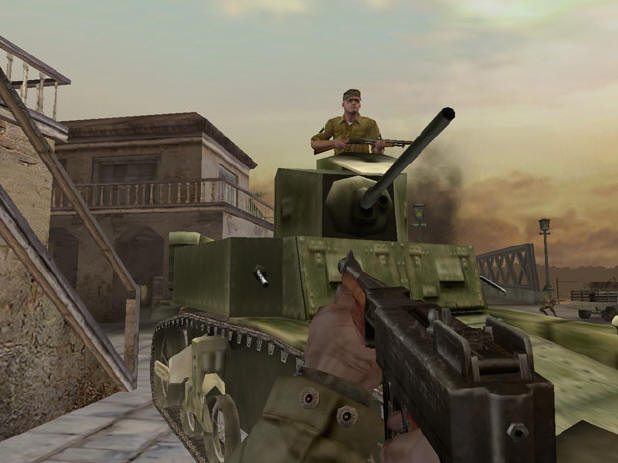 The so-called 'additional features' feel exactly that - additional. As though they've been forgotten about until the very end and then clumsily sellotaped on with five minutes to spare until launch. Online, when it was still active, was difficult to understand for the non-technical and when you finally got into a game, it was lumbering and sparsely populated. EA were making a good move when they shut the servers down.
I don't enjoy giving bad reviews to games. When I play a game, I really want to enjoy it, whatever it is. But there just isn't a way around it - Medal of Honor: Rising Sun is a disappointment in almost every sense of the word. If you are collecting retro WWII games, doing research or have nothing better to spend your money on, then Rising Sun might be of at least a little use. However, if a normal person buys this out of choice, then they ought to be shot.
Linford
Labels: PS2, Retro review, Review
- Linford Butler

First things first with this game; it isn’t based on the movie by the same name and released in the same year, it has many similarities to the Walt Disney movie: Pirates (obviously), English soldiers who move from being the goodies to the baddies, then back to goodies and even a ship called the “Black Pearl.” The game was developed by legendary RPG studio, Bethesda, in 2003 but despite its link to the popular movie, gained only average reviews.
The year is 1630, and the Caribbean is bustling with piracy. The main protagonist is Captain Nathaniel Hawk of a small merchant ship, the “Victory”. After leaving the port of Oxbay (which serves as the tutorial, teaching you how to fight, buy and sell booty, hire crewman, fix your ship or loan money) you are given control of a ship and a crew and then given complete freedom in usual Bethesda fashion. Some players might find this intimidating, personally: I loved it.

The 7 islands that you can now explore are each controlled by one of six different factions, with England controlling two. You can choose to do whatever you want, sail to Redmond to inform the English Governor there of the attack on Oxbay that forced you to leave, you could continue your career as a merchant sailor, going from island to island buying and selling goods or you could turn pirate, praying on rich trading ships and becoming a terror of the seas. The fast travel system -which would be essential for a game like this that involves moving large areas that would usually take days-, is solid and straight forward. You are given a crow’s eye view of a map, focussing on your ship. The graphics for the time are beautiful, one thing I disliked about Morrowind (which was released by Bethesda a year earlier) was the graphics, in the small amount of time between these two games, the change is astounding. The gameplay too is good, the main quest line is captivating but not original as once again, ideas from the Disney movie have been borrowed; the hunt for cursed Aztec treasure is the order of the day for this game.

The good points of the Pirates of the Caribbean are almost equalled by its weak points however. The huge areas and brilliant graphics are often dwarfed by bug problems that can destroy your entire campaign; multiple and regular saves are a must. Misspellings in the subtitles are also common and give the game a very unprofessional feel at times. Other, smaller, things; such as how a single, regular crewman will often slay highly paid officers during boarding battles get increasingly annoying. The vagueness of the quest log can also become frustrating at times; this is the draw back to sand-box RPGs, with other games a system of trial and error will –in most cases- eventually pay off. In Pirates you may often find yourself combing the Caribbean, looking for “someone with information about a secret pirate hideout”. Asking the tavern keeper of every island is usually a good way of finding this kind of information out, however, even this sometimes fails to work and you have to ask people at random or have the good fortune to simply stumble upon the person/place you were looking for in the first place.
The overall quality and enjoyability (yes, I think I just made this word up) of Pirates of the Caribbean is high, however, the constant paranoid saving that becomes almost second nature due to a fear of game-killing bugs spoils what was otherwise a great game that, with a few tweaks, had the ability to be a game to be remembered for years to come. Instead, the game was forgotten about soon after its release.
7/10
Lewis
Labels: PC, pirates of the caribbean, Retro review, Xbox
- Anonymous

Friends, Romans, Countrymen, lend me your eyes for this retro review!

Creative Assembly haven’t forgotten the campaign map however and changes here are also exceptionally good. The “chess board” style of the map has been abandoned, when you move one of your armies, the leader of the army will march to the desired location and if an attack is needed will lunge with his sword at the enemy before the game gives you a choice of auto-resolve, fighting manually or withdrawing. If you get bored of sending your generals all over Europe and

To start with you can play only as one of three ruling family factions in Rome, the Julii, the Brutii or the Scipii families all of whom are allied to each other and the SPQR (Latin for the Senate and People of Rome) a non-playable faction that controls Rome and gives varying missions to all three Roman factions. To a first player of the Total War series the vastness of the campaign map can be daunting and because of the nice folks down at Creative have given you the option of a short campaign as well as the long one. The short campaign changes from different factions but usually involves taking over roughly 15 settlements to win the game whereas the long campaign orders you to take control of

When Rome: Total War was first released in 2004 it surpassed the exceptionally high standards many people had set it and left RTS fans hungry for Medieval II which was released in 2006.
9/10
LewisLabels: PC, Retro review, Rome, Total War
- Anonymous

Tony Hawks' first story based game ever was released in 2003 and was in my opinion, one of the best games of the year. The story was based on your character, who is a rising star in the skating world. He must overcome trials of friendship and trust, all while skating for a world title.
Graphics: 7
Gameplay: 8
Multi-player: 9
Sound: 9
Longevity: 8
Story: 10
All in all, a brilliant track-list, solid gameplay and a immersive storyline cements this game as one of my PS2 classics.
9.0/10
Matt
Labels: Matthew Meadows, Retro review
- Anonymous
Subscribe to our content
and never miss a single thing

 subscribe to our monthly newsletter:


Our most recent writing

Our most recent reviews
Recent comments
All comments are subject to our commenting policy
Latest videos

Subscribe on YouTube

GGTL Classics
Some of the very best articles dug out from deep in the GGTL archives, written by some of our past and present wordsmiths alike.
Your continued use of this website and/or any others owned by Gamer's Guide to Life.com represents your acceptance and indicates your full understanding of all of our legal policies and terms. Our legal policies and terms are legally binding. If you in any way disagree with or refuse to be bound by any part of said legal policies and terms, you are advised to leave this website immediately.