 Follow us on Twitter: @ggtl
 Join our friendly community!


Latest news

 24.4.10

Spring is upon us, which means we can finally stow that nasty old snow shovel away for the next several months and pick up the Wiimote or DS a little more. Oh wait, I guess that grass isn’t going to cut itself. Crap. But, for those you who don’t have to worry about tedious Spring chores (lucky), there are some nice titles hitting the Wii in the next few months. I’m only diving into the Wii this time around because I was hard pressed to find any noteworthy games for the DS (besides Tetris Party Deluxe). I may need to delve a little bit deeper to find them, but please, if there’s one or more solid ones you know about coming in the next few months, let me know about it and I’ll put together an exclusive DS “On The Horizon” piece.
Now, onto the games…
Super Mario Galaxy 2
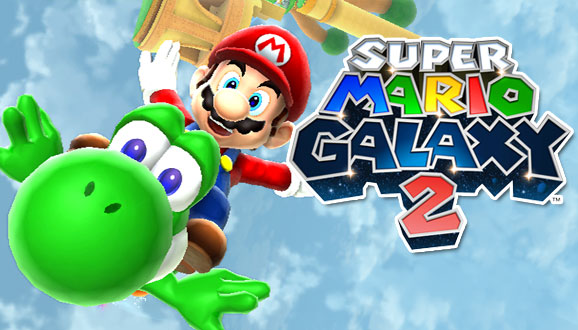
How can I start anywhere else than with the Big N’s mustachioed mascot in his big Wii sequel, Super Mario Galaxy 2? Once again you will launch yourself across the galaxy, this time travelling in your own starship, battling baddies on large and small planetoids, defying many laws of gravity, much like the first game of the series. And much like its predecessor, you will use features such as Pull Stars and reverse-gravity arrows to obtain stars in order to unlock new levels. The biggest inclusion would have to be the return of that lovable green dinosaur mount, Yoshi. As we can expect, Yoshi brings forth his usual tools such as his long and sticky tongue and the ability to power up by eating different fruits; some that make him quickly dash, inflate like a balloon, and even find secrets paths. Mario will also have a healthy new supply of power-ups, like Cloud Mario, Rock Mario, and a drill which allows you to tunnel through the ground. Don’t expect anything new as far as graphics quality or music, which isn’t necessarily a bad thing considering the first game was absolutely gorgeous to look at, and the orchestrated music was equally pleasant to listen to. Although this is a definite purchase for myself and any other Nintendophiliacs out there, I’m going to remain a bit sceptical. As fun as the game may be, and even though we’ve been told by Nintendo’s big boys that the game contains over 90% new content, right now it just doesn’t seem like enough of a break from the first game to keep it fresh. I hope the game proves me wrong, and you can definitely expect a review from me on this on. Super Mario Galaxy 2 will be released in Europe on June 11th and in the U.S. on May 27th.
Metroid: Other M

Alright, just a quick teaser here about Metroid: Other M, the next game in the venerable series. Since it is technically coming out shortly after the Summer Solstice, I won’t dive into it here, but you can expect a thorough preview as we get closer to the release date. Until then, the official website has a couple of nice trailers for you to enjoy.
Tetris Party Deluxe
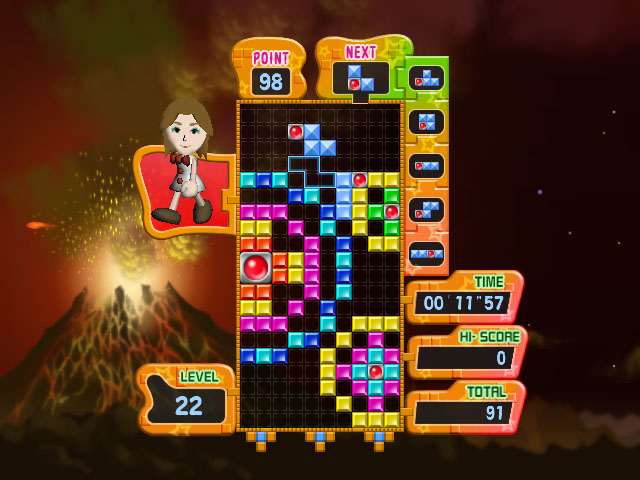
Let me move on then to another long running series, Tetris. You all know it, and most of you love it. Well, if you weren’t smart enough to download Tetris Party for the WiiWare, here’s your chance for redemption. A full-fledged disc/cartridge version of Tetris Party Deluxe is coming to the Wii and the DS, and includes all the wonderful game modes that made the WiiWare version a hit, along with even more to satiate your puzzling appetite. Add that to the full spectrum of Wii peripherals that can be used to play, and you can expect a solid solo or multiplayer experience. The Wii Speak, Mario Kart wheel, and the Balance Board are all used to make it the most versatile Tetris, or any game for that matter, available for the Wii. Remember using your bottom on the Balance Board to move around the Tetrominoes? Well it’s time to find that ass grove again. You will also be able to use the Wii Speak as a chatting (taunting) device when playing multiplayer matches. My biggest hope for this version is that Hudson and Tetris Online continue the success of the tournament they created back in December of 2008 and give us a stable mode to win prizes, or better yet a league would be killer. Sign me up! For the DS most of the game modes found on the Wii version (minus the ones that require a Wii peripheral) are also available for the DS. You can even chat in multiplayer using the microphone on the DS, so no heavy breathing… it’s a sign of weakness. Since Tetris began its legacy on a handheld, it only makes sense to bring it to the DS, and hails as one of the easiest games pick up and play, and one the best for those on-the-go gaming spurts (or long car rides). Both the Wii and DS versions are scheduled for a Q2 2010 release.
Trauma Team
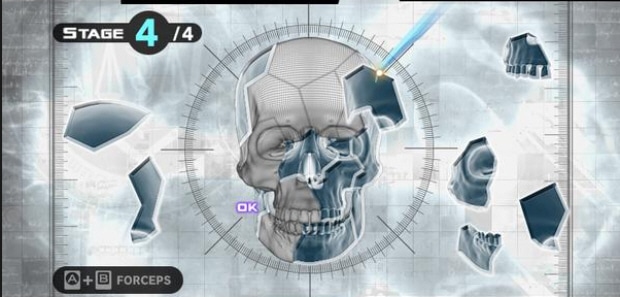
Trauma Team, an installment from the Trauma Center series, will hit U.S. stores on May 18th with no European release date set, but probably to be expected late spring or early summer. Trauma Team keeps some similarities with the other games of the series, such as the Japanime art style and comic book presentation, along with the character intrigue and overblown plotlines. Oh yeah, and the medical procedures too. The difference this time around is that you are not confined to just performing surgeries. You’ll also get to work with endoscopy, orthopedics, forensics, first response, and diagnosis, all which come with different tools for you to use. Forensics and diagnosis will bring elements of CSI and House to the anime world, as you must use devices other than surgical tools in order to solve the murder or discover the medical condition. For these tasks, instead of the patient losing vitals for poor skills, there is a limit counter which racks up any mental mistakes you make and will fail the mission if you have too many brain lapses. For the most part the characters are all new and a mixed bag of backgrounds and attitudes, which plays well with the chaotic life that is medicine. I’m saddened that there is no mention of using the WiiMotion Plus peripheral for this game. While the motion controls in previous games of the series functioned well enough, there really are more boundaries you can cross with the WiiMotion Plus. That alone may get my thumbs down after I try the game.
Arc Rise Fantasia

Finally for the Wii is Arc Rise Fantasia, a new RPG game, yet containing elements that will make gamers think of Tales of Symphonia, the Star Ocean series, and the Dragon Quest series. Now I must admit that I am not a huge fan of Japanese-style RPG games, but the lack of classic turn-based RPGs for the Wii has given me the inkling to look a little closer at this one. The Meridian Empire which you explore promises to be an expansive and full of monsters to combat. The game boasts a large roster of playable characters, all with different aspirations, which will create many different engaging plotlines. You can expect to lose about 60 hours trying to complete the game, and that’s without doing any side quests. The battles are turn-based, which although some may label as outdated, I like to call refreshingly nostalgic. During a battle sequence, all the characters use the same AP gauge to carry out their movements and attacks. There are also various combos that can be chained together, adding a nice strategic element, which definitely need to be utilised in the later levels of the game. In typical fashion, you can also summon giant beasts to carry out massive attacks. So don’t expect to see any groundbreaking new features, but if you’re a fan of the tried and true turn-based formula, this one is definitely worth at least a rental. Arc Rise Fantasia is slated for Q2 2010 for Europe, and will hit American shelves on June 22nd.
So that’s the list for the next few months, some worth a little coin to try out, and some that definitely need to be picked up and placed alongside your great collection. I’ll be keeping eye out for any surprises that may come out of this year’s E3, and hope to bring you a jam-packed summer edition of “On The Horizon”.
Sean
Labels: JRPG, Link List, Metroid: Other M, Nintendo, On The Horizon, Releases, Sean Engemann, Tetris, Wii
- Sean Engemann

It’s odd to think, with today’s gaming culture, high-definition graphics and internet-based, 256 player battles, that even twenty-five years ago, gaming was going strong. True, it might not have been the most immersive or graphically intense gameplay ever to have graced a gaming platform, but it was gaming nonetheless, and today – twenty five years since what I consider as the beginning of the gaming culture we know and enjoy now – we pay our tribute to the legend which catapulted gaming from tech-heads in a dark room to pensioners in bungalows, children in playgrounds, and pregnant mothers approaching labour in a hospital bed. That game is, of course, Tetris.
Over twenty five years, much has changed. Berlin is now one city, instead of two divided up by a very large garden wall; British Telecom has been privatised; and we’ve had at least three different prime ministers. But one thing that hasn’t changed: the success and popularity which one small, not-so-technically-advanced game developed on a Soviet Elektronika 60 computer came to have.

While studying at the Soviet Union’s Academy of Science, a twenty-nine year old Alexey Pajitnov first designed the bare bones for a game which would, eventually, go on to define the term ‘arcade gaming’. Inspired by the classic riddles and puzzles which Pajitnov was so fond of as a child, the earliest version of what we now know as Tetris was only ten levels long – a restriction of the hardware which the game was first designed on. The game became known as ‘Tetris’ – a title created from a combination of the Greek prefix ‘tetra’, meaning ‘four’, and the name of Pajitnov’s favourite sport: tennis.
"The program wasn't complicated," Pajitnov told the Guardian. "There was no scoring, no levels. But I started playing and I couldn't stop. That was it."
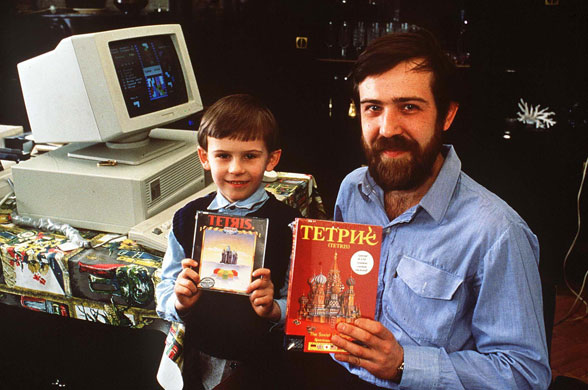
The concept wasn’t at all complicated: from the top of the screen a series of differently-shaped "blocks" fall slowly towards the bottom. The player can turn each block as it falls or move it sideways, but at the lowest point the block will stay and a new one will begin falling. If the blocks fill a line without gaps, they disappear, and the player gains points. Otherwise they pile up, giving the player less and less time before they hit the "bottom". Allow the blocks to pile up to the top of the screen, and it’s game over.
And that was the beauty of Tetris – it’s utter simplicity. It made it fun and frustrating, amazing and addictive all at once. It infested the dreams of those who played it, and was even (at one point) considered by the US as a possible Soviet plot to distract the youth of the US. There’s no denying that, in some form, Tetris has been spoken about by pretty much every person on the planet.
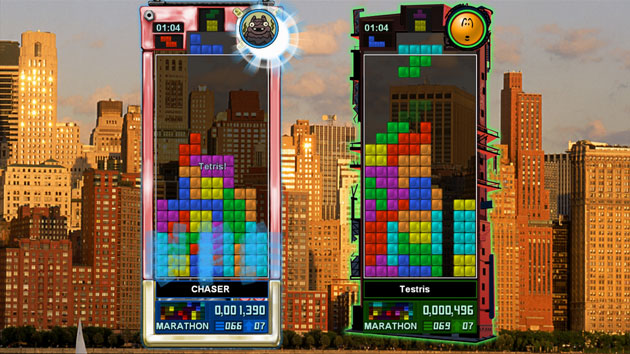
The game’s success didn’t really start until 1988, when a Dutch games publisher by the name of Henk Rogers saw potential in Pajitnov’s brain child.
"I first saw it at the Consumer Electronics Show in Las Vegas in January of 1988. My first impression was that this game was too simple, that there was nothing to it. Then I came back and played it again. And again. Soon I realised there was something going on – no game had grabbed me at a show just like that."
And it was that moment which made Tetris into what we know now – two people, one product, the right place at the right time. Rogers fought off heavy competition in order to secure the rights to Pajitnov’s Tetris, and – with the help of ally and then-boss of Nintendo America, Minoru Arakawa – managed to propel Tetris to success, bundled with every Game Boy.

It was this love affair with Nintendo’s handheld, the Game Boy, that made Tetris a household name. Without the backing of such as popular games system behind it, Tetris may well have faded away into the oblivion of time, lost somewhere back in the 1980’s, its genius undiscovered. But Henk Rogers was a motivated, determined, driven Dutchman, and with his expertise and connections he managed to license the game’s rights to companies worldwide.
However, the success of Tetris barely made an impression on Pajitnov – partly because he didn’t start earning anything from Tetris until 1996, when the rights for the game finally reverted back to him when he left to pursue a career with Microsoft in the US. Before then, all the royalties were claimed by the Kremlin, as – under Russia’s then-communist leadership – the rights for the game belonged to the state.

Both Pajitnov and Rogers now work on licensing the game to developers and publishers worldwide. And the popularity of Tetris shows no likelihood of slowing – one game developed deep in the bowels of the Soviet Academy has spawned hundreds of different versions on various platforms, art, television shows, scientific experiments and even furniture.
And we mustn’t forget that, without the kick-start that was Tetris, gaming may never have made the geek to chic change which now makes gaming a multi-million pound, worldwide followed industry. Which is why I am proud to pay tribute to the grandfather of modern gaming: Tetris.
Linford

Labels: Tetris, Tribute, Writer's note
- Linford Butler
Subscribe to our content
and never miss a single thing

 subscribe to our monthly newsletter:
Our most recent writing

Our most recent reviews
Recent comments
All comments are subject to our commenting policy
Latest videos

Subscribe on YouTube

GGTL Classics
Some of the very best articles dug out from deep in the GGTL archives, written by some of our past and present wordsmiths alike.
Your continued use of this website and/or any others owned by Gamer's Guide to Life.com represents your acceptance and indicates your full understanding of all of our legal policies and terms. Our legal policies and terms are legally binding. If you in any way disagree with or refuse to be bound by any part of said legal policies and terms, you are advised to leave this website immediately.